Commercial Solar
Solar for Cold Storage: A Worked Example (2026)
September 2, 2026 · SolarSwitch · 8 min read
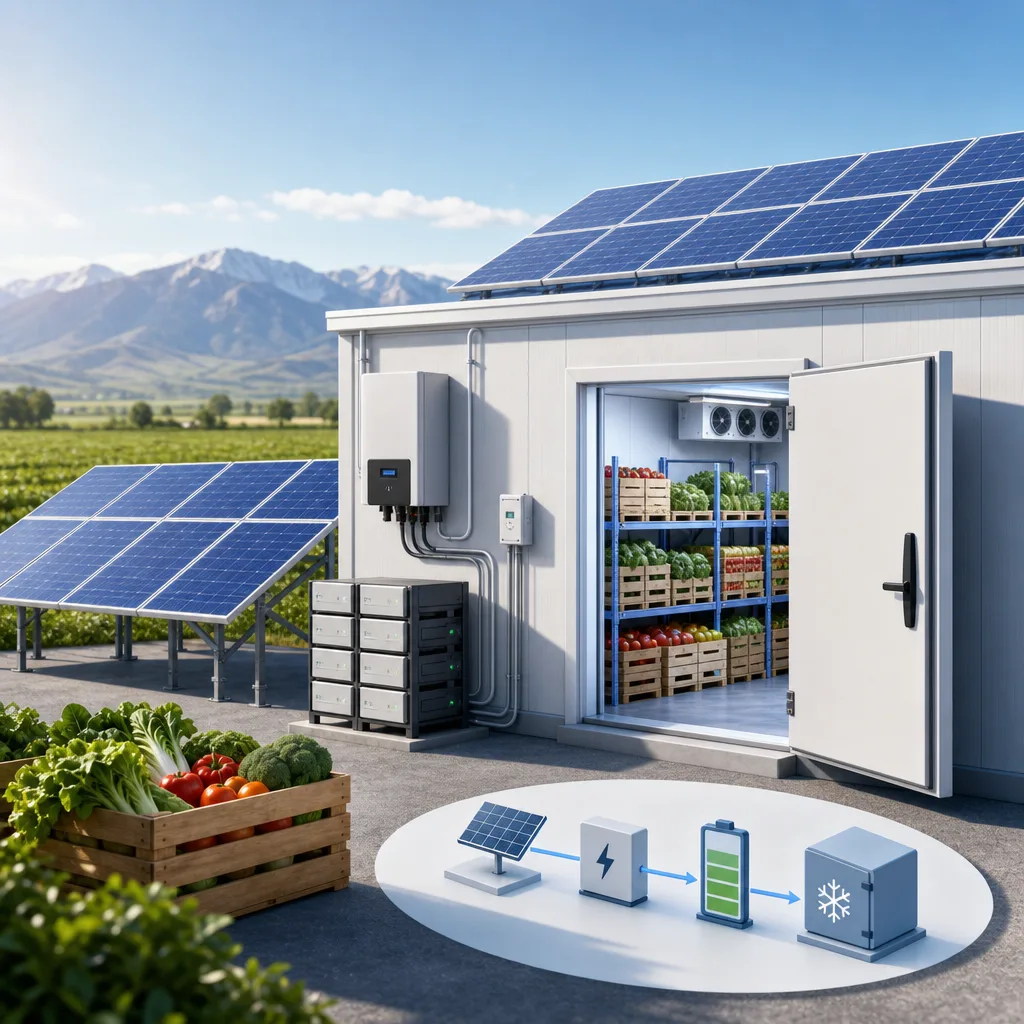
Cold storage compressors work hardest in the afternoon heat, which is exactly when solar produces most. We modelled a 500 m³ facility from the equipment schedule up — and found that the obvious answer on backup is the wrong one by a factor of ten.
What this is. A complete engineering and financial model for a representative 500 m³ cold storage facility, built from the equipment schedule upward and run against an hour-by-hour generation profile.
What this is not. A client case study. The facility modelled here is representative.
Quick Answer
The modelled facility: two freezer rooms and two chiller rooms, roughly 500 m³, with dock, office and forklift charging. Consumption: 23,299 kWh a month, against a peak demand of 48.6 kW. Estimated bill ₱269,893 a month — about ₱3.24 million a year. Cold storage has a genuinely favourable load shape. Compressor duty cycle rises with ambient temperature, so the plant works hardest in the afternoon heat — the same hours the array produces most. 55% of consumption falls in the solar window, and the day block draws more than the night block. Very few continuous-process facilities are shaped this way. A 100 kWp system covers about 40% of the bill, with payback between 3.1 and 4.6 years. On backup, the obvious answer is wrong. Battery storage sized for six hours of refrigeration costs around ₱5.3 million — roughly ten times a diesel generator that does the same job. For this load, the genset is correct and we would say so.
Why cold storage is different
Most continuous-load facilities are a poor match for solar: they draw the same power at 03:00 as at 13:00, so half the consumption sits outside generating hours.
Refrigeration is not like that. Compressor duty cycle is driven by ambient temperature and heat ingress — how hard the plant works depends on how hot it is outside, how often doors open, and how much warm product comes in. All of those peak during the working day.
| Freezer duty | Chiller duty | Average load | |
|---|---|---|---|
| Day, 06:00–18:00 | 85% | 65% | 35.32 kW |
| Night, 18:00–06:00 | 65% | 45% | 28.40 kW |
The day block draws 24% more than the night block, and accounts for 55% of daily consumption. That is the opposite of a supermarket, where refrigeration is flat and the peak lands in the evening.
Step 1 — Equipment schedule
| Equipment | Connected load |
|---|---|
| Freezer condensing units, 2 × 15 HP | 22.4 kW |
| Chiller condensing units, 2 × 7.5 HP | 11.2 kW |
| Evaporator fans, 6 × 0.75 kW (continuous) | 4.5 kW |
| Defrost heaters (intermittent) | 6.0 kW |
| Forklift charging | 3.0 kW |
| Office air conditioning | 1.7 kW |
| Lighting | 1.5 kW |
| Dock door curtains | 1.0 kW |
| Controls and CCTV | 0.3 kW |
| Peak, simultaneous including defrost | 48.6 kW |
Condensing unit figures are connected load. Actual draw depends on duty cycle, which is why the day and night blocks differ.
Step 2 — Energy and bill
| Daily consumption | 777 kWh |
| Monthly consumption | 23,299 kWh |
| Peak demand | 48.6 kW |
| Load factor | 0.67 |
A load factor of 0.67 is high, and it tells you most of the bill is energy rather than capacity — which is good news, because energy is what solar reaches.
At Meralco General Power Secondary rates, July 2026, VAT-exclusive:
| Energy charge (₱10.1355/kWh) | ₱236,149 — 87% |
| Demand charge (48.6 kW × ₱660.17) | ₱32,084 — 12% |
| Fixed supply and metering | ₱1,659 |
| Monthly bill | ₱269,893 |
| Annual | ₱3,238,711 |
Step 3 — Sizing
Generation modelled as a half-sine across the 06:00–18:00 window, compared hour by hour against the day-block load of 35.32 kW.
| System | Peak output | Self-consumed | Self-consumption | Monthly saving | Share of bill |
|---|---|---|---|---|---|
| 60 kWp | 28.3 kW | 216.0 kWh/day | 100.0% | ₱65,678 | 24% |
| 80 kWp | 37.7 kW | 283.7 | 98.5% | ₱87,456 | 32% |
| 100 kWp | 47.1 kW | 316.9 | 88.0% | ₱108,319 | 40% |
| 120 kWp | 56.5 kW | 336.4 | 77.9% | ₱128,819 | 48% |
| 150 kWp | 70.7 kW | 354.9 | 65.7% | ₱159,280 | 59% |
Note where the curve bends. Up to 60 kWp every kilowatt-hour is consumed on site. Beyond 100 kWp, self-consumption falls away quickly and additional capacity increasingly exports at the lower generation-only rate.
Specified: 100 kWp, at 88% self-consumption.
Larger systems still save more in absolute terms — 150 kWp reaches 59% of the bill — so if roof area and capital allow, the case for going bigger here is stronger than in most sectors. But each additional kilowatt-peak returns less than the one before it.
Payback at 100 kWp
| Installed cost | System cost | Payback |
|---|---|---|
| ₱40,000/kWp | ₱4,000,000 | 3.1 years |
| ₱50,000/kWp | ₱5,000,000 | 3.8 years |
| ₱60,000/kWp | ₱6,000,000 | 4.6 years |
Step 4 — The backup question, answered honestly
For a cold storage operator this is the real question, because an extended outage does not cost you electricity. It costs you the contents.
Critical refrigeration load: 27.8 kW — condensing units at working duty plus evaporator fans and controls.
What battery storage would cost
| Autonomy | Usable capacity needed | At ₱20,000/kWh | At ₱25,000/kWh | At ₱30,000/kWh |
|---|---|---|---|---|
| 4 hours | 142 kWh | ₱2.84M | ₱3.55M | ₱4.26M |
| 6 hours | 213 kWh | ₱4.26M | ₱5.33M | ₱6.39M |
| 8 hours | 284 kWh | ₱5.68M | ₱7.10M | ₱8.53M |
What a generator would cost
A 40 kVA diesel genset covers this load. Installed cost is typically in the region of ₱350,000 to ₱700,000, and fuel runs roughly 8 litres an hour at working load — about ₱3,120 for a six-hour outage at ₱65 per litre.
The comparison
| Battery, 6 h | Generator, 40 kVA | |
|---|---|---|
| Capital | ~₱5.33M | ~₱500,000 |
| Running cost per 6-hour outage | Nil | ~₱3,120 |
| Runtime limit | 6 hours | As long as there is fuel |
| Noise, emissions, maintenance | None | Yes |
| Useful when there is no outage | Yes — peak shaving | No |
Battery storage costs about ten times the generator for the same six hours of cover. On fuel savings alone the payback runs to centuries. Even valuing the peak-shaving benefit generously, it does not close a gap that size at current Philippine battery prices.
For this load, the generator is the right answer, and any installer telling a cold storage operator otherwise is selling batteries rather than solving the problem.
Where storage does earn its place is as a bridge — enough capacity to carry the plant through the seconds or minutes before a generator starts and stabilises, protecting against the compressor restart surge and any brief interruption. That is a much smaller battery and a much easier case.
The comparison differs by facility. A poultry house loses a flock in minutes and its ventilation load is a fraction of this, so storage is far more defensible there. Cold storage has thermal mass on its side — a well-insulated freezer room holds temperature for a useful period — and a much larger connected load. Same principle, opposite conclusion.
What else to look at before adding panels
Because the load factor is already high, most of the bill is reachable by solar. But three things return money without capital:
Door discipline. Every door opening admits warm, humid air that the plant then has to remove. Strip curtains, air curtains and simple procedure are among the cheapest interventions in refrigeration.
Defrost scheduling. Defrost heaters are 6 kW and they run into the plant's own cooling load — the heat has to be removed again. Scheduling defrost cycles outside your peak demand window reduces the billed peak directly.
Condenser cleaning. A fouled condenser raises head pressure and forces the compressor to work harder for the same cooling, continuously and invisibly. It is the refrigeration equivalent of a dirty solar array.
Forklift charging. At 3 kW, moving it out of any window where it could coincide with your peak is free.
Frequently asked questions
How much electricity does cold storage use in the Philippines?
Our model for a 500 m³ facility with two freezer rooms and two chiller rooms gives approximately 777 kWh a day, or 23,299 kWh a month, against a peak demand of 48.6 kW. Condensing units dominate, and their duty cycle rises with ambient temperature — so consumption is materially higher during the day than overnight.
Is solar good for cold storage?
Unusually good. Refrigeration load is driven by ambient heat, so the plant works hardest during the same hours the array produces most. In our model 55% of consumption falls inside the solar window and the day block draws 24% more than the night block. A 100 kWp system covers about 40% of the bill with payback between 3.1 and 4.6 years.
Should a cold storage facility install batteries for backup?
Generally not for extended outages. Covering 27.8 kW of critical refrigeration for six hours requires roughly 213 kWh of usable storage, costing about ₱5.3 million — approximately ten times a 40 kVA diesel generator capable of the same duty and running indefinitely on fuel. A small battery as a bridge to generator start-up is a reasonable and much cheaper proposition.
What size solar system does a cold storage facility need?
It depends on roof area and how much export you are willing to accept. In our model every kilowatt-hour is self-consumed up to about 60 kWp; at 100 kWp self-consumption is still 88%, and beyond 120 kWp it falls away quickly. Larger systems continue to save more in absolute terms but return progressively less per kilowatt-peak.
How can a cold store reduce electricity costs without buying anything?
Improve door discipline with strip or air curtains, schedule defrost cycles outside the peak demand window, keep condensers clean to avoid raised head pressure, and move forklift charging away from any time it could coincide with the monthly peak. Each reduces either consumption or billed demand at no capital cost.
Assumptions
| Item | Value |
|---|---|
| Facility | ~500 m³, two freezer rooms, two chiller rooms |
| Freezer duty cycle | 85% day, 65% night |
| Chiller duty cycle | 65% day, 45% night |
| Tariff | Meralco General Power Secondary, July 2026, VAT-exclusive |
| Energy | ₱10.1355/kWh · Demand ₱660.17/kW/month · Fixed ₱1,659/month |
| Solar yield | 4.5 peak sun hours × 0.80 efficiency |
| Generation profile | Half-sine across 06:00–18:00, self-consumption computed hour by hour |
| Battery usable depth | 90%, plus 15% for round-trip and inverter losses |
| Generator | 40 kVA, ~8 L/h at working load, fuel ₱65/L |
Send SolarSwitch twelve months of bills including the demand (kW) figures, and your room temperatures and volumes — we will model your facility rather than this one, including where the answer is a generator rather than a battery.