Commercial Solar
Solar for a Water Refilling Station: A Worked Example (2026)
August 23, 2026 · SolarSwitch · 8 min read
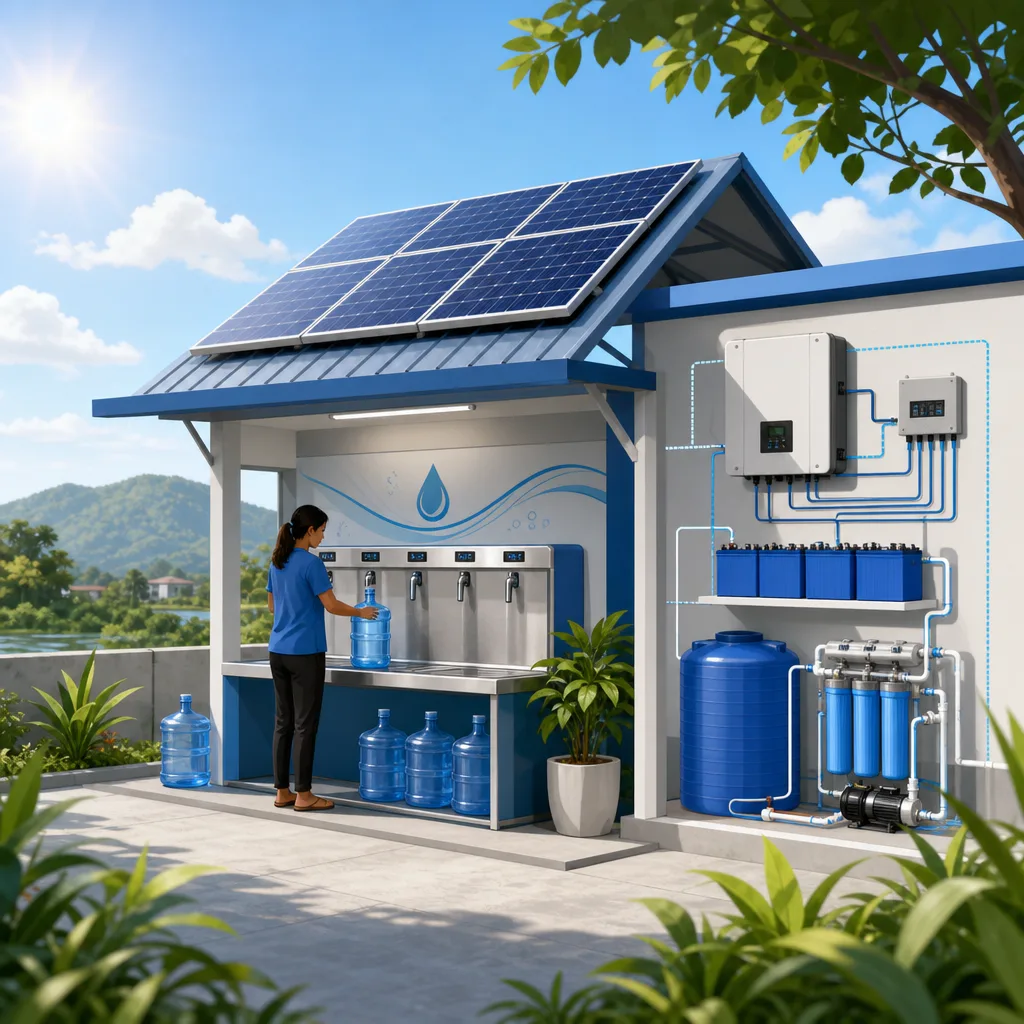
We modelled two water refilling stations from the equipment schedule up. They turn out to be the strongest solar candidate of any sector we've analysed — for a reason that has nothing to do with the roof and everything to do with the storage tank.
What this is. Two complete models — a small and a mid-size station — built from the equipment schedule upward. Every assumption stated so you can substitute your own.
What this is not. A client case study. The stations modelled here are representative.
Quick Answer
Water refilling stations are the strongest solar candidate we have modelled — stronger than poultry, supermarkets or hotels. Small station (approx 2,500 gal/day): 3.62 kW connected load, 762 kWh a month, roughly ₱11,265. A 6 kWp system covers about 82% of the bill. Mid-size station (approx 5,000 gal/day): 6.65 kW, 1,716 kWh a month, roughly ₱22,055. A 13 kWp system with scheduled production covers about 72%. The reason is the storage tank. Your RO plant is the largest controllable load in the building, and the water it makes sits in a tank until customers arrive. You can run the entire treatment train during peak solar hours without buying a single kilowatt-hour of battery. Water storage is energy storage. Watch the 5 kW line. Below it you are billed like a household. Above it you take on demand charges, which for the mid-size station are 19% of the bill.
Why this business suits solar unusually well
Three things line up, and it is rare to get all three.
Your hours are daylight hours. Most stations trade from around 06:00 to 20:00. Very little of the operation happens in the dark.
Your biggest load is schedulable. The RO high-pressure pump and feed pump together are the largest draw in the building. Unlike a restaurant's dinner service or a hotel's evening aircon, it does not matter when they run — only that the tank is full when customers arrive.
You already own the storage. This is the part that changes the economics. Most businesses wanting to use solar energy outside daylight hours must buy batteries. A refilling station stores its product, not its electricity — and product water keeps perfectly well overnight.
Model 1 — Small station, approx 2,500 gal/day
Equipment schedule
| Equipment | Power | Hours/day | kWh/month |
|---|---|---|---|
| RO high-pressure pump | 1,500 W | 6 | 270.0 |
| Feed / booster pump | 550 W | 6 | 99.0 |
| Aircon, 1.0 HP inverter | 600 W | 8 | 144.0 |
| Store lighting | 200 W | 13 | 78.0 |
| Illuminated signage | 150 W | 13 | 58.5 |
| Transfer / dispensing pump | 370 W | 3 | 33.3 |
| POS and miscellaneous | 80 W | 13 | 31.2 |
| CCTV | 30 W | 24 | 21.6 |
| UV steriliser | 40 W | 12 | 14.4 |
| Ozone generator | 100 W | 4 | 12.0 |
| Total | 3,620 W | 762 kWh |
Connected load 3.62 kW — under the 5 kW threshold, so this station is billed under General Service A, which uses the same bracketed structure as a household.
At 762 kWh a month the station sits in the top distribution bracket, giving an all-in rate around ₱14.7833 per kWh and a bill of roughly ₱11,265 a month.
With a 6 kWp system
| Production | 648 kWh/month |
| Self-consumed (90%) | 583 kWh |
| Exported | 65 kWh |
| Value of generation | ₱9,221/month |
| Bill reduction | ≈82% |
Self-consumption is high because the load is daytime and the RO pump can be scheduled to run when the array is producing hardest.
82% is the highest figure we have modelled for any sector. For comparison: a supermarket managed 31%, a hotel 38.6%.
Model 2 — Mid-size station, approx 5,000 gal/day
Equipment schedule
| Equipment | Power | Hours/day | kWh/month |
|---|---|---|---|
| RO high-pressure pump | 2,200 W | 8 | 528.0 |
| Water chiller | 1,500 W | 8 | 360.0 |
| Aircon, 1.5 HP inverter | 850 W | 10 | 255.0 |
| Feed / booster pump | 750 W | 8 | 180.0 |
| Store lighting | 300 W | 14 | 126.0 |
| Illuminated signage | 200 W | 14 | 84.0 |
| Transfer / dispensing pump | 500 W | 4 | 60.0 |
| POS and miscellaneous | 100 W | 14 | 42.0 |
| CCTV | 40 W | 24 | 28.8 |
| Ozone generator | 150 W | 6 | 27.0 |
| UV steriliser | 60 W | 14 | 25.2 |
| Total | 6,650 W | 1,716 kWh |
6.65 kW crosses the 5 kW threshold, which changes the billing structure entirely.
The tariff changes at 5 kW
| Energy charge | ₱9.9816 /kWh |
| Demand charge | ₱632.77 /kW/month |
| Fixed supply and metering | ₱718.51 /month |
General Service B, July 2026, VAT-exclusive. Energy = generation ₱9.2504 + system loss ₱0.8751 + distribution ₱0.1339 − AWAT refund ₱0.2778. Demand = transmission ₱400.57 + distribution ₱232.20.
| Energy charge | ₱17,128 |
| Demand charge (6.65 kW) | ₱4,208 — 19% of the bill |
| Fixed charges | ₱719 |
| Estimated monthly bill | ₱22,055 |
Nearly a fifth of the bill is now capacity rather than consumption. Adding equipment that pushes a station over 5 kW is more expensive than the extra kilowatt-hours alone suggest.
With a 13 kWp system and scheduled production
| Production | 1,404 kWh/month |
| Self-consumed (92%) | 1,292 kWh |
| Energy saving | ₱13,932/month |
And here the demand charge moves too — which is unusual, and it happens because the RO plant is schedulable.
If the RO high-pressure pump and feed pump run only during daylight, when solar covers them, they drop out of the evening load entirely:
| Peak demand before | 6.65 kW → ₱4,208/month |
| Peak demand after scheduling | 3.70 kW → ₱2,341/month |
| Demand saving | ₱1,867/month — ₱22,400 a year |
| Total monthly saving | ₱15,799 |
| Bill reduction | ≈72% |
Compare this with the supermarket model, where solar reduced the bill 31% and moved the demand charge by nothing. The difference is not the panels. It is that a supermarket's peak load is customers and refrigeration at 19:00, and a water station's peak load is a pump that does not care what time it is.
The storage tank is a battery you already bought
Worth stating plainly, because it is the single most valuable insight for this business.
The RO pump and feed pump together are 2.95 kW — the largest controllable load in the building. Running them from 09:00 to 15:00 rather than spread across the day means roughly 17.7 kWh a day of consumption moved into peak generation hours.
To achieve the same thing in a business without product storage, you would need a battery.
| Battery cost per kWh installed | Equivalent storage cost avoided |
|---|---|
| ₱20,000 | ₱354,000 |
| ₱25,000 | ₱442,500 |
| ₱30,000 | ₱531,000 |
You do not need to buy it. The product water sits in the tank until customers arrive, which is exactly what a battery does for electricity — except you already own it, it needs no maintenance, and it does not degrade over ten years.
Two practical requirements. Your storage tank capacity has to be sufficient to cover a full day's dispensing from a compressed production window — most stations already have this, but it is worth checking. And the RO plant needs a timer or controller so production actually follows the sun rather than customer demand.
Watch the 5 kW threshold
The billing cliff is worth understanding before you add equipment.
| Under 5 kW (GS-A) | Over 5 kW (GS-B) | |
|---|---|---|
| Distribution charge | Bracketed, up to ₱2.0941/kWh | ₱0.1339/kWh |
| Demand charge | None | ₱632.77/kW/month |
| Fixed charges | ₱21.38/month | ₱718.51/month |
Adding a water chiller and a larger aircon to our small station would push it from 3.62 kW to well over 5 kW — and the fixed charges alone jump from ₱21.38 to ₱718.51 a month, before a single demand kilowatt is counted.
If you are close to the line, know which side you are on. It changes both what your electricity costs and how solar should be designed.
What to check before quoting a station
Your actual production schedule. How many hours does the RO plant currently run, and is that driven by demand or by habit? Most stations have more scheduling flexibility than the owner realises.
Storage tank capacity. Sufficient to cover a full day's dispensing from a compressed production window?
Whether you are GS-A or GS-B. Look for a demand (kW) figure on your bill. If there is one, demand charges apply and scheduling is worth more than it appears.
Roof area. Many stations occupy a small commercial unit with limited or shared roof. This is often the binding constraint rather than consumption — as it is for supermarkets. A 13 kWp array needs roughly 85 square metres of usable roof.
Whether you offer cold water. The chiller is a continuous load that runs into the evening and does not schedule well. It changes the design.
Frequently asked questions
How much electricity does a water refilling station use in the Philippines?
Our model for a small station producing around 2,500 gallons a day gives approximately 762 kWh a month against 3.62 kW of connected load. A mid-size station at around 5,000 gallons a day with a water chiller reaches roughly 1,716 kWh a month and 6.65 kW. The RO high-pressure pump is the largest single load in both.
Is solar worth it for a water refilling station?
It is the strongest fit of any sector we have modelled. Trading hours are daylight hours, the largest load is schedulable, and the product storage tank removes the need for battery storage. Our small station model shows roughly 82% bill reduction from a 6 kWp system.
Do I need batteries for a solar-powered water station?
Usually not, and this is the key advantage of the business. Because product water is stored, the RO plant can run entirely during peak generation hours and customers can be served from the tank afterwards. That avoids roughly 17.7 kWh a day of battery capacity — between ₱354,000 and ₱531,000 of storage you do not have to buy.
Will solar reduce my demand charge?
For a water station, unusually, yes — provided you are above the 5 kW threshold where demand charges apply. Because the RO and feed pumps are schedulable, running them only in daylight removes them from the evening peak. In our mid-size model that reduces peak demand from 6.65 kW to 3.70 kW, worth ₱22,400 a year.
What size solar system does a water refilling station need?
Our models suggest roughly 6 kWp for a small station and 13 kWp for a mid-size one with a chiller, assuming production is scheduled into daylight hours. Available roof area is often the real constraint — a 13 kWp array needs about 85 square metres of usable roof.
Assumptions
| Item | Value |
|---|---|
| Small station tariff | General Service A — bracketed, all-in ≈₱14.7833/kWh |
| Mid station tariff | General Service B — energy ₱9.9816/kWh, demand ₱632.77/kW/month, fixed ₱718.51/month |
| Peak sun hours | 4.5 annual average |
| System efficiency | 0.80 |
| Self-consumption | 90% small, 92% mid-size, assuming scheduled RO production |
| Month length | 30 days |
| Equipment figures | Average operating draw, not nameplate maximum |
Send SolarSwitch twelve months of bills and your RO plant's run schedule — and if your bill carries a demand (kW) figure, include it. We will model your station rather than this one, including how much is available from scheduling alone before any panels are installed.