Commercial Solar
Solar for Fishponds: A Practical Guide for Philippine Operators
August 26, 2026 · SolarSwitch · 9 min read
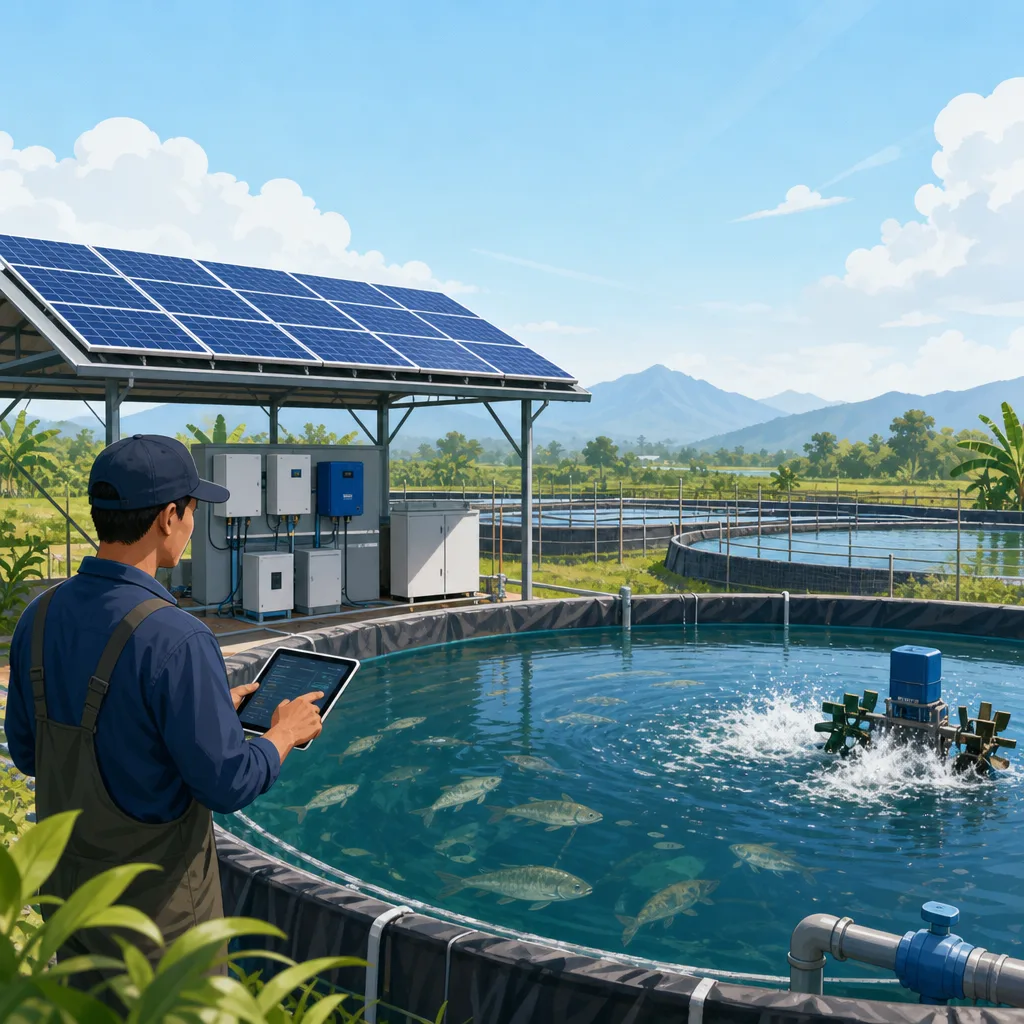
If your pond runs a diesel pump, you are spending more on fuel than most households spend on electricity. Solar pumping replaces it without a battery, because the pond already is one.
Quick Answer
If your pond runs a diesel or gasoline pump, that is where solar pays. A 10 HP diesel pump running four hours a day burns roughly ₱14,040 of fuel a month — ₱168,480 a year. That is more than most Philippine households spend on electricity. A 5.5 kWp solar array replaces it, and the payback is about 1.8 years on fuel alone — before counting oil, filters, engine servicing and hauling fuel to the pond. You do not need a battery. The pump runs when the sun is up and the water sits in the pond. The pond is the storage. That single fact removes the most expensive component from the system. Aeration is the harder problem, because ponds need oxygen most before dawn. If you aerate, keep the grid or a generator for that and use solar for pumping. This works off-grid. Many ponds have no electrical service at all. Solar pumping needs none.
Start with the honest question: what does your pond actually use power for?
Most guidance about solar and aquaculture is written for intensive shrimp farms with twenty aerators running all night. That is not what most Philippine ponds look like.
For a typical 1–2 hectare bangus or tilapia operation, the electrical picture is usually simple:
Water exchange pumping — filling, draining, and refreshing. Often the only real load, and often done with a diesel or gasoline engine because there is no grid at the pond.
Aeration — sometimes none at all in extensive ponds. A few units in semi-intensive operations, typically run in the hours before dawn.
Everything else — a light, a phone charger, maybe a feed blower. Negligible.
Which of those you have decides whether solar is an easy yes or a complicated maybe. Pumping is the easy yes.
The diesel pump is the opportunity
Fuel is the largest recurring cost on most small ponds, and it is easy to underestimate because it goes out in small amounts.
| Engine | Fuel use | Hours/day | Litres/month | Cost/month | Cost/year |
|---|---|---|---|---|---|
| 7 HP | 1.3 L/h | 3 | 117 | ₱7,605 | ₱91,260 |
| 7 HP | 1.3 L/h | 4 | 156 | ₱10,140 | ₱121,680 |
| 10 HP | 1.8 L/h | 4 | 216 | ₱14,040 | ₱168,480 |
| 10 HP | 1.8 L/h | 6 | 324 | ₱21,060 | ₱252,720 |
| 16 HP | 2.6 L/h | 4 | 312 | ₱20,280 | ₱243,360 |
| 16 HP | 2.6 L/h | 6 | 468 | ₱30,420 | ₱365,040 |
At ₱65 per litre. Fuel figures are typical for engines at working load.
And that is fuel alone. Add engine oil, filters, servicing, occasional rebuilds, and the time and cost of getting fuel to a pond that may be some distance from a road.
Solar pumping: why no battery is needed
This is the part that makes the economics work, and it is worth understanding properly.
Most solar systems need batteries because electricity has to be used the moment it is generated. Water does not have that problem. Pump when the sun is up, and the water stays in the pond until you need it — overnight, tomorrow, all week.
The pond is the storage. It cost you nothing extra, it never degrades, and it needs no maintenance.
A solar pumping system is therefore simple: array, a solar pump controller or drive, and the pump. No battery bank, no complex protection, far less to go wrong.
Sizing:
| Pump | Load | Hours/day | Daily energy | Array needed |
|---|---|---|---|---|
| 3 HP | 2.98 kW | 4 | 11.9 kWh | 3.3 kWp |
| 3 HP | 2.98 kW | 6 | 17.9 kWh | 5.0 kWp |
| 5 HP | 4.97 kW | 4 | 19.9 kWh | 5.5 kWp |
| 5 HP | 4.97 kW | 6 | 29.8 kWh | 8.3 kWp |
| 7.5 HP | 7.46 kW | 4 | 29.8 kWh | 8.3 kWp |
| 7.5 HP | 7.46 kW | 6 | 44.8 kWh | 12.4 kWp |
The numbers on a real case
A 5 HP pump running four hours a day, currently driven by a 10 HP diesel engine.
| Pump load | 4.97 kW |
| Daily energy | 19.9 kWh |
| Array required | 5.5 kWp |
| Diesel currently burned | ₱14,040/month — ₱168,480/year |
| Installed cost | Payback on fuel alone |
|---|---|
| ₱248,667 | 1.5 years |
| ₱303,926 | 1.8 years |
| ₱359,185 | 2.1 years |
| ₱414,444 | 2.5 years |
And the payback barely moves with running hours, because fuel cost and array size scale together:
| Hours/day | Array | Fuel replaced | Payback |
|---|---|---|---|
| 2 | 2.8 kWp | ₱7,020/mo | 1.8 years |
| 3 | 4.1 kWp | ₱10,530/mo | 1.8 years |
| 4 | 5.5 kWp | ₱14,040/mo | 1.8 years |
| 6 | 8.3 kWp | ₱21,060/mo | 1.8 years |
That consistency is unusual and it makes the decision easier — you do not need to pump a lot of hours for this to work. A small pond pumping two hours a day gets the same payback as a larger one pumping six.
If your pond has grid power already
The case is different but still worth doing.
At ₱15.95 per kWh, that same 5 HP pump running four hours daily costs about ₱9,525 a month on the grid — against ₱14,040 for diesel. So grid is already cheaper than fuel, and solar then reduces the grid cost further.
Payback is longer than the diesel case, because you are displacing electricity at ₱15.95 rather than fuel at an effective ₱23 per kWh equivalent. But pumping is a daytime load that matches solar production almost perfectly, so self-consumption is close to 100% — which is the best position a grid-tied system can be in.
The order is the same either way: solar covers the pumping.
Aeration: the honest part
If your pond uses aerators, understand why they are harder before anyone quotes you a system to run them.
Dissolved oxygen in a pond is produced by phytoplankton during daylight and consumed all night by fish, plankton and sediment. Oxygen peaks in late afternoon and falls to its minimum before dawn — which is when aerators must run, and when solar produces nothing.
For a small pond with two 1 HP aerators:
| Running | Energy | Grid cost |
|---|---|---|
| 4 h/night | 179 kWh/month | ~₱2,855 |
| 8 h/night | 358 kWh/month | ~₱5,710 |
Covering eight hours from storage needs about 15.3 kWh of usable battery — roughly ₱183,000 to ₱381,000 depending on installed cost, against grid cost of ₱5,710 a month. That is a payback of around 3.3 years at mid-range battery pricing, which is defensible but no longer the easy decision that pumping is.
Our recommendation for a small pond:
Do the pumping with solar. Easy, no battery, fast payback, works off-grid.
Keep aeration on the grid or a generator, unless you have no service at all — in which case price the battery properly rather than assuming.
Before buying storage for aeration, look at control. Many operators run every aerator all night as insurance because the cost of getting it wrong is a pond of dead fish. Dissolved oxygen monitoring lets you run only what the pond needs. On a small operation that is a modest saving in pesos, but on any pond it reduces wear and gives you data you did not have before.
What to check before you buy
Your actual fuel consumption. Not the engine's rating — how many litres you actually buy in a month. Most operators underestimate this because it is spent in small amounts.
Your real pumping hours, and whether they are flexible. Solar pumping works best if you can shift pumping into daylight, which most ponds can.
Static head and flow requirement. How high the water must be lifted and how much you need per day. This determines the pump, and the pump determines the array — getting it wrong in either direction is expensive.
Water source and intake condition. Silt and debris are harder on pumps than anything electrical.
Whether the pond has or could have grid service. It changes the comparison, though not usually the conclusion.
Security. Panels at a remote pond need to be mounted where they can be seen or secured.
Frequently asked questions
Can solar run a fishpond water pump?
Yes, and it is one of the better applications for solar in Philippine agriculture. Pumping happens during daylight, and the water is stored in the pond rather than in a battery — so no battery bank is needed. A 5 HP pump running four hours a day needs an array of about 5.5 kWp.
How much does a diesel pump cost to run on a fishpond?
A 10 HP diesel engine running four hours a day burns roughly 7.2 litres, or 216 litres a month — about ₱14,040 at ₱65 per litre, and ₱168,480 a year. That excludes oil, filters, servicing and the cost of transporting fuel to the pond.
What is the payback on solar pumping for a fishpond?
Replacing diesel, roughly 1.8 years on fuel savings alone across a wide range of pump sizes and running hours. The payback stays consistent because fuel cost and array size scale together — a pond pumping two hours a day sees the same payback as one pumping six.
Do I need batteries for a solar fishpond pump?
No. The pond stores the water, which is what a battery would otherwise be storing energy to do. Pump during daylight and the water is there when you need it. This removes the most expensive component of a typical solar system.
Can solar run pond aerators at night?
Only with battery storage, because aeration is needed most before dawn when there is no generation. For a small pond with two 1 HP aerators running eight hours, that means roughly 15.3 kWh of usable storage. It is a reasonable proposition at current battery prices but a considerably longer payback than pumping. Where grid service exists, keeping aeration on the grid is usually the better choice.
Will solar pumping work if my pond has no electricity?
Yes, and that is where it works best. A solar pumping system needs no grid connection at all — array, controller and pump. Many Philippine ponds have no service at the pond site, which is exactly why they run diesel.
Assumptions
| Item | Value |
|---|---|
| Diesel price | ₱65/litre |
| Engine fuel use | 1.3–2.6 L/h depending on size, at working load |
| Pump and motor efficiency | 75% combined |
| Solar yield | 3.6 kWh per kWp per day — 4.5 peak sun hours × 0.80 |
| Grid rate | ₱15.95/kWh — Meralco August 2026, higher-consumption tier |
| Battery usable depth | 90%, plus 15% for losses |
| Installed costs | Shown as ranges; obtain current quotes |
Head, flow, water quality and pumping schedule vary enormously between ponds. Treat this as the shape of the decision rather than your answer.
Tell us your pump size, how many hours a day you run it, and how much fuel you buy in a month — we will size the array against your actual pumping and tell you what it replaces.