
Market & Policy
Global Solar Installations in 2026: The First Decline in 20 Years, Explained
August 5, 2026 · SolarSwitch · 8 min read
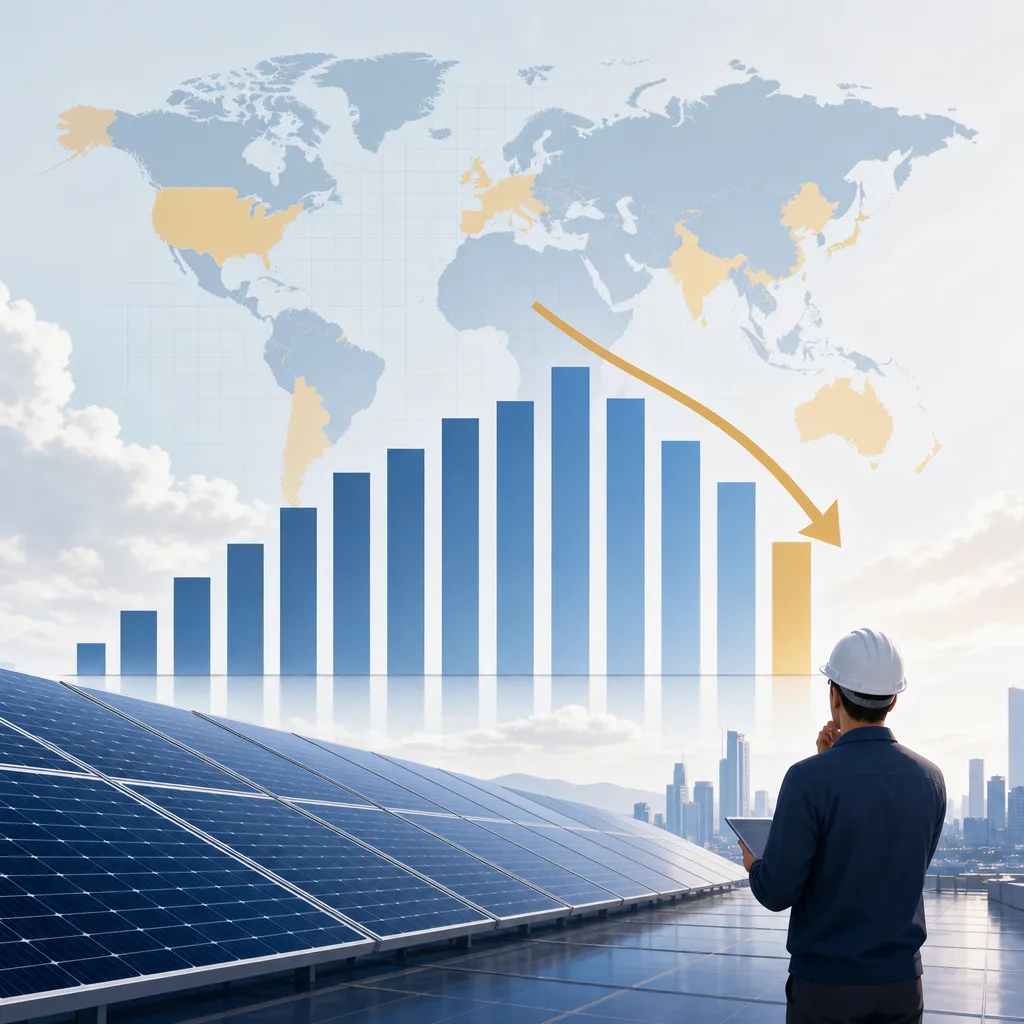
Global solar installations are projected to reach 649 GW in 2026, down from 655 GW in 2025 — the first annual decline since 2000, according to BloombergNEF. The drop is driven almost entirely by China easing off, not by weakening demand elsewhere.
Last updated: 5 August 2026
Quick answer
Global solar installations are projected to reach 649 GW in 2026, down from 655 GW in 2025 — a decline of roughly 0.9% and the first annual drop since records began in 2000, according to BloombergNEF's Global PV Market Outlook.
The decline is almost entirely caused by China, not by weakening demand elsewhere. Three facts explain it:
- China is easing off. Chinese deployment falls from about 372 GW in 2025 to roughly 341 GW in 2026, a 14% drop, after a mid-2025 policy shift from guaranteed pricing to competitive bidding.
- The rest of the world is still growing. Non-China installations rise from about 283 GW in 2025 to roughly 308 GW in 2026.
- The drop is smaller than the forecast error. BNEF's margin of error is around 10%, or roughly 65 GW — more than ten times the size of the projected 6 GW decline.
BloombergNEF expects global growth to resume in 2027 at approximately 688 GW.
What it means for buyers: solar hardware is near historic lows. Tier-1 Chinese TOPCon modules traded at $0.085–$0.095 per watt FOB in Q1 2026, down 38% from the 2022 peak of $0.30/W.
Key numbers at a glance
| Metric | 2024 | 2025 | 2026 (projected) | Source |
|---|---|---|---|---|
| Global solar deployment | — | 655 GW | 649 GW | BloombergNEF |
| China deployment | — | 372 GW | 341 GW (−14%) | BloombergNEF |
| Non-China deployment | 251 GW | 283 GW | 308 GW | Bloomberg data |
| Tier-1 TOPCon module price (China FOB) | — | — | $0.085–0.095/W | BloombergNEF, Q1 2026 |
| Global module manufacturing capacity | — | — | 1,100+ GW | BloombergNEF |
| Polysilicon price vs. 2022 peak | — | — | −84% | BloombergNEF |
Is global solar really declining in 2026?
Technically yes, but the word "decline" oversells it.
The projected drop is about 6 GW on a base of 655 GW — roughly 0.9%.
BloombergNEF analyst Jenny Chase has been explicit that this figure sits comfortably inside the firm's own margin of error of around 10%, which amounts to roughly 65 GW in absolute terms. The forecast error bar is more than ten times larger than the forecast decline.
The accurate framing is that global solar deployment has gone flat for one year after two decades of compounding growth. That is a genuine inflection worth understanding. It is not a collapse, and anyone characterising it as one is selling something.
Why are global solar installations falling in 2026?
Because China is slowing, and China is more than half the world market.
China alone accounts for slightly over 50% of every solar panel installed globally. When Chinese deployment moves, world totals move with it.
Remove China from the arithmetic and the picture inverts completely:
- 2024: non-China world installs about 251 GW
- 2025: grows nearly 13% to roughly 283 GW
- 2026: projected to reach approximately 308 GW
The non-China world is still growing at a healthy clip. It has simply been mathematically overwhelmed by one country easing off the accelerator.
As Chase told pv magazine, the trajectory China chooses effectively determines the world's build trajectory. That concentration is the real structural story underneath the headline.
What caused China's solar slowdown?
Two policy factors converged.
A pricing reform in mid-2025. China shifted solar procurement away from guaranteed pricing toward competitive bidding. S&P Global's analysis is that this triggered a rush of installations ahead of the deadline, followed by a sharp drop once guaranteed returns disappeared. The monthly data shows the spike clearly — China deployed around 92 GW in May 2025 alone, more than most countries install in a decade.
The latest five-year plan. China's current economic plan signals deliberate moderation from what BNEF describes as a breakneck pace. Developers previously building against guaranteed returns now build against market prices.
Neither factor suggests solar has become less attractive as a technology. Both indicate a heavily subsidised market being weaned onto market economics — which is what every observer said they wanted.
When will global solar growth resume?
In 2027, according to BloombergNEF's projections:
- 2027: approximately 688 GW
- 2028: approximately 743 GW
- 2035: approximately 864 GW
India and Africa are accelerating. Europe and the United States are expected to soften somewhat in 2026 before recovering. The 2026 dip is a pause in a curve that resumes climbing immediately.
What does this mean if you're buying solar in 2026?
Three practical consequences, and they mostly run in your favour.
1. Panels have never been cheaper — and the slowdown is why
The manufacturing overhang is enormous. Global module manufacturing capacity now exceeds 1,100 GW against roughly 650 GW of installation demand. Polysilicon, the raw material at the base of the supply chain, has fallen roughly 84% from its 2022 peak according to BloombergNEF.
Tier-1 Chinese TOPCon modules traded at $0.085–$0.095 per watt FOB in Q1 2026 — down about 38% from the post-COVID peak of $0.30/W in 2022.
Softening demand against structural oversupply means one thing for buyers: hardware is cheap, and cheap in the near term.
2. The cheapness is not guaranteed to last
Polysilicon inventory exceeded 570,000 metric tons in early 2026, according to InfoLink Consulting — equivalent to roughly 300 GW of latent module supply sitting in warehouses.
That inventory is a price ceiling right now. It is also a symptom. Chinese authorities have made intermittent attempts to consolidate polysilicon overcapacity, and manufacturers including Tongwei, GCL Tech and Daqo New Energy have been throttling production rather than expanding. Rystad Energy expects Chinese manufacturing costs to rise in the first half of 2026 before potentially easing later in the year.
Prices in an oversupplied market are cheap until they suddenly aren't.
3. Supplier solvency now matters more than spec sheets
This is what most buyers never consider.
China booked roughly $130 billion of solar manufacturing investment between 2022 and 2024. Much of that capacity now runs below cost, and polysilicon has at points been sold at a loss.
A 25-year product warranty is only as good as the company standing behind it. When comparing quotes, the relevant question is not only which panel is more efficient — it is which manufacturer will plausibly still exist in fifteen years to honour a claim.
Ask your installer three things: who backs the warranty, whether third-party warranty insurance is in place, and what happens to your coverage if the manufacturer exits the market. A competent installer will have a straight answer ready.
What does the global slowdown mean in the Philippines?
It means the cheapest solar hardware in history is arriving in a market where electricity has never been more expensive. That is an unusually favourable combination.
Installed prices have fallen sharply. Philippine installers were quoting roughly ₱80–₱90 per watt two years ago. In 2026 quality residential installations land closer to ₱37–₱50 per watt, with on-grid systems in the ₱33,500–₱38,000 per kW range based on installer quotes collected in Metro Manila in May 2026. A 5 kWp residential system now typically falls between ₱190,000 and ₱375,000 fully installed depending on brand, inverter type and roof complexity.
Meanwhile Meralco rates keep climbing. The typical household rate rose from ₱12.9508/kWh in January 2026 to ₱14.8261/kWh in July 2026 — an increase of roughly 14% in six months. Drivers included higher generation charges, peso depreciation past ₱60 to the dollar, and tight Luzon supply.
Falling hardware costs against rising grid rates is the definition of an improving payback. Typical Philippine residential payback in 2026 runs about 4–7 years against a 25-year panel life.
The oversupply also means brand choice matters more, not less. With global manufacturing capacity above 1,100 GW against roughly 650 GW of demand, some manufacturers will not survive the shakeout. Tier-1 brands widely supported in the Philippine market include LONGi, JinkoSolar, JA Solar and Canadian Solar, with Growatt, Huawei, Solis and SMA common on the inverter side. Ask specifically who honours the warranty locally — a 25-year warranty from a company with no Philippine service presence is a piece of paper.
Related reading: Why batteries — not panels — are the growth story of 2026
Frequently asked questions
Are solar panel prices going up in 2026?
Not in most of the world. Tier-1 Chinese TOPCon modules traded at $0.085–$0.095 per watt FOB in Q1 2026, down 38% from the 2022 peak. However, US delivered prices sit far higher at around $0.28/W due to stacked tariffs, and Rystad Energy expects Chinese production costs to rise in the first half of 2026 before easing.
How much solar will the world install in 2026?
BloombergNEF projects approximately 649 GW of global solar deployment in 2026, compared with roughly 655 GW in 2025.
Why is China installing less solar?
China shifted solar procurement from guaranteed pricing to competitive bidding in mid-2025, which triggered a rush of installations followed by a sharp drop. Its latest five-year economic plan also signals deliberate moderation. Chinese deployment is projected to fall about 14%, from roughly 372 GW to 341 GW.
Is the solar industry in trouble?
No. Global deployment is flat for one year while non-China installations continue growing, from roughly 283 GW in 2025 to 308 GW in 2026. BloombergNEF expects global growth to resume in 2027 at around 688 GW. The industry's challenge is manufacturing oversupply and thin margins, not weak demand.
Magkano ang solar panel sa Pilipinas ngayong 2026?
Quality residential installations run roughly ₱37–₱50 per watt in 2026, down from ₱80–₱90 two years ago. A 5 kWp system typically costs ₱190,000–₱375,000 fully installed depending on brand, inverter type and roof complexity. On-grid systems quoted in Metro Manila in May 2026 ranged from ₱33,500 to ₱38,000 per kW.
Will solar panels get cheaper in the Philippines?
Unlikely by much. Global module prices are already near historic lows because of structural oversupply, and Philippine installed cost is now dominated by labour, permits, mounting and inverters rather than the panels themselves. Peso weakness also works against further declines, since most hardware is dollar-denominated.
Should I wait for solar prices to drop further?
Prices are already near historic lows because of structural oversupply — manufacturing capacity above 1,100 GW against roughly 650 GW of demand. There is limited room for further declines, and upward pressure exists from potential tariffs and production discipline. Waiting costs you a year of electricity bill savings against a small and uncertain price benefit.
Figures cited from BloombergNEF's Global PV Market Outlook, S&P Global, Rystad Energy and InfoLink Consulting, current as of August 2026. Forecasts are estimates and carry material uncertainty.
Related Articles

Market & Policy
GEOP, RCOA or Solar? The Three Levers on a Philippine Business Electricity Bill
September 1, 2026

Market & Policy
SSS Will Lend ₱400,000 for Solar. Is the Payment Less Than Your Meralco Bill?
August 18, 2026
Market & Policy
How to Read Your Meralco Bill (And What Solar Would Actually Save You)
August 11, 2026