Market & Policy
SSS Will Lend ₱400,000 for Solar. Is the Payment Less Than Your Meralco Bill?
August 18, 2026 · SolarSwitch · 8 min read
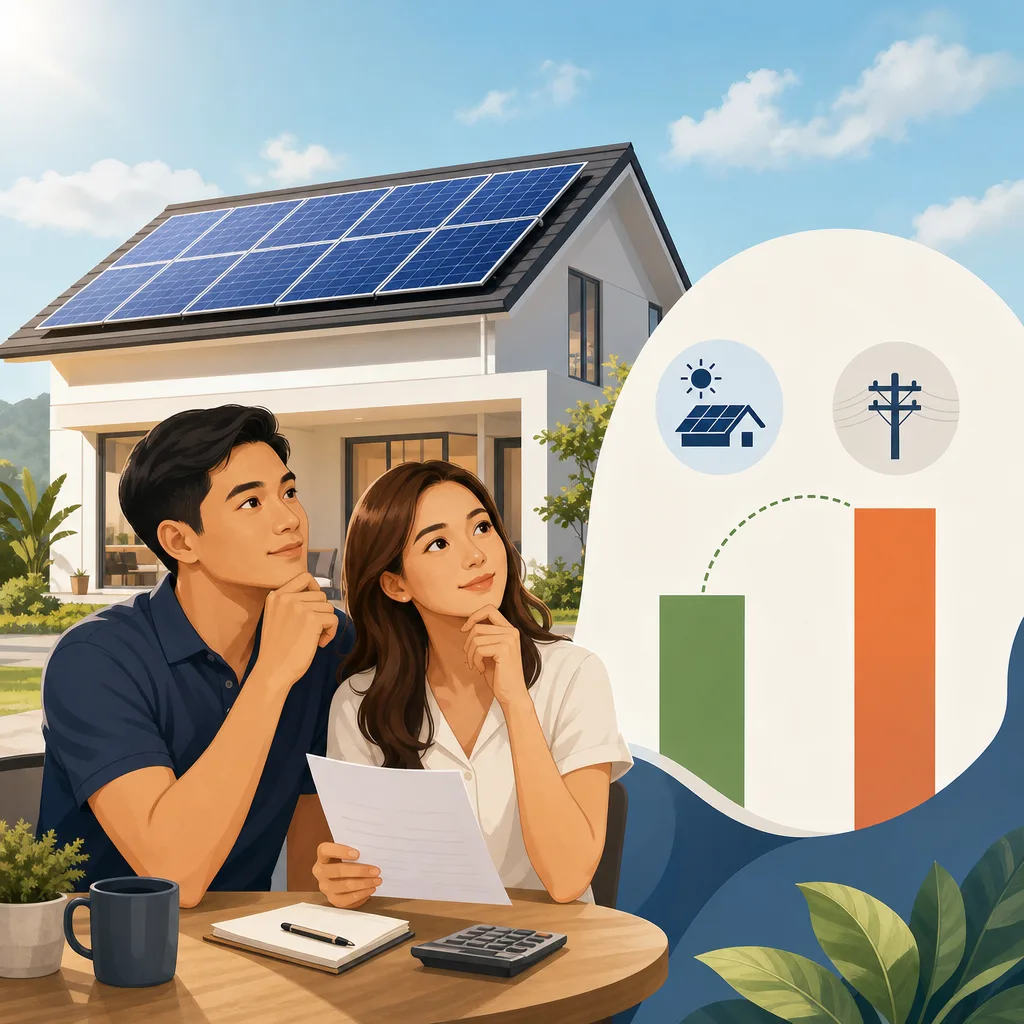
SSS is preparing to lend members up to ₱400,000 for rooftop solar, repayable over seven years. So the obvious question: is the monthly payment less than the electricity it replaces? We ran the numbers.
Quick Answer
SSS is earmarking ₱40 billion for an Energy Sustainability Loan Program offering members up to ₱400,000 for residential solar, repayable over four to seven years. A ₱400,000 loan over seven years costs roughly ₱6,234 a month at an assumed 8% interest. That same ₱400,000 buys a system generating ₱8,700 to ₱13,600 a month in electricity value, depending on installed cost. At every realistic price point, the loan payment is smaller than the electricity it replaces — cash-flow positive from month one. The break-even is not close. On a seven-year term the maths only fails above roughly ₱98,000 per kWp installed — far beyond anything in this market. But most members won't qualify. Eligibility is currently limited to holders of a Mandatory Provident Fund account, which covers members with a monthly salary credit above ₱20,000. That is a much smaller group than "SSS members." Nothing is final. The interest rate is not set, guidelines are not published, and implementation may slip to early 2027.
What has actually been announced
Cutting through the reposts, here is what SSS officials have said on the record.
| Programme name | Energy Sustainability Loan Program |
| Total allocation | ₱40 billion |
| Loan per member | ₱300,000 to ₱400,000 |
| Repayment term | 4 to 7 years |
| Target households | 100,000 |
| Announcement targeted | September 2026 |
| Implementation | End of 2026 or early 2027 |
| Interest rate | Not finalised — indicated as slightly above the prevailing Treasury bill rate |
| Eligibility | Members with a Mandatory Provident Fund account |
SSS President and CEO Robert Joseph de Claro has been careful about the timeline, telling reporters he is personally targeting September to announce the programme, with implementation possibly at the end of this year or early next, and that the rules are still being drafted.
That distinction matters. September is when we expect to learn the terms. It is not when the money becomes available.
The question everyone is actually asking
Not "how much can I borrow." "Will the monthly payment cost me more than my current electricity bill?"
If the answer is no, the loan is close to free — you redirect money you were already spending to Meralco into an asset you end up owning. If the answer is yes, it is a real financial commitment that needs thinking about.
So we ran it.
Step 1 — What the loan costs each month
Standard amortisation on ₱400,000. The rate is not final, so here is a range around a plausible figure.
| Interest rate | 4 years | 5 years | 6 years | 7 years |
|---|---|---|---|---|
| 7% | ₱9,578 | ₱7,920 | ₱6,820 | ₱6,037 |
| 8% | ₱9,765 | ₱8,111 | ₱7,013 | ₱6,234 |
| 9% | ₱9,954 | ₱8,303 | ₱7,210 | ₱6,436 |
| 10% | ₱10,145 | ₱8,499 | ₱7,410 | ₱6,640 |
And for the lower ₱300,000 tier:
| Interest rate | 4 years | 5 years | 6 years | 7 years |
|---|---|---|---|---|
| 7% | ₱7,184 | ₱5,940 | ₱5,115 | ₱4,528 |
| 8% | ₱7,324 | ₱6,083 | ₱5,260 | ₱4,676 |
| 9% | ₱7,466 | ₱6,228 | ₱5,408 | ₱4,827 |
| 10% | ₱7,609 | ₱6,374 | ₱5,558 | ₱4,980 |
Step 2 — What that money generates
A kWp of solar in Philippine conditions produces roughly 1,314 kWh a year — 4.5 peak sun hours × 80% system efficiency × 365 days. That is about 110 kWh per kWp per month.
Value per kilowatt-hour depends on whether you use it or export it. Energy consumed on site displaces your full retail rate; energy exported earns the generation component only. At 85% self-consumption, the blended value works out to ₱13.9534 per kWh at Meralco's August 2026 rate.
Step 3 — Put them side by side
₱400,000 borrowed over seven years at 8% — payment ₱6,234 a month:
| Installed cost | System size | Generation | Value per month | Net position |
|---|---|---|---|---|
| ₱45,000/kWp | 8.9 kWp | 973 kWh | ₱13,581 | +₱7,347 |
| ₱50,000/kWp | 8.0 kWp | 876 kWh | ₱12,223 | +₱5,989 |
| ₱55,000/kWp | 7.3 kWp | 796 kWh | ₱11,112 | +₱4,877 |
| ₱60,000/kWp | 6.7 kWp | 730 kWh | ₱10,186 | +₱3,951 |
| ₱65,000/kWp | 6.2 kWp | 674 kWh | ₱9,402 | +₱3,168 |
| ₱70,000/kWp | 5.7 kWp | 626 kWh | ₱8,731 | +₱2,496 |
Every row is positive. At every installed cost we tested, the system generates more electricity value each month than the loan payment costs.
Step 4 — How much room is there?
The honest test of a result like this is how close it runs to failing.
| Term and rate | Monthly payment | Cash-flow neutral at |
|---|---|---|
| 7 years @ 8% | ₱6,234 | ₱98,029/kWp |
| 7 years @ 10% | ₱6,640 | ₱92,035/kWp |
| 5 years @ 8% | ₱8,111 | ₱75,353/kWp |
| 4 years @ 8% | ₱9,765 | ₱62,585/kWp |
On a seven-year term, installed cost would have to reach roughly ₱98,000 per kWp before the payment exceeded the electricity value — roughly double what systems actually cost in this market.
Even on the shortest four-year term, the break-even sits above ₱62,000 per kWp. The result is not marginal.
The catches, stated plainly
Anyone telling you this is free money is skipping four things.
1 · Most members will not qualify
Eligibility is currently indicated as members holding a Mandatory Provident Fund account — the compulsory savings scheme covering members with a monthly salary credit above ₱20,000.
That is a considerably smaller group than "SSS members," and it is the single most important detail in the entire announcement. If your MSC is below that threshold, on current information you are not eligible.
2 · The savings assume you actually use the power
Our figures assume 85% self-consumption. A household that is empty from 08:00 to 18:00 will export far more of its generation, and export earns the generation rate rather than the full retail rate. That does not break the case, but it narrows the margin.
The fix is free: shift laundry, ironing, water pumping and dishwashing into daylight hours.
3 · You pay interest, and it is not trivial
| Term | Monthly | Total repaid | Interest paid |
|---|---|---|---|
| 4 years | ₱9,765 | ₱468,728 | ₱68,728 |
| 5 years | ₱8,111 | ₱486,633 | ₱86,633 |
| 6 years | ₱7,013 | ₱504,957 | ₱104,957 |
| 7 years | ₱6,234 | ₱523,697 | ₱123,697 |
The longest term gives the best monthly cash flow and costs the most overall. Which matters more depends on whether your constraint is monthly budget or total outlay.
4 · Nothing is final
The rate is not set. Guidelines are not published. Implementation may be end of 2026 or early 2027. Do not sign a solar contract on the assumption this financing will be available on particular terms — nobody knows the terms yet, including us.
What this means for the market
The scale is worth sitting with.
₱40 billion across 100,000 households averages ₱400,000 each. If the average system lands around 6 kWp, that is roughly 600 MW of new rooftop capacity.
For context, Philippine rooftop solar capacity nearly doubled to about 1,300 MW by early 2026, up from 721 MW a year earlier. This one programme would add close to another 46% on top of that.
The broader picture behind it: the Philippines has become China's second-largest export market for solar panels, importing $407 million worth between March and May 2026 alone. President Marcos declared a state of national energy emergency in March. Household solar has moved from niche to policy instrument in about eighteen months.
What to do now
If you think you qualify:
Check your MPF status. Log into My.SSS and confirm whether you have a Mandatory Provident Fund account. This is the gate, and it is checkable today.
Gather twelve months of electricity bills. Whatever the terms turn out to be, any credible installer will ask for these first, and consumption varies enough across a Philippine year that a single bill will mislead.
Work out your daytime share. Roughly what proportion of your usage happens between 08:00 and 16:00? This determines how much of the generation you capture at full value, and it moves the numbers above more than the interest rate does.
Get a site survey done. Roof type, orientation, shading and structural condition all affect what is possible and what it costs. Knowing your actual number beats planning around ₱400,000.
And be careful who you sign with. A financing programme of this size will attract operators who did not exist last year. Our guide to solar red flags in the Philippines covers what to check — the short version is: ask for the licence, the engineer's name and PRC number, the complete equipment model numbers, and never pay in full upfront.
Frequently asked questions
How much can I borrow under the SSS solar loan?
SSS officials have indicated a maximum of ₱300,000 to ₱400,000 per member, repayable over four to seven years, under a total allocation of ₱40 billion targeting 100,000 households.
When does the SSS solar loan start?
SSS is targeting a September 2026 announcement, with implementation expected by the end of 2026 or early 2027. September is when the terms are expected to be published, not when funds become available.
Who is eligible for the SSS Energy Sustainability Loan?
Current indications are that eligibility is limited to members holding a Mandatory Provident Fund account, which covers those with a monthly salary credit above ₱20,000. Full guidelines have not been released.
What is the interest rate on the SSS solar loan?
Not finalised. SSS has indicated it would likely be set slightly above the prevailing Treasury bill rate at the time of rollout.
Is the SSS solar loan payment cheaper than my electricity bill?
Our modelling suggests yes at every realistic installed cost. A ₱400,000 loan over seven years at an assumed 8% costs about ₱6,234 monthly, while the system it funds generates roughly ₱8,700 to ₱13,600 of electricity value each month depending on price per kWp. The break-even only occurs above about ₱98,000 per kWp, far above market rates.
What size solar system will ₱400,000 buy?
Between roughly 5.7 and 8.9 kWp depending on installed cost per kWp, which varies with roof type, structural requirements and whether battery storage is included. A system in that range covers a substantial share of a typical Philippine household's consumption.
Assumptions and sources
| Assumption | Value |
|---|---|
| Production yield | 1,314 kWh/kWp/year — 4.5 PSH × 0.80 efficiency × 365 |
| Retail electricity rate | ₱14.7833/kWh — Meralco, August 2026 |
| Export credit rate | ₱9.2504/kWh — generation component |
| Self-consumption | 85% |
| Blended value | ₱13.9534/kWh |
| Interest rate | 7–10% modelled; actual rate not yet set |
Sources: Philippine Daily Inquirer, BusinessWorld, Manila Bulletin, GMA News and Tech Pilipinas reporting on SSS statements, May to July 2026; Ember analysis of Philippine rooftop solar capacity; Chinese customs data on solar panel exports.
This is analysis, not financial advice. Programme terms are not final. Confirm details with SSS directly before making commitments.
Related Articles

Market & Policy
GEOP, RCOA or Solar? The Three Levers on a Philippine Business Electricity Bill
September 1, 2026
Market & Policy
How to Read Your Meralco Bill (And What Solar Would Actually Save You)
August 11, 2026

Market & Policy
Global Solar Installations in 2026: The First Decline in 20 Years, Explained
August 5, 2026