
Technology & Storage
Why Batteries — Not Panels — Are the Growth Story of 2026
August 3, 2026 · SolarSwitch · 11 min read
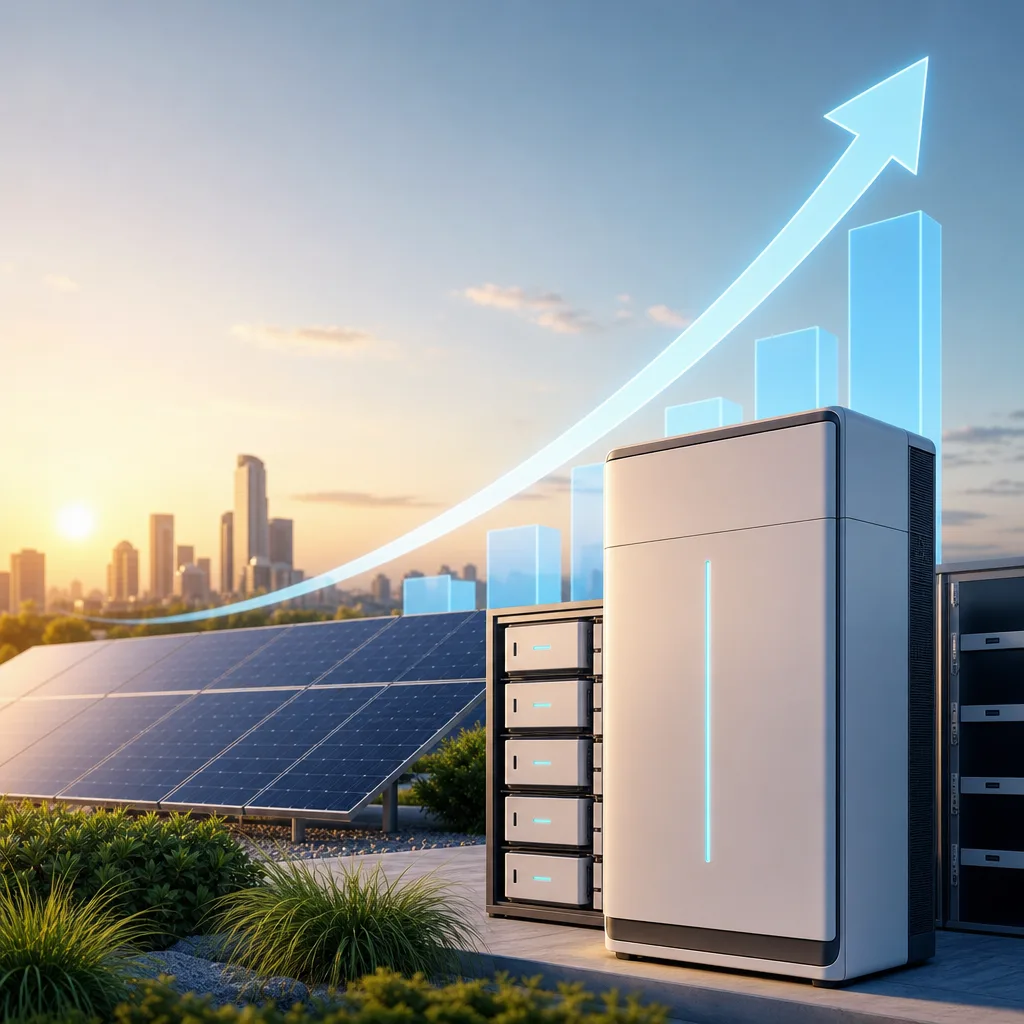
Global solar deployment is flat in 2026, but battery storage is growing more than 40% — to 459 GWh, according to BloombergNEF. Here's why storage, not panels, is now the real growth story, and what it means for a Philippine solar system.
Last updated: 5 August 2026
Quick answer
Global solar deployment is flat in 2026. Global battery storage is growing more than 40%. That divergence is the defining shift in energy this year.
The core numbers:
- Storage is scaling fast. BloombergNEF projects 158 GW / 459 GWh of storage deployed globally in 2026, up roughly 41% from the record 112 GW / 307 GWh installed in 2025 — which was itself a 48% jump over 2024.
- It is still nowhere near enough. The 459 GWh added in 2026 can store roughly 43 minutes of peak output from the 640 GW of new solar going up the same year.
- Homeowners moved first. Nearly half of all new US residential solar installations in Q1 2026 were paired with a battery, up from 38% a year earlier, per ACP and Wood Mackenzie.
- Utilities followed. Battery storage accounts for 26.3 GW of the 86 GW of new US utility-scale capacity planned for 2026, with solar and storage together making up 79% of all additions (EIA).
Why it's happening: solar generates all at once, in the middle of the day. In markets with enough of it, midday prices fall to zero or below. Storage is the only thing that moves that energy to the hours when it is worth something.
Key numbers at a glance
| Metric | Figure | Period | Source |
|---|---|---|---|
| Global storage deployed | 112 GW / 307 GWh | 2025 | BloombergNEF |
| Global storage projected | 158 GW / 459 GWh (+41%) | 2026 | BloombergNEF |
| Storage vs. new solar output | ~43 minutes of peak | 2026 | BloombergNEF |
| Spain negative-price hours | 397 hours | Q1 2026 alone | BloombergNEF |
| US residential storage installed | 673 MW (record) | Q1 2026 | US EIA |
| US residential storage growth | 1.3 GWh, +86% YoY | Q1 2026 | ACP / Wood Mackenzie |
| US solar installs paired with storage | ~50% (from 38%) | Q1 2026 | ACP / Wood Mackenzie |
| US home battery capacity in VPPs | +153% | 2025 | Yale E360 |
Why is battery storage growing faster than solar?
Because the industry solved generation and hasn't yet solved timing.
When enough solar comes online in one region, it all generates simultaneously. Supply overshoots demand in the middle of the day. Prices fall — and in markets with sufficient solar penetration, they fall through zero into negative territory, meaning generators pay to offload power.
Spain is the clearest example. According to BloombergNEF, Spain logged roughly 800 hours of zero or negative pricing across all of 2025. In the first quarter of 2026 alone it recorded 397 negative-price hours — already approaching the full-year 2025 total of 555, and representing more than a third of the roughly 1,080 daylight hours in that three-month window.
Spain is not an outlier so much as an early arrival. Zero and negative pricing hours rose across seven European countries in 2025. California and China show versions of the same pattern.
This is what a market looks like with plenty of solar and not enough storage. Daytime power becomes nearly worthless while evening power stays expensive. The value of a solar panel stops being about how much energy it makes and starts being about when that energy can be delivered.
How much storage does the world actually need?
Far more than it is building.
BloombergNEF's Jenny Chase has pointed out that the 459 GWh of batteries being added worldwide in 2026 can store roughly 43 minutes of peak output from the 640 GW of new solar installed the same year.
Forty-three minutes, against a night that lasts twelve hours.
Storage is growing at 41% annually and remains nowhere close to catching the generation already being built. That gap is the investment thesis for the next decade, and it explains why utilities, developers and homeowners are all moving in the same direction at once.
What does the shift look like in practice?
Utility scale: solar plants are becoming battery plants
The flagship projects being financed now are not solar farms with a battery bolted on. They are integrated systems where the storage is the point.
In Abu Dhabi, Masdar and EWEC reached financial close in July 2026 on a $6.1 billion facility pairing 5.2 GW of solar PV with 19 GWh of battery storage, designed to deliver 1 GW of continuous, dispatchable clean power around the clock. A consortium of 13 international and local banks provided $5.1 billion in debt financing, with Masdar contributing $1 billion in equity. The project broke ground in October 2025 and is expected to be operational in 2027, avoiding roughly 5.7 million tonnes of CO₂ annually.
The financing detail matters more than the megawatts. Masdar's own framing is that the deal shows round-the-clock renewable projects have moved from technical ambition to bankable infrastructure. Banks now underwrite intermittency solutions.
Dubai follows the same pattern. DEWA has tendered the seventh phase of the Mohammed bin Rashid Al Maktoum Solar Park as 2,000 MW of PV paired with a 1,400 MW battery system at six-hour duration — 8.4 GWh. Earlier phases were solar alone.
Grid scale: storage is now most of what gets built
In the United States, the Energy Information Administration expects 86 GW of new utility-scale generating capacity in 2026 — the largest single-year addition in over two decades, nearly double the 53 GW installed in 2025.
Of that total:
- 26.3 GW is battery storage
- Solar and storage together account for 79% of everything planned
- Renewables and storage combined account for 93% of new utility-scale capacity
- Natural gas developers plan to add 6.3 GW
Residential: homeowners got there first
This is the part that surprised most analysts.
US homeowners installed 673 MW of battery storage in Q1 2026 — a record, per EIA data. In energy terms, the residential segment added 1.3 GWh in the quarter, up 86% year over year according to ACP and Wood Mackenzie.
Most tellingly: nearly half of all new US residential solar installations in Q1 2026 were paired with battery storage, up from 38% a year earlier.
That happened in a quarter after the US federal residential tax credit expired. Homeowners are attaching batteries for reasons unrelated to subsidy — time-of-use rate spreads, outage resilience, and the shrinking value of exported daytime power.
Home batteries are also starting to earn revenue. US home battery capacity enrolled in virtual power plant programmes — networks of distributed batteries coordinated to support the grid at peak — grew 153% in 2025, according to Yale E360. A demonstration that year showed a network of 100,000 home batteries delivering more power than a large gas peaker plant.
Should you add a battery to your solar system?
Three things determine the answer, and only one of them is the battery itself.
1. Design storage-ready even if you don't buy storage today
Inverter choice, DC coupling, available panel space and electrical panel capacity all constrain what you can add later. Retrofitting a battery onto a system that wasn't planned for one is meaningfully more expensive than leaving the door open now.
2. In the Philippines, export is worth less than self-consumption — and that's the whole argument
This is the single most important number in Philippine solar economics, and most homeowners never see it.
Philippine net metering does not credit you at the retail rate. Under ERC Resolution No. 09, Series of 2013, exported energy is credited at the blended generation rate — the generation component of your bill, not the full tariff you pay when importing.
As of July 2026, for a Meralco customer, that gap looks like this:
| Rate per kWh | What it means | |
|---|---|---|
| You pay to import | ₱14.8261 | Full residential tariff, July 2026 |
| You're credited to export | ~₱9.25 | Blended generation rate |
| Gap | ~₱5.58 | Value lost on every exported kWh |
Every kilowatt-hour you consume yourself is worth roughly 60% more than the same kilowatt-hour exported to the grid.
That single fact is the entire case for storage in the Philippines. A battery converts low-value exported energy into high-value self-consumed energy. It is not a luxury add-on — it is a direct response to how the tariff is structured.
It also explains why a hybrid system deserves serious consideration if your household runs heavy load at night. Solar only offsets consumption between roughly 6am and 6pm. If your aircon runs after dark, an on-grid-only system exports cheap and buys back expensive, twice a day, for twenty-five years.
3. Brownouts are not hypothetical in Luzon
The backup case strengthened considerably in 2026.
In May 2026 the National Grid Corporation of the Philippines placed the Luzon grid on red alert for three consecutive days. On 13 May, Meralco implemented emergency manual load dropping affecting roughly 1.9 million customers across Bulacan, Cavite, Laguna, Metro Manila, Quezon and Rizal, with interruptions averaging three hours.
Peak demand records fell twice that year — 14,016 MW on 24 April and 14,268 MW on 12 May — against available capacity that repeatedly fell short. NGCP reported 16 plants on forced outage since May and another 14 running derated, taking roughly 4,160 MW off the grid.
An on-grid solar system shuts down during a blackout. Anti-islanding protection requires it, for the safety of line workers. If you install solar without a battery, you will sit in the dark during a brownout while your panels sit idle in full sun. Most Filipino homeowners do not learn this until it happens to them.
4. Know what the battery is actually for
Backup power, bill arbitrage and evening self-consumption are three different jobs requiring three different sizing approaches. A battery specified for brownout resilience on essential loads only is not the same battery as one specified to run your aircon until midnight.
Budget roughly ₱50,000–₱150,000 on top of a grid-tied system for a LiFePO4 battery bank, depending on capacity. A hybrid inverter costs more up front than a straight grid-tie unit, but retrofitting one later costs considerably more than specifying it at the start.
The Philippines is also building storage at national scale. The MTerra Solar project in Nueva Ecija and Bulacan pairs 3,500 MWp of solar with a 4,500 MWh battery system across a 3,500-hectare site, at an investment of roughly ₱200 billion. Meralco has secured 850 MW of mid-merit power from it under a 20-year supply agreement. The same logic driving that project — that stored solar is worth more than exported solar — applies on your roof.
Related reading: Global solar installations in 2026: the first decline in 20 years
Frequently asked questions
Is battery storage growing faster than solar in 2026?
Yes. BloombergNEF projects global storage deployment of 158 GW / 459 GWh in 2026, roughly 41% above 2025's record 112 GW / 307 GWh. Global solar deployment over the same period is projected to fall slightly, from about 655 GW to 649 GW.
How much of the world's solar output can current batteries store?
Very little. The 459 GWh of batteries being added globally in 2026 can store roughly 43 minutes of peak output from the 640 GW of new solar installed the same year, according to BloombergNEF.
What percentage of solar installations include a battery?
In the United States, nearly half of new residential solar installations in Q1 2026 included battery storage, up from 38% a year earlier, according to ACP and Wood Mackenzie.
What is a virtual power plant?
A virtual power plant is a network of distributed energy resources — primarily home batteries, solar inverters and smart thermostats — aggregated and coordinated to function like a single power plant. Participants are typically compensated for making capacity available at peak. US home battery capacity enrolled in VPPs grew 153% in 2025.
Is a home battery worth it in the Philippines?
Often yes, for two reasons specific to this market. First, Philippine net metering credits exported energy at the blended generation rate — roughly ₱9.25/kWh for a Meralco customer in July 2026 — while imported energy costs ₱14.8261/kWh. Self-consumed energy is worth about 60% more than exported energy, and a battery captures that difference. Second, on-grid systems shut down during brownouts, and Luzon saw three consecutive days of red alert status in May 2026.
What is the Meralco net metering buyback rate?
Exported energy is credited at the blended generation rate, not the full retail tariff. As of July 2026 this was approximately ₱9.25/kWh against a residential retail rate of ₱14.8261/kWh. The blended generation rate is recalculated each billing cycle and moves with Meralco's generation costs.
Will my solar panels work during a brownout?
Not unless you have a battery and a hybrid inverter. Grid-tied systems include anti-islanding protection that shuts the system down when grid power is lost, to protect utility line workers. Without storage, your panels sit idle during an outage even in full sunlight.
Why do electricity prices go negative?
When a region has enough solar, generation peaks simultaneously in the middle of the day and can exceed demand. Prices fall to zero or below, meaning generators pay to offload power. Spain recorded 397 negative-price hours in Q1 2026 alone, against 555 across all of 2025.
Figures cited from BloombergNEF, the US Energy Information Administration, ACP/Wood Mackenzie, Yale E360, Masdar and DEWA, current as of August 2026. Battery economics vary significantly by tariff structure and jurisdiction — this article is general information, not a system recommendation.
Related Articles
Technology & Storage
How Many Solar Panels Do I Need? A Philippine Sizing Guide (2026)
September 4, 2026
Technology & Storage
Your Solar Bill Didn't Drop as Much as You Expected. Here's Why.
August 22, 2026
Technology & Storage
Solar in the Rainy Season: What Habagat Actually Does to Your Output (2026)
August 19, 2026