
Technology & Storage
Solar in the Rainy Season: What Habagat Actually Does to Your Output (2026)
August 19, 2026 · SolarSwitch · 9 min read
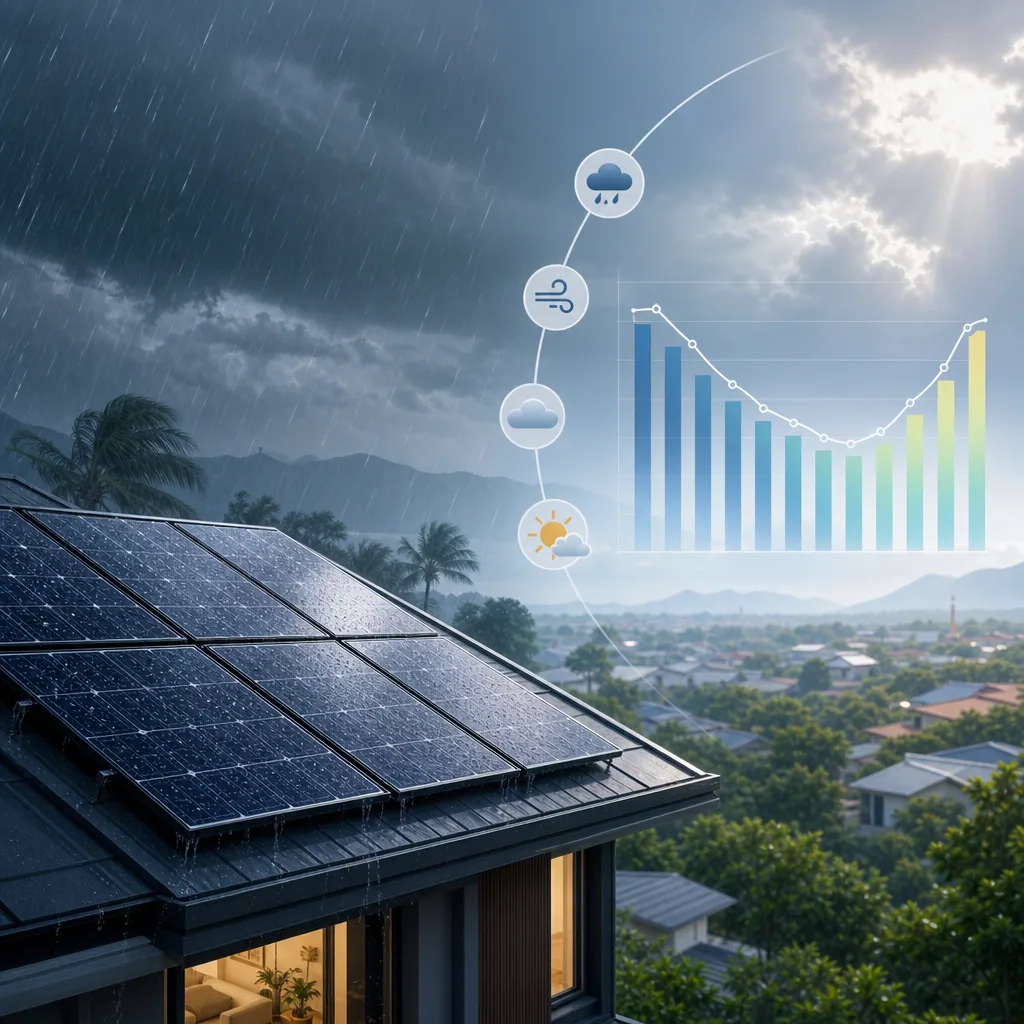
Metro Manila flooded this week and solar owners are watching their output drop. Here's what habagat actually costs you month by month, why a cloudy day still produces, and how to tell normal seasonal decline from an actual fault.
Quick Answer
August produces roughly 64% of what April produces — not zero, and not half. For a 6 kWp system that is around 518 kWh in August against 806 kWh in April.
Across the whole wet season, June to October averages about 80% of the dry-season months. Solar in the Philippines is a seasonal asset, not a fair-weather one.
Cloudy is not dark. Panels generate from daylight, not direct sun. A heavily overcast habagat day still produces around 45% of a clear dry-season day. Only extreme storm cloud drops output to the 10–20% range, and that lasts hours, not weeks.
Net metering is what smooths it. Credits banked in March, April and May are drawn down through August and September. A properly sized system is designed around the year, not around one month.
Sizing for August is usually a mistake. It takes 25% more capacity, and that extra array spends the dry season exporting surplus at the lower generation-only rate.
Why this is on your mind right now
Metro Manila flooded on 17 August. PAGASA has forecast 100 to 200 millimetres of rain across Benguet, La Union, Pangasinan, Zambales and Bataan, warned that flash floods and landslides may occur during extreme rainfall events, and expects habagat rains to continue until the end of August.
There is a wrinkle worth knowing. The weather bureau has said the extreme rainfall now being experienced is consistent with an El Niño rainfall pattern — and it warned back in April that El Niño could make the habagat more active this year, producing above-normal rainfall in parts of the country. Most people associate El Niño with drought. In the Philippines its effect on the southwest monsoon can run the other way.
So if you own solar, this is the fortnight when the app shows numbers you have not seen since last September, and you start wondering whether something is wrong.
Usually nothing is. Here is what normal looks like.
What your system actually produces, month by month
Modelled for a 6 kWp system, using typical Philippine peak sun hours and 80% system efficiency after inverter losses, heat derating, wiring and soiling.
| Month | Peak sun hours | kWh/day | kWh/month |
|---|---|---|---|
| January | 4.6 | 22.1 | 662 |
| February | 5.0 | 24.0 | 720 |
| March | 5.4 | 25.9 | 778 |
| April | 5.6 | 26.9 | 806 |
| May | 5.4 | 25.9 | 778 |
| June | 4.2 | 20.2 | 605 |
| July | 3.8 | 18.2 | 547 |
| August | 3.6 | 17.3 | 518 |
| September | 3.9 | 18.7 | 562 |
| October | 4.2 | 20.2 | 605 |
| November | 4.3 | 20.6 | 619 |
| December | 4.3 | 20.6 | 619 |
| Annual | 4.52 | 21.7 | ≈7,900 kWh/yr |
August is 64% of April. In money, at Meralco's August 2026 rate of ₱14.7833 per kWh, that is roughly ₱7,664 of generation this month against ₱11,921 in April — a difference of about ₱4,258.
That is a real cost, and it is also entirely normal. It was in the model when the system was designed.
Cloudy is not the same as dark
The most common misunderstanding about solar is that panels need direct sunlight. They do not — they generate from daylight, including the diffuse light that reaches the ground through cloud.
| Condition | Peak sun hours | 6 kWp output | Share of a clear day |
|---|---|---|---|
| Clear dry-season day | 5.5 | 26.4 kWh | 100% |
| Good dry-season day | 5.0 | 24.0 kWh | 91% |
| Annual average day | 4.5 | 21.6 kWh | 82% |
| Typical habagat day | 3.75 | 18.0 kWh | 68% |
| Overcast habagat day | 2.5 | 12.0 kWh | 45% |
| Heavy rain, thick cloud | 1.2 | 5.8 kWh | 22% |
| Extreme storm cloud, all day | 0.6 | 2.9 kWh | 11% |
Even a properly overcast day delivers around 45% of a clear-sky day. The 10–20% figures only happen under the heaviest storm cloud, and they last hours rather than weeks.
There is also a small compensation people miss: panels perform better when they are cooler. Solar modules lose output as cell temperature rises, and a rooftop array in April can run 30 to 40°C above its rating. A cool, wet day recovers a little of what the cloud takes away. It does not offset the loss, but it is part of why wet-season output holds up better than the sky suggests.
Rain is good for your panels
Genuinely. Soiling — dust, salt, organic deposits, and in some locations bird droppings and industrial fallout — accumulates through the dry months and reduces output continuously and invisibly.
Habagat washes it off. Systems often show a small efficiency improvement in the weeks after heavy rain begins, because the array is clean for the first time since December.
The practical implication: if you clean your array on a schedule, the sensible time is at the end of the wet season, not the start. Rain does the dry-season job for you.
How net metering smooths the year
This is the mechanism that makes seasonal variation manageable rather than painful.
Under net metering, surplus generation is exported for credit against your bill. In March, April and May, a well-sized system produces more than the household consumes during the day and banks credit. In August and September, when production drops and you import more, that credit is drawn down.
The system is designed around the year, not the month. A 6 kWp system averaging 21.7 kWh a day across twelve months is doing exactly what it was specified to do, even in the fortnight it manages 17.
Worth knowing: export credits are based on the generation component rather than your full retail rate, so a kilowatt-hour used on site is always worth more than one exported. That is why sizing to your daytime consumption, rather than to your peak-month production, gives the better return.
Should you oversize for the wet season?
Almost always no, and here is the arithmetic.
Say you want 21.6 kWh a day — the annual average for a 6 kWp system.
| Sized for | Capacity needed |
|---|---|
| The annual average | 6.0 kWp |
| August specifically | 7.5 kWp |
That is 25% more array to hold output flat through the worst month. And in April, that larger system overshoots by roughly 360 kWh a month — surplus exported at the lower generation-only rate rather than consumed at full retail value.
You would be paying 25% more capital to convert your best months into low-value exports, in order to avoid a shortfall in two months of the year that net metering credits already partly cover.
The exception: if your operation genuinely cannot tolerate reduced output in August — cold storage, certain agricultural operations, anything where a shortfall costs more than the electricity — then oversizing or adding storage is a legitimate design decision. For a household, it rarely is.
How to tell a wet season from a fault
The honest problem with August is that it hides real faults. Output is down anyway, so a failed string or a dirty array looks like weather.
Check these before assuming it is the season:
Compare against your model, not your memory. A proper proposal includes an expected monthly production profile. If yours does not, that is worth knowing about your installer. Compare this month against what August was supposed to produce, not against April.
Check the inverter status. A steady green indicator generally means normal operation. Red or flashing amber indicates a fault, and the pattern maps to a code in the manual.
Look at string-level data if your monitoring provides it. If one string is reading materially below the others under the same sky, that is not weather — that is a fault, and it will still be there in November.
Compare a clear day to a clear day. Habagat has bright intervals. If you get a genuinely sunny August afternoon and output is still well below what a sunny day produced in May, something has changed.
Rule out the obvious. A tripped breaker, a communications dropout after changing internet provider, or new shading from a neighbour's construction all present as unexplained low output.
Habagat is not a typhoon
Worth separating, because people conflate them.
Habagat is the southwest monsoon — a seasonal wind pattern bringing sustained rain over weeks. Its effect on solar is reduced output. It does not damage a properly installed array.
Tropical cyclones are a different risk. PAGASA is currently tracking three tropical depressions, one inside the Philippine Area of Responsibility. The engineering concern there is wind uplift on the mounting system, not rainfall — and the mounting and roof attachment, rather than the panels themselves, are usually what fails first.
That is a separate subject and deserves its own treatment. The short version: ask any installer what design wind speed the mounting system is engineered to, and how it attaches to your specific roof structure. A well-rated panel on an under-specified rail system is not a typhoon-resistant installation.
Frequently asked questions
Do solar panels work when it is raining?
Yes, at reduced output. Panels generate from daylight rather than direct sunlight, so production continues under cloud. A typical habagat day produces roughly 68% of a clear dry-season day, and a heavily overcast day around 45%. Only extreme storm cloud drops output to the 10 to 20% range.
How much does solar output drop during the rainy season in the Philippines?
For a 6 kWp system, August produces approximately 518 kWh against 806 kWh in April — about 64%. Across the whole wet season from June to October, output averages roughly 80% of the dry-season months.
Is my solar system broken if output drops in August?
Probably not, but check rather than assume. Compare against the expected monthly production profile from your proposal rather than against April, check the inverter status indicator, and look for one string reading materially below the others. Reduced output in August is normal; one string underperforming on a clear day is not.
Should I buy a bigger solar system because of the rainy season?
Usually not. Holding output flat through August requires about 25% more capacity, and that extra array spends the dry season exporting surplus at the lower generation-only credit rate. Net metering credits banked in the dry months already offset part of the wet-season shortfall. Oversizing makes sense only where reduced output carries a cost beyond the electricity itself.
Does rain damage solar panels?
No. Panels are sealed and tested to withstand rain, hail and humidity. Rain is beneficial, washing off dust and deposits that accumulate through the dry months, and systems often show a small efficiency gain once heavy rain begins. Typhoon wind is a genuine risk, but that is a question about the mounting system rather than the panels.
Does solar still save money in the wet season?
Yes. Even at August levels, a 6 kWp system generates roughly ₱7,664 of electricity value a month at current Meralco rates. The saving is smaller than in April, not absent.
Assumptions
| Item | Value |
|---|---|
| System modelled | 6 kWp |
| System efficiency | 0.80 — inverter, thermal derating, wiring, soiling |
| Peak sun hours | Typical Philippine monthly values, 4.52 annual average |
| Electricity rate | ₱14.7833/kWh — Meralco, August 2026 |
| Weather conditions | PAGASA advisories, August 2026 |
Peak sun hours vary by location. Coastal and southern sites generally see better wet-season performance than sites in the Cordillera or the western Luzon lowlands. Your own monitoring data, once you have a full year of it, beats any table.
Related Articles

Technology & Storage
How Many Solar Panels Do I Need? A Philippine Sizing Guide (2026)
September 4, 2026

Technology & Storage
Your Solar Bill Didn't Drop as Much as You Expected. Here's Why.
August 22, 2026
Technology & Storage
What Can You Actually Run on a 6kW Solar System? A Philippine Breakdown (2026)
August 15, 2026