
Technology & Storage
What Can You Actually Run on a 6kW Solar System? A Philippine Breakdown (2026)
August 15, 2026 · SolarSwitch · 11 min read
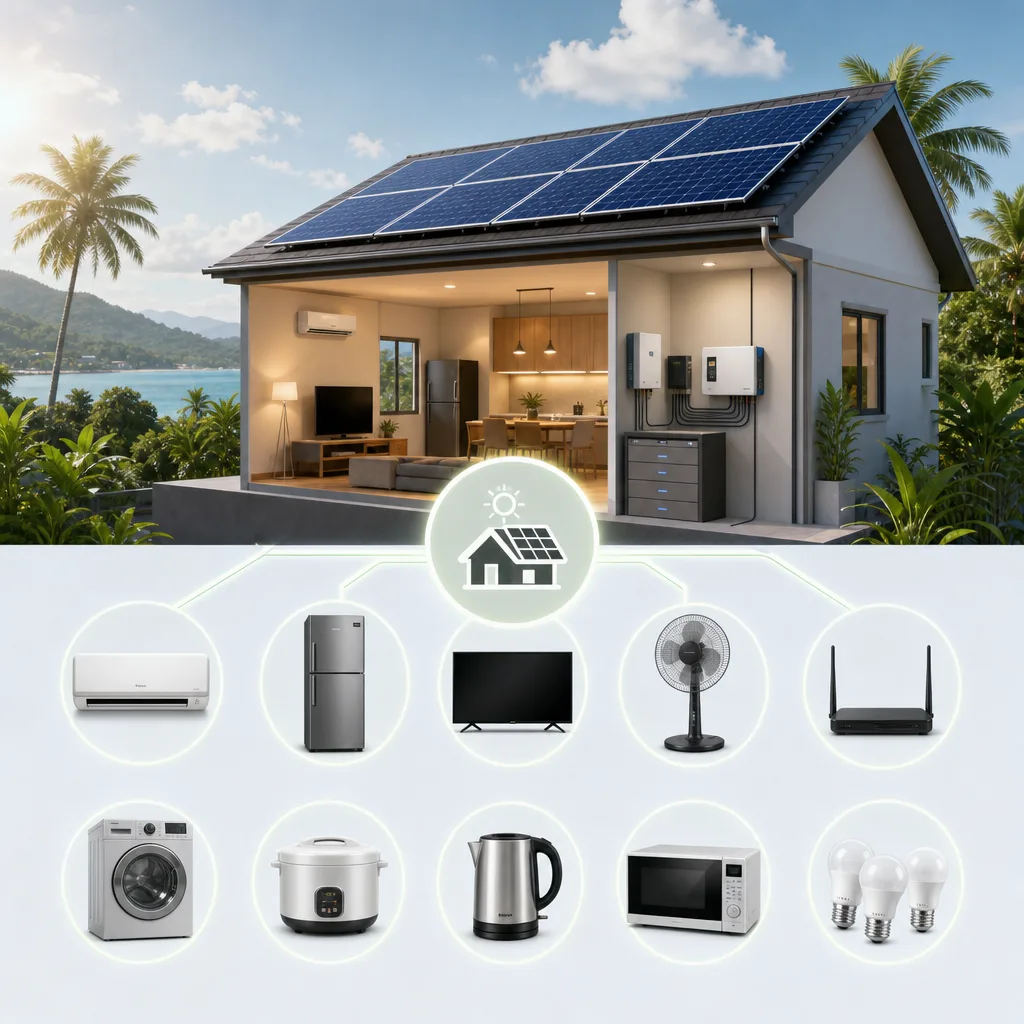
A 6kW solar system produces roughly 21.6 kWh a day in Philippine conditions. Here's exactly what that powers, how many appliances can run at once, and the three appliances that will swallow the entire system on their own.
Quick Answer
A 6kW system in the Philippines produces roughly 21.6 kWh per day — around 650 kWh a month — assuming 4.5 peak sun hours and typical system losses. That's enough to cover most of a well-equipped Filipino home. But "6kW" answers two different questions, and people mix them up. It describes how much power the system can deliver at one instant (about 5 kW of usable AC output, and only around midday) and separately how much energy it makes over a day (21.6 kWh). Running one aircon for eight hours and running eight aircons for one hour are very different problems. Running simultaneously at midday, 6kW comfortably handles two 1.5 HP inverter aircons, a refrigerator, full house lighting, fans, TV, WiFi and two laptops — with roughly half the system still spare. Three appliances will eat it alive: an instant electric water heater (3,500–5,500 W), an induction cooker (1,800–2,000 W), and non-inverter aircon. One shower heater alone can consume most of a 6kW system's entire output. Without a battery, none of this applies after sunset. A 6kW grid-tied system powers your daytime loads and exports the surplus. Your evening aircon still comes from Meralco.
First: 6kW is not "6,000 watts of appliances"
This is the single most common misunderstanding, and getting it straight makes everything else obvious.
Kilowatts (kW) measure power — the rate of flow. It's how much your system can deliver at any given moment.
Kilowatt-hours (kWh) measure energy — the total volume. It's power multiplied by time.
A 6kW system has two separate limits, and either one can be the binding constraint:
| Constraint | The limit | What it stops you doing |
|---|---|---|
| Instantaneous power | ~5 kW usable AC output, near midday | Running too many things at the same time |
| Daily energy | ~21.6 kWh per day | Running things for too many hours |
A house running 5 kW of load for one hour uses 5 kWh. A house running 1 kW for twenty hours uses 20 kWh — four times the energy from a fifth of the power.
Both matter. The rest of this guide handles them separately.
What a 6kW system actually produces in the Philippines
Start with the arithmetic:
6 kWp × 4.5 peak sun hours × 0.80 system efficiency ≈ 21.6 kWh per day
That 0.80 accounts for inverter conversion losses, high-temperature derating (significant on a Philippine roof), wiring losses, and soiling. Anyone quoting you production without a loss factor is quoting a laboratory number.
Seasonally, expect roughly:
| Period | Peak sun hours | Daily output | Monthly |
|---|---|---|---|
| ☀️ Dry season (Mar–May) | ~5.0–5.5 | 24–26 kWh | 720–790 kWh |
| 🌤️ Transition months | ~4.5 | ~21.6 kWh | ~650 kWh |
| 🌧️ Habagat (Jun–Oct) | ~3.5–4.0 | 17–19 kWh | 510–580 kWh |
| Annual average | ~4.5 | ~21.6 kWh | ~650 kWh |
A critical detail about shape. That 21.6 kWh does not arrive evenly. Production follows a bell curve — near zero at 6 a.m., peaking around noon, back to zero by 6 p.m. At 8 a.m. a 6kW array might be making 1.5 kW. At noon, close to 5 kW. At 4 p.m., under 2 kW again.
So "what can I run on 6kW" has a different answer at 8 a.m. than at 12 p.m. The tables below use the midday peak, which is the best case.
How many appliances can run at the same time?
Here's what a typical Filipino household draws. These are steady-state figures for inverter-type units where relevant.
| Appliance | Typical draw |
|---|---|
| 💡 LED lighting, whole house (10–12 fixtures) | 110 W |
| 📶 WiFi router | 10 W |
| 💻 Laptop | 50 W |
| 🌀 Electric fan | 60 W |
| 📺 LED TV (43") | 80 W |
| 🧊 Refrigerator, inverter (8–10 cu ft) | 150 W average |
| 🥶 Chest freezer | 200 W average |
| 🧺 Washing machine | 500 W |
| 🍚 Rice cooker (cooking) | 700 W |
| 💧 Water pump, 0.5 HP | 400 W (surges much higher) |
| ☕ Coffee maker | 900 W |
| ♨️ Microwave | 1,100 W |
| 👔 Electric iron | 1,200 W |
| 🍟 Air fryer | 1,400 W |
| 🫖 Electric kettle | 1,500 W |
| ❄️ 1.0 HP inverter aircon | 600 W |
| ❄️ 1.5 HP inverter aircon | 850 W |
| ❄️ 2.0 HP inverter aircon | 1,150 W |
| ❄️ 1.5 HP non-inverter aircon | 1,300 W |
| 🍳 Induction cooker | 1,800–2,000 W |
| 🚿 Instant electric water heater | 3,500–5,500 W |
A realistic midday load
Here's a household running a lot of things at once, at noon:
| Running simultaneously | Draw |
|---|---|
| ❄️ 2 × 1.5 HP inverter aircon | 1,700 W |
| 🧊 Refrigerator | 150 W |
| 💡 Whole-house lighting | 110 W |
| 🌀 3 × electric fan | 180 W |
| 📺 LED TV | 80 W |
| 📶 WiFi + 2 laptops | 110 W |
| Subtotal | 2,330 W |
| 🍳 Add induction cooker | +1,900 W |
| Total with cooking | 4,230 W |
Against roughly 5 kW of usable midday output, that fits — with the whole house cooling, cooking, and running electronics simultaneously.
Now add one instant water heater at 4,500 W and the total hits 8,730 W. The system can't cover it. The shortfall simply draws from Meralco, so nothing breaks — but you're buying power at full rate during the hours your solar should be saving you money.
What can it run over a whole day?
The energy question. Here's a household budget against the 21.6 kWh daily production:
| Load | Draw | Hours | Energy |
|---|---|---|---|
| 🧊 Refrigerator | 150 W | 24 | 3.60 kWh |
| 📶 WiFi router | 10 W | 24 | 0.24 kWh |
| 💡 Lighting | 110 W | 6 | 0.66 kWh |
| 🌀 3 × electric fan | 180 W | 8 | 1.44 kWh |
| 📺 LED TV | 80 W | 5 | 0.40 kWh |
| 💻 2 × laptop | 100 W | 8 | 0.80 kWh |
| 🍚 Rice cooker | 700 W | 1 | 0.70 kWh |
| 🧺 Washing machine | 500 W | 1 | 0.50 kWh |
| 💧 Water pump | 400 W | 1 | 0.40 kWh |
| 👔 Electric iron | 1,200 W | 0.5 | 0.60 kWh |
| ♨️ Microwave | 1,100 W | 0.3 | 0.33 kWh |
| Everything except aircon | 9.67 kWh | ||
| ❄️ 2 × 1.5 HP inverter aircon | 1,700 W | 8 | 13.60 kWh |
| Total | 23.27 kWh |
Look at what that shows.
Everything in a normal household except air conditioning comes to under 10 kWh a day — less than half a 6kW system's output. Fridge, lights, fans, TV, laptops, cooking, laundry, ironing, water pump: all of it, together, uses under 45% of the system.
Two aircons for eight hours adds 13.6 kWh — more than everything else combined.
That's the whole story of residential solar sizing in the Philippines in two lines. Your appliances are cheap to run. Your aircon isn't.
The three appliances that break the budget
🚿 1. Instant electric water heaters
The worst offender by a distance. A shower-type instant heater draws 3,500–5,500 W. Even at fifteen minutes a day per person, a family of four is looking at 3.5–5.5 kWh — around a quarter of your entire system output, for hot showers.
Worse, it's usually used at 6 a.m. and 7 p.m., when solar production is near zero. So you pay full Meralco rate for nearly all of it.
If you have one and you're going solar, a solar water heater or a heat pump water heater is often a better investment than adding panels to feed an electric one.
🍳 2. Induction cookers
1,800–2,000 W is not catastrophic in isolation, but cooking happens at breakfast and dinner — the two windows when your panels produce least. An induction cooker used at midday is nearly free; the same cooker at 7 p.m. is grid power at full rate.
❄️ 3. Non-inverter aircon
A 1.5 HP non-inverter unit draws around 1,300 W against 850 W for the inverter equivalent — roughly 50% more for the same cooling. Over eight hours that's 3.6 kWh versus 6.8 kWh per unit.
Two non-inverter units for eight hours is 20.8 kWh, which is almost your entire daily production for aircon alone. Switching to inverter units frees up roughly 7 kWh a day, which is the same as adding about 2 kWp of panels — at a fraction of the cost. See our guide on running aircon on solar for the full comparison.
What happens at night?
Without a battery: nothing. Your panels produce zero after sunset, and every appliance running in the evening draws from the grid at full rate.
This matters because Filipino households are evening-heavy. Aircon for sleeping, cooking dinner, TV, hot showers — the bulk of household activity happens when solar can't help.
A 6kW grid-tied system still saves you real money by covering daytime loads and exporting surplus. But if your goal is running aircon overnight on solar, you need storage.
Roughly what storage buys you:
| Overnight load | Usable battery needed |
|---|---|
| Lights, fans, fridge, WiFi (6 hrs) | ~5 kWh |
| Above + 1 × 1.5 HP inverter aircon (8 hrs) | ~12 kWh |
| Above + 2 × 1.5 HP inverter aircon (8 hrs) | ~20 kWh |
A 6kW array can comfortably recharge 10–15 kWh of storage alongside daytime loads on a good day. In habagat months, less.
Storage also means the system keeps running during a brownout — a grid-tied system without a battery shuts down when the grid does, which surprises most first-time buyers. Our brownout guide explains why.
What Meralco bill does a 6kW system suit?
If a 6kW system produces ~650 kWh a month and you consumed all of it yourself, at Meralco's rate that's meaningful money.
But self-consumption is the variable that decides everything. A kilowatt-hour you use on site displaces your full blended rate. A kilowatt-hour you export earns you the generation component only — considerably less. See our guide on reading your Meralco bill for why that gap exists.
So:
| Your situation | Is 6kW a good fit? |
|---|---|
| Someone home during the day, daytime aircon, consumption 600–800 kWh/month | Excellent — high self-consumption, strong return |
| Home empty 9–6, evening-heavy usage, 600 kWh/month | Oversized without a battery — much of it exports at low credit |
| Consumption under 400 kWh/month | Oversized — a smaller system returns more per peso |
| Consumption over 1,000 kWh/month | Undersized — you'll still have a substantial bill |
The instinct to buy the biggest system you can afford is usually wrong. A system sized close to your daytime consumption, almost entirely self-consumed, typically outperforms a larger one exporting a big surplus.
How to work out your own number
Three steps, using your own bill.
1. Get your actual monthly consumption. Twelve months if possible — Philippine consumption swings hard between April and December.
2. Estimate your daytime share. Roughly what proportion of your usage happens between 8 a.m. and 4 p.m.? A household with someone home all day might be 50–60%. A household empty on weekdays might be 25%.
3. Size to the daytime portion first. If you use 700 kWh a month and 45% of it is daytime, that's about 315 kWh you can offset directly — around 10.5 kWh a day, which a 3kW array would cover. Going bigger only pays if you'll either shift load into daylight hours or add storage.
That last point is worth sitting with. Shifting laundry, ironing, water pumping and dishwashing into daylight hours is free and can meaningfully improve the return on any system size.
Frequently asked questions
How much electricity does a 6kW solar system produce per day in the Philippines?
Approximately 21.6 kWh per day on an annual average, based on 4.5 peak sun hours and around 80% system efficiency after inverter, temperature, wiring and soiling losses. Expect 24–26 kWh daily during the dry season and 17–19 kWh during the habagat months.
How many aircons can a 6kW solar system run?
At midday, a 6kW system can run three to four 1.5 HP inverter aircon units simultaneously alongside normal household loads. Over a full day the limit is energy rather than power: two 1.5 HP inverter units running eight hours each consume 13.6 kWh, which is about 63% of the system's daily output.
Can a 6kW solar system run a whole house?
It can run a typical Filipino household's non-cooling loads several times over — refrigerator, lighting, fans, TV, laptops, cooking, laundry and water pump together come to under 10 kWh a day. Whether it covers the whole house depends almost entirely on air conditioning use and how much of your consumption falls during daylight hours.
Can I run an electric water heater on a 6kW solar system?
Technically yes at midday, but it is rarely sensible. An instant shower-type heater draws 3,500 to 5,500 W and is typically used early morning and evening when solar production is near zero, meaning almost all of it comes from the grid at full rate. A solar or heat pump water heater is usually a better investment than adding panels to feed an electric one.
Does a 6kW solar system work at night?
Not without battery storage. Solar produces nothing after sunset, so evening loads draw from the grid. Adding roughly 12 kWh of usable storage would cover overnight lights, fans, refrigerator and one 1.5 HP inverter aircon for about eight hours.
What Meralco bill size suits a 6kW solar system?
Broadly, households consuming around 600 to 800 kWh per month with a substantial daytime load. If most of your consumption is in the evening, a 6kW system will export a large share at the lower generation-only credit rate, and a smaller system or the addition of storage will usually deliver a better return.
How many solar panels is 6kW?
With modern modules in the 550 to 600 W range, roughly 10 to 11 panels. Older or smaller panels need more. Plan on approximately 36 to 42 square metres of usable roof area, before allowing for walkways, obstructions and edge setbacks.
The bottom line
A 6kW system is a substantial residential installation. It will cover everything in a typical Filipino home except air conditioning several times over, and it will handle a good amount of aircon on top of that — during the day.
The two questions worth asking before you commit are when do you actually use power, and which of your appliances are the expensive ones. For most Philippine households the honest answers are "mostly in the evening" and "the aircon and the water heater" — and those two answers, not the panel count, are what should drive the design.
Send SolarSwitch twelve months of Meralco bills and tell us roughly when your household is home. We'll model what a 6kW system would actually offset for you, and tell you if a different size fits better.
Sources
- Typical appliance power ratings for units sold in the Philippine market
- Meralco appliance energy consumption reference data
- Philippine irradiance and peak sun hour data
- SolarSwitch installation and sizing practice
Related Articles

Technology & Storage
How Many Solar Panels Do I Need? A Philippine Sizing Guide (2026)
September 4, 2026

Technology & Storage
Your Solar Bill Didn't Drop as Much as You Expected. Here's Why.
August 22, 2026
Technology & Storage
Solar in the Rainy Season: What Habagat Actually Does to Your Output (2026)
August 19, 2026