Buyer Guides
Solar Red Flags in the Philippines: 11 Warning Signs Before You Sign (2026)
August 12, 2026 · SolarSwitch · 14 min read
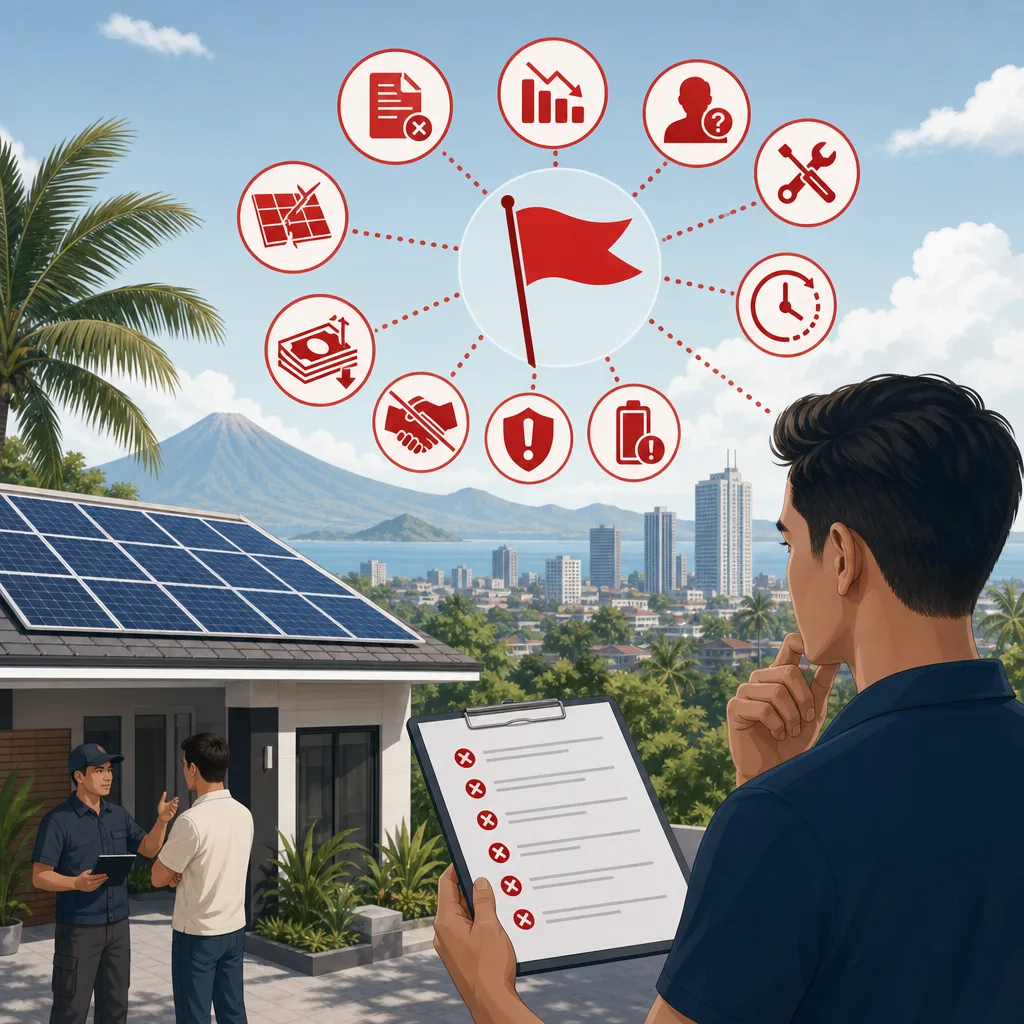
Most solar scam advice online is written for American buyers and doesn't transfer — there's no NABCEP here, no BBB, no federal tax credit to defraud. These are the warning signs that actually matter in the Philippine market, and what to do if you've already signed.
Quick Answer
Most solar warning-sign advice online was written for American buyers and doesn't transfer. There's no NABCEP certification here, no Better Business Bureau, and no federal tax credit for anyone to defraud. The Philippine market has its own failure modes. The credentials that matter locally are specific and checkable: a PCAB licence, DOE accreditation, and a named PRC-licensed Professional Electrical Engineer or Registered Master Electrician who will sign your electrical plans and Certificate of Compliance. An installer who won't name theirs is telling you something. Payment structure is the single strongest predictor of trouble. A reasonable schedule is roughly 30–50% down, 40–50% on substantial completion, and a final 10–20% held back until your net metering approval comes through. Anyone asking for full payment upfront has removed your only leverage. Without proper sign-off, your system may work but your paperwork won't. Distribution utilities reject net metering applications missing a valid Certificate of Compliance, LGU inspection can fail, and home insurance can deny claims tied to unpermitted electrical work. The industry is mostly legitimate. Solar adoption is growing fast in the Philippines, and rapid growth attracts a minority of operators who cut corners. This guide is about spotting that minority, not avoiding solar.
A note on what this guide is and isn't
SolarSwitch installs solar. We compete for the same customers as everyone else in this market, which means we have an obvious interest in you distrusting certain kinds of competitors.
So here's the discipline we've applied: every warning sign below is something you can verify independently, without taking our word for it. Where a red flag is a matter of judgement rather than fact, we've said so. And we've included the recourse options at the end even though a company like ours would rather you never need them.
If a point here doesn't hold up when you check it, ignore it.
Why the American advice doesn't work here
Search "solar scams" and you'll get the FTC, the Better Business Bureau, and a stack of US consumer sites. The advice is structurally sensible — don't be rushed, get multiple quotes, read the contract — but the specifics are useless in Manila.
American guides tell you to check NABCEP certification. That body doesn't operate here. They tell you to search the BBB scam tracker. There isn't one. Much of the American fraud discussion centres on federal tax credit misrepresentation and third-party lease agreements, neither of which is how the Philippine market works.
Meanwhile, there's a Philippine-specific problem American guides never mention: you often can't rely on reviews. Even relatively prominent local installers have review counts in the single digits. The verification method most buyers instinctively reach for barely exists here.
That's why this guide is built around credentials and contract structure rather than reputation signals.
The 11 red flags
1. They won't name their PCAB licence
The Philippine Contractors Accreditation Board, under the Construction Industry Authority of the Philippines, licenses contractors to legally perform construction and electrical work — and solar installation is construction work. This isn't a nice-to-have credential. An unlicensed contractor cannot legally pull building permits or pass government inspections.
What to do: ask for the licence number and the category. A legitimate contractor produces it without hesitation.
The nuance: very small installers doing purely off-grid work sometimes operate differently. For any grid-tied installation involving permits and a utility interconnection, treat the absence of a PCAB licence as disqualifying.
2. They can't name the engineer who'll sign your plans
Philippine law requires a PRC-licensed Professional Electrical Engineer to sign solar installation electrical plans and permit documents. Without that signature, LGU permits cannot be filed and your Meralco application cannot proceed.
What to do: ask for the engineer's name and PRC registration number. Then verify it. A company that has to "check who's available" hasn't thought about your permits.
3. They want full payment upfront
This is the highest-signal red flag in the entire list, because it's the one that determines what happens when things go wrong.
A reasonable payment schedule looks roughly like this:
| Stage | Share |
|---|---|
| Downpayment on signing | 30–50% |
| Substantial completion of installation | 40–50% |
| After net metering approval received | 10–20% |
That final retention is the important part. It aligns the installer's incentive with actually getting your paperwork through the distribution utility — which is the step most likely to be abandoned once they've been paid.
Anyone requesting 100% before work begins has removed your only leverage. There is no legitimate reason for it.
4. The quote has no model numbers
"Jinko 550W" is not a specification. You need the complete model designation for the panels, the inverter make and model, and ideally the mounting system.
Without model numbers you cannot look up the datasheet, cannot verify the warranty terms, and cannot tell whether what arrives matches what you bought.
What to do: ask for full model numbers in writing before signing, then check them against the manufacturer's own website. This takes ten minutes and it's the single most useful thing you can do.
5. "You'll have zero electric bill"
You won't, unless you disconnect from the grid entirely — which is a completely different system with different costs and trade-offs.
On any grid-connected system, fixed monthly charges apply regardless of consumption. Meralco bills a fixed supply charge and a fixed metering charge every month no matter how little you draw. Most households also still import power at night.
Substantial bill reduction is realistic. Elimination is a sales line. If someone promises it, everything else they've told you deserves re-examination.
6. One quote is dramatically cheaper than the rest
Solar hardware is a globally traded commodity with fairly transparent pricing. When one quote comes in far below the others, the money came out of somewhere — and the usual candidates are:
- Lower-grade or unbranded panels
- An undersized or lower-quality inverter
- Cheaper mounting hardware, which is exactly the wrong economy in a typhoon zone
- Thinner cabling or omitted protection devices
- Permits and DU application excluded from scope
- No structural assessment
- Labour rates that suggest an inexperienced crew
What to do: don't reject a cheap quote automatically. Ask what's different about it, item by item, against a more expensive one. A good installer can explain their pricing. If the answer is vague, you've learned what you needed to.
7. Pressure to sign immediately
"This price is only good until Friday." "We have one slot left this month." "The incentive is ending."
Sometimes there's a legitimate reason to move — a genuine equipment price change, a real scheduling constraint. But urgency manufactured to prevent you from comparing quotes is one of the most consistent markers of a bad actor in every market where this has been studied.
A solar system is a twenty-five-year purchase. Anyone unwilling to give you a week to think has priorities that aren't yours.
8. A two-page contract
The contract should specify, at minimum: complete equipment list with model numbers, system capacity in kWp, scope of electrical and structural work, who handles permits and the DU application, payment schedule tied to milestones, timeline with defined completion, warranty terms split between product, performance, and workmanship, and what happens if the system underperforms or the net metering application is rejected.
If it fits on two pages, things you'll care about later have been left out.
9. Vague answers about net metering
Ask directly: who files the application, what's included in the price, what's the expected timeline, and what happens if it's rejected?
Net metering applications get rejected for real reasons — missing Certificate of Compliance, non-compliant equipment, documentation gaps. An installer who's done this repeatedly will answer specifically. One who hasn't will speak in generalities.
Worth asking: "Can you give me a reference from a customer whose net metering was approved?" That's a much harder claim to fake than a testimonial.
10. Warranty terms that blur together
Every quote advertises "25-year warranty." There are actually three separate things:
- Product warranty — manufacturing defects, typically 10–12 years
- Performance warranty — guaranteed output, typically 25–30 years
- Workmanship warranty — the installer's own work, and it dies with the installer
An installer who can't cleanly separate these either doesn't understand them or is relying on you not to. Ask for all three terms in writing, and ask specifically whether warranty claims cover the labour to remove and replace a failed panel — many don't.
11. No handover package
At completion you should receive: as-built drawings, the Certificate of Compliance signed by the PEE or RME, equipment serial numbers, warranty certificates, monitoring system credentials, and the approved net metering documentation.
Serial numbers and warranty certificates are what you'll need if you ever have to claim directly with a manufacturer — which becomes your only route if your installer is no longer trading. An installer who doesn't provide them has left you dependent on their continued existence.
The equipment question: a live regulatory story
Worth knowing about, because it's being debated right now and it affects how you read equipment claims.
In May 2026, the Department of Trade and Industry, through its Bureau of Philippine Standards, proposed mandatory certification for solar equipment sold in the Philippines. The draft order would cover PV modules, battery energy storage systems, inverters, charge controllers, and cables, applying to both locally manufactured and imported products. The DTI framed it as protecting consumers from substandard imports, warning against the Philippines becoming a destination for equipment rejected in other markets. Manufacturers would get one year to comply, with violations exposing firms to show-cause orders, cease and desist orders, and possible product recalls.
Not everyone agrees it's necessary. A Manila Times editorial pushed back, noting there have not been widespread reports of accidents or damage caused by solar installations, and that the vast majority of solar components available in the Philippines are already certified by Underwriters Laboratories, TÜV Rheinland, or IEC-accredited laboratories under ISO/IEC 17025.
Both positions have merit. The practical takeaway for a buyer sits in the middle: mainstream equipment from established manufacturers is generally already independently certified, and you can verify that on the datasheet. The risk concentrates in unbranded or unverifiable products — which is precisely why red flag #4 matters.
Note also that the DTI proposal explicitly does not extend to installation or mounting services. Whatever happens with equipment certification, installation quality remains entirely a matter of who you hire.
What good looks like
Red flags are easier to interpret against a baseline. A well-run Philippine solar company will typically:
- Produce PCAB licence and DOE accreditation details on request, without being pushed
- Name the PRC-licensed engineer who will sign the plans
- Conduct a site visit before quoting — not quote from a satellite image and a bill photo
- Ask for twelve months of consumption history, not one bill
- Provide full equipment model numbers in the proposal
- Present a payment schedule tied to milestones, with retention until net metering approval
- Give you a written scope covering permits, DU application, and structural work
- Separate product, performance, and workmanship warranties explicitly
- Offer references, including customers whose net metering was approved
- Give you time to compare
None of that guarantees a good outcome. But an installer doing all ten has systems in place, and systems are what survive the twenty-five years your panels are supposed to last.
If it's already gone wrong
This does happen. Community reports circulate of homeowners who chose the cheapest quote, signed a thin contract, and ended up with an underperforming system or an installer who stopped answering the phone — in one documented case on r/SolarPH, a homeowner reported losing an estimated ₱280,000 after a contractor folded six months in.
If you're in that position, you have more options than you might think:
1. Go directly to the equipment manufacturer. Major panel and inverter brands maintain regional service centres or authorised service partners in the Philippines. Your serial numbers and warranty certificates are what unlock that support — which is why the handover package matters so much.
2. Engage a different DOE-accredited installer for operations and maintenance. A competent second installer can assess the system, identify what was done wrong, and take over the service relationship. This is common and not as expensive as people fear.
3. File a complaint with the relevant authority. The DOE's Renewable Energy Management Bureau handles issues within its remit. The PRC is the route if the problem involves the licensed engineer's work. The DTI's Consumer Protection Group handles consumer disputes, and the courts remain available for financial claims — though that route is slow.
4. Document everything now. Contract, receipts, correspondence, photographs of the installation, and the model numbers of what was actually installed versus what was quoted. Whatever route you take, the case rests on documentation.
Frequently asked questions
What are the biggest warning signs when choosing a solar installer in the Philippines?
The strongest signals are a demand for full payment upfront, refusal or inability to name a PCAB licence and a PRC-licensed engineer, quotes without complete equipment model numbers, and promises of a zero electricity bill on a grid-connected system. Any one of these justifies pausing; two or more justifies walking away.
How much should I pay upfront for solar installation in the Philippines?
A reasonable structure is roughly 30 to 50 percent as a downpayment, 40 to 50 percent on substantial completion, and a final 10 to 20 percent retained until your net metering application is approved. Holding back that final portion keeps the installer motivated to complete the utility paperwork, which is the step most commonly abandoned after payment.
Do solar installers in the Philippines need a licence?
Yes. Solar installation is construction work, and contractors performing it require a licence from the Philippine Contractors Accreditation Board. Separately, a PRC-licensed Professional Electrical Engineer or Registered Master Electrician must sign the electrical plans and the Certificate of Compliance, without which LGU permits cannot be filed and a distribution utility will not approve net metering.
Can solar really eliminate my electricity bill?
Not on a grid-connected system. Fixed monthly supply and metering charges apply regardless of consumption, and most households continue importing power at night. Substantial reduction is realistic; complete elimination requires disconnecting from the grid entirely, which is a different system with different economics.
Why is one solar quote so much cheaper than the others?
Because something was removed. Common candidates include lower-grade panels, a cheaper inverter, lighter mounting hardware, thinner cabling, omitted protection devices, or permits and the utility application being excluded from scope. A cheap quote isn't automatically a bad one, but the difference should be explainable item by item.
What should I do if my solar installer disappears?
Contact the equipment manufacturers directly using your serial numbers and warranty certificates, since product warranties survive the installer. Engage another DOE-accredited installer to assess the system and take over maintenance. For formal complaints, the DOE's Renewable Energy Management Bureau, the PRC where a licensed engineer's work is involved, and the DTI's Consumer Protection Group are the relevant channels.
Is solar equipment regulated in the Philippines?
Not yet through mandatory national certification, though that may change. In May 2026 the DTI proposed a rule requiring certification for solar modules, batteries, inverters, charge controllers, and cables. Most equipment from established manufacturers already carries independent certification from bodies such as UL, TÜV Rheinland, or IEC-accredited laboratories, which you can verify on the product datasheet.
The bottom line
The Philippine solar industry is largely made up of competent operators doing careful work. But it's growing quickly, the credentials are unfamiliar to most buyers, and reviews barely function as a signal — which creates room for a minority who cut corners.
The defence isn't suspicion. It's specificity. Ask for the licence number, the engineer's name, the model numbers, the payment schedule, and the three warranty terms. Five questions, all verifiable, all answerable in a single email by any company that has its house in order.
If you'd like a second opinion on a quote you've received from anyone — including a competitor — send it over. We'll tell you what's missing from it.
Sources
- Department of Trade and Industry, Bureau of Philippine Standards — proposed mandatory certification for solar energy systems, May 2026
- Manila Times — editorial response to the DTI certification proposal, 28 May 2026
- Philippine Contractors Accreditation Board / Construction Industry Authority of the Philippines — contractor licensing requirements
- Professional Regulation Commission — licensing of Professional Electrical Engineers and Registered Master Electricians
- Department of Energy — Renewable Energy Management Bureau
- Community reports from Philippine solar consumer forums
Related Articles

Buyer Guides
Solar for OFW Families: How to Buy a System You Can't Stand Next To
August 20, 2026
Buyer Guides
What If Your Solar Installer Goes Out of Business? A Philippine Owner's Guide (2026)
August 15, 2026
Buyer Guides
Solar Panel Brands in the Philippines: What's Actually Available (2026)
August 14, 2026