Technology & Storage
Solar and Brownouts in the Philippines: What Actually Keeps Your Lights On (2026)
August 11, 2026 · SolarSwitch · 16 min read
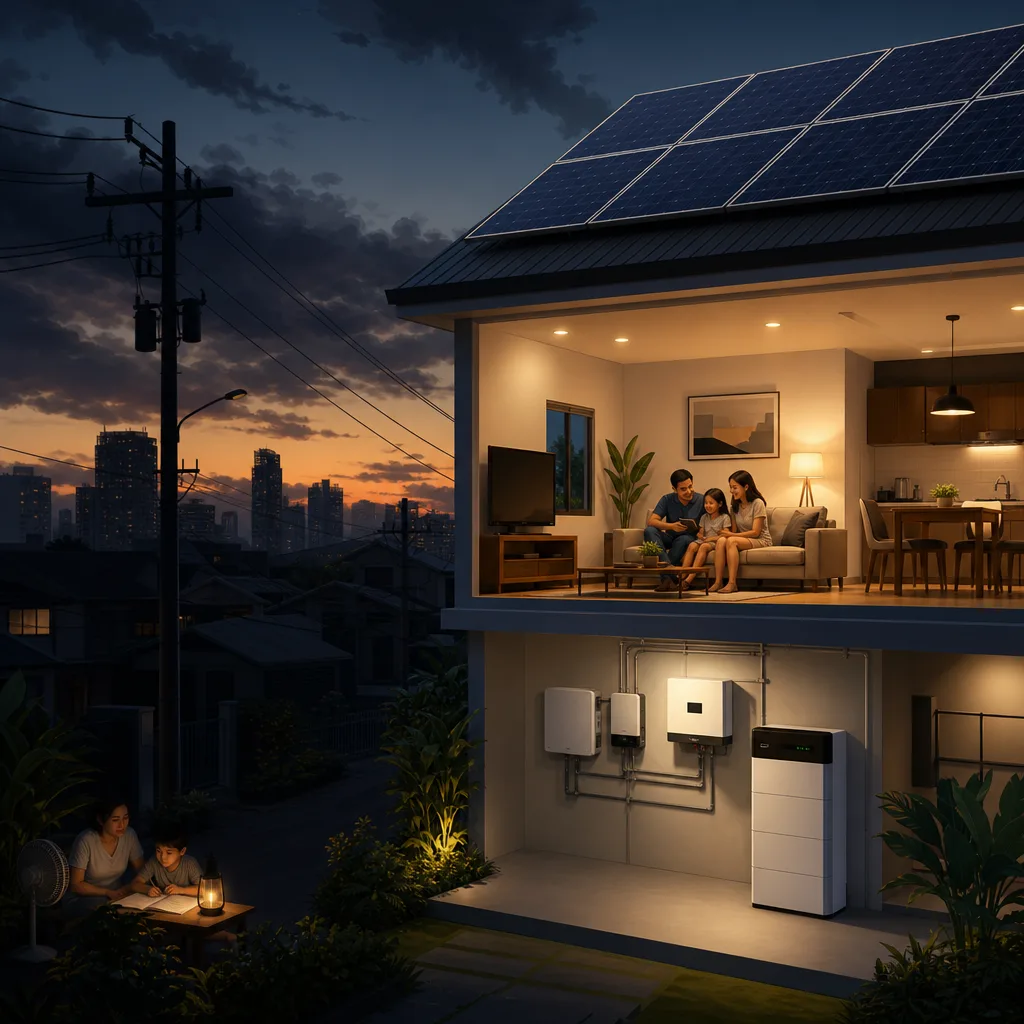
A standard grid-tied solar system shuts down the moment a brownout starts. Here's why, what actually keeps your lights on, and how to size a system for the realities of the 2026 Philippine grid.
Quick Answer
A standard grid-tied solar system will not power your home during a brownout. By law and by design, grid-tied inverters shut down the moment the utility supply disappears — a safety feature called anti-islanding that protects linemen working on the downed line. Your panels can be in full sun and your house will still be dark. Only three setups actually keep the lights on: a hybrid solar system with battery storage, an off-grid system, or solar paired with a conventional generator. Of these, a hybrid system is the usual answer for Filipino homes and businesses already connected to Meralco or an electric cooperative, because it delivers everyday bill savings and backup, and can still export excess under DOE net metering rules. How much backup you need depends on what you're protecting. A 5-kWh battery typically carries lights, fans, WiFi, and a refrigerator through a 4–6 hour rotational brownout. Running aircon or commercial refrigeration through the same window usually means 10–15 kWh or more. Brownouts also cost you money even when they don't reach your house. When the Luzon grid went on red alert for three straight days in May 2026, spot-market prices spiked — and Meralco's generation charge rose the following billing month. Grid stress shows up on your bill whether or not your power goes out.
Brownouts didn't go away — they came back
For a stretch, it looked like the rotational brownout was a 1990s memory. 2026 has been a reminder that it isn't.
On 14 May 2026, the National Grid Corporation of the Philippines (NGCP) placed the Luzon grid under red alert from 4 p.m. to 10 p.m., with available capacity of 12,479 MW against a projected peak demand of 12,595 MW. The Visayas grid was under red alert the same afternoon, at 2,413 MW available against 2,541 MW of demand. Luzon's red alert ran three consecutive days, from 13 to 15 May.
The reason wasn't a lack of installed capacity on paper. It was plants that weren't running. NGCP reported that 17 plants were on forced outage since March 2026, three since 2025, two since 2024, and one plant that had been out since 2019 — plus 14 more running at derated capacity. Total unavailable capacity: 4,242.5 MW, roughly a third of Luzon's peak demand.
Two terms worth knowing, both defined by NGCP:
| Alert level | What it means | What you should expect |
|---|---|---|
| Yellow alert | Reserves have fallen below the required safety margin. Supply still meets demand. | No outage yet, but the risk of rotational interruptions rises. |
| Red alert | Reserves are depleted; supply is insufficient to meet demand. | Rotational brownouts are scheduled deliberately to stop the whole grid from collapsing. |
The Department of Energy and the Energy Regulatory Commission ordered NGCP to submit a full incident report on the May disruptions. But the structural picture, as the Manila Bulletin summarised it, is consistent: Luzon leans on a relatively small number of large coal and gas units, so a handful of simultaneous outages erodes reserves fast. When that happens, expensive oil-fired generators get called in to fill the gap — and that cost flows to consumers.
What 2026 looks like from here
The DOE has said baseline supply remains adequate, with Energy Undersecretary Felix William Fuentebella projecting at least one more yellow alert in Luzon, seven in the Visayas, and six in Mindanao for the remainder of the year — plus the possibility of red alerts in the Visayas during evening peak.
The Institute for Climate and Sustainable Cities (ICSC), in its April–June 2026 Philippine Power Outlook, described the situation as "manageable but fragile." ICSC flagged the Visayas as carrying the highest risk, and noted that Luzon's adequacy is contingent on new capacity arriving on schedule — delays would push operating margins back toward yellow alert territory during peak months.
Layered on top: PAGASA has put the probability of El Niño developing between June and August 2026 at roughly 70–79%, with the potential to persist into early 2027. El Niño means hotter days, more aircon, higher demand, and less hydro output — the exact combination that produced the May alerts.
The practical read for a homeowner or business owner: brownouts in 2026 are not a daily certainty, but they are a real and recurring risk, concentrated in the late-afternoon and early-evening peak. If your operations can't absorb a 4–6 hour interruption on short notice, that risk needs a plan.
The part most people get wrong: grid-tied solar goes dark too
This surprises almost every first-time solar buyer, so it's worth being blunt about.
If you have a standard grid-tied (on-grid) solar system with no battery, your system stops producing the instant the utility supply drops. Panels in full noon sun, inverter healthy, and the house is still dark.
This is not a defect. It's anti-islanding protection, and it's required by the Philippine Distribution Code and by every credible international inverter standard. Here's why it exists:
When a distribution line goes down, utility crews assume it's dead so they can work on it safely. If thousands of rooftop systems kept pushing power into that line, they'd create energised "islands" of live wire on a circuit everyone believes is de-energised. People would be killed. So every grid-tied inverter is built to detect the loss of grid signal and disconnect within milliseconds.
The implication is simple: net metering saves you money; it does not give you backup. Those are two separate products solving two separate problems. If your goal for going solar includes brownout resilience, an on-grid system alone will not deliver it, no matter how many kilowatts you install.
What actually works: four setups compared
| Setup | Powers your home during a brownout? | Everyday bill savings | Export credit under net metering | Typical fit |
|---|---|---|---|---|
| Grid-tied (on-grid), no battery | No — inverter shuts down | Highest per peso invested | Yes | Homes where the goal is purely cost reduction and the grid is reliable |
| Grid-tied + conventional generator | Yes, after a manual or auto changeover | Solar savings only | Yes | Existing gensets; sites needing very long runtime at low capital cost |
| Hybrid solar + battery | Yes — seamless changeover, and the battery recharges from the sun | High, plus peak-shaving | Yes (excess export still allowed) | Most Filipino homes and SMEs on Meralco or a co-op |
| Off-grid solar | Not applicable — you have no grid to lose | No utility bill at all | N/A (no grid connection) | Remote sites, islands, areas served by missionary electrification |
Why hybrid is usually the answer
For a household or business already connected to a distribution utility, a hybrid system is the setup that does both jobs at once:
- On a normal day, it behaves like a grid-tied system — solar covers your load, excess charges the battery, and anything left over exports to the grid for net metering credit.
- During a brownout, the hybrid inverter isolates your home from the grid (satisfying anti-islanding) and runs your critical loads off the battery, recharging from your panels while the sun is up.
- At evening peak, when grid stress is highest and rates bite hardest, it can discharge the battery instead of drawing from Meralco.
That last point matters more than people expect. The May 2026 red alerts fell squarely in the 4 p.m.–10 p.m. window — which is also when Filipino households use the most power and when spot-market prices spike. A hybrid system attacks the same hours from both directions.
Where a generator still makes sense
Don't dismiss the genset. A generator delivers long runtime cheaply — if a brownout stretches to 12 hours, a diesel unit just keeps going as long as you keep feeding it. Batteries don't.
The trade-offs: fuel cost and price volatility, noise, emissions, maintenance, and a changeover delay that's disruptive for anything with sensitive electronics. Many commercial sites in the Philippines end up with both — a hybrid system handling the first several hours seamlessly, with a generator as deep backup for extended events.
Related reading: Hybrid vs. On-Grid vs. Off-Grid: Which Solar System Is Right for You? · Net Metering in the Philippines: The Complete Guide
How to size a brownout-resilient solar system
Sizing for backup is a different exercise from sizing for savings. For savings, you size to your annual consumption. For backup, you size to your critical load during the worst realistic outage. Here's the sequence.
Step 1 — List your critical loads, not your total loads
Walk the house or the site and write down only what genuinely must stay running. For most Filipino homes that's lights, electric fans, WiFi router, phone charging, and the refrigerator. For a business it might be POS terminals, chest freezers, a server, and security systems.
Be honest here. The instinct is to protect everything, and that's what makes quotes balloon.
Step 2 — Convert each load to watts, then to watt-hours
Multiply each appliance's wattage by the hours you need it running.
A typical Philippine household critical load looks roughly like this:
| Load | Power draw | Hours (6-hr outage) | Energy |
|---|---|---|---|
| LED lighting (8 fixtures) | 80 W | 6 | 480 Wh |
| Electric fans (3) | 180 W | 6 | 1,080 Wh |
| Refrigerator (inverter type) | 150 W average | 6 | 900 Wh |
| WiFi + phone charging | 40 W | 6 | 240 Wh |
| Subtotal | ~2,700 Wh | ||
| Add 1.5 HP inverter aircon | ~900 W average | 6 | +5,400 Wh |
Note what that last row does. Adding a single aircon unit triples the requirement. This is the single biggest driver of system cost in Philippine backup design, and it's worth deciding deliberately rather than by default.
Step 3 — Set your target outage duration
Match this to the real risk. Rotational brownouts under a red alert typically run in blocks of a few hours — NGCP's May 2026 Luzon red alert covered a 6-hour window. Typhoon-related outages are a different animal entirely and can run for days; no residential battery is sized for that, which is where a generator earns its place.
A practical starting point: 4–6 hours of critical-load coverage.
Step 4 — Size the battery with usable capacity and losses
Divide your energy requirement by your battery's usable depth of discharge, then add roughly 10–15% for inverter and round-trip losses.
For a lithium iron phosphate (LFP) battery at ~90% usable depth of discharge:
- 2,700 Wh ÷ 0.90 × 1.15 ≈ 3.45 kWh → a 5 kWh battery covers this comfortably
- 8,100 Wh ÷ 0.90 × 1.15 ≈ 10.35 kWh → with aircon, you're looking at 10–15 kWh
Step 5 — Check that your inverter handles peak surge, not just average draw
Continuous wattage isn't the constraint that trips systems up — surge is. Motor-driven appliances (refrigerator compressors, water pumps, aircon) can draw three to five times their rated wattage for a second or two on startup. Your hybrid inverter needs headroom for the worst-case simultaneous surge, or it will fault out exactly when you need it.
Step 6 — Size the array to recharge the battery within a day
There's no point having a 10 kWh battery if your array can't refill it. As a rule of thumb, you want your PV array to cover your daily consumption and replenish the battery during useful sun hours. In most of the Philippines, plan on roughly 4.5–5 peak sun hours per day, less during the habagat months.
Step 7 — Confirm net metering eligibility before you finalise
If you intend to export, your system has to comply with your distribution utility's interconnection requirements and the DOE net metering rules. Hybrid systems are eligible — but the approval process, documentation, and the export cap that applies to you should be confirmed with your DU before equipment is ordered, not after.
⚠️ Verify before you commit: there are conflicting reports in public sources about whether the April 2026 DOE circular raised the non-residential net metering cap from 100 kW to 1 MW. If you are sizing a commercial system near that threshold, confirm the current cap directly with Meralco or the DOE before proceeding.
What it costs — and why you should distrust any single number
Installed solar pricing in the Philippines varies dramatically between sources, and much of what's published online is either outdated, quoting a different scope of work, or quietly excluding the things that actually drive cost — structural mounting, cabling runs, DU interconnection, permits.
Rather than give you one figure that's wrong for your situation, here's the honest structure of the decision:
| Cost driver | Effect on price | Notes |
|---|---|---|
| Battery capacity (kWh) | Largest single variable | Cost scales close to linearly with kWh. This is where aircon backup gets expensive. |
| Battery chemistry | Significant | LFP costs more upfront than lead-acid but delivers far more cycles and usable depth of discharge; lower cost per kWh delivered over its life. |
| Hybrid vs. string inverter | Moderate | Hybrid inverters carry a premium over grid-tied-only units, plus the changeover and protection hardware. |
| Array size (kWp) | Moderate, improves with scale | Cost per watt generally falls as system size rises. |
| Roof type and access | Highly variable | Concrete deck, tile, and long cable runs to the meter all add labour. |
| Net metering application | Fixed-ish | Documentation, DU processing, and any required metering upgrade. |
The comparison that matters is not "how much does solar cost" — it's what a brownout costs you. For a household, that's spoiled food, an uncomfortable night, and lost work-from-home hours. For a business, it's far more concrete: lost trading hours, spoiled stock, idle staff, and customers who go elsewhere. Put a peso figure on a 6-hour outage for your own situation, multiply it by a realistic number of events per year, and the payback maths on backup becomes a lot clearer.
Note for SolarSwitch: replace this section with actual transaction pricing before publishing.
The hidden cost: brownouts raise your bill even when your lights stay on
This is the part almost nobody connects.
When plants go offline and reserves get thin, distribution utilities have to buy from the Wholesale Electricity Spot Market (WESM), and expensive oil-fired peaking plants get dispatched. Those costs land in the generation charge on your next bill.
You can watch it happen in Meralco's own 2026 announcements. In its June 2026 rate advisory, Meralco attributed a ₱0.2762 per kWh increase in the generation charge partly to WESM prices rising to ₱7.0281 per kWh amid tight Luzon supply — explicitly citing the three consecutive days of red alerts from 13 to 15 May. By July 2026, the overall rate for a typical Meralco household had reached ₱14.8261 per kWh, up from ₱12.9508 in January.
So grid stress hits you twice: once as an outage, and again as a rate increase the following month. A hybrid solar system reduces exposure to both — it covers the outage, and it cuts the kilowatt-hours you're buying at the elevated rate.
Who should prioritise brownout resilience?
Not everyone needs battery backup. Be honest about which bucket you're in.
Strong case for a hybrid system:
- You run a business where downtime costs real money — food service, retail, clinics, cold storage, BPO
- You have medical equipment at home that must not lose power
- You work from home and can't afford dropped hours
- You're in a Visayas or Mindanao service area with a history of frequent interruptions
- You already experience outages more than a handful of times a year
Grid-tied without battery is probably fine if:
- Your area rarely loses power
- Your priority is straightforwardly reducing a high monthly bill
- You have an existing generator that covers the rare event adequately
- Budget is tight and you'd rather maximise kWp per peso now and add storage later
That last point deserves emphasis: you can phase this. A well-specified hybrid inverter installed today lets you add battery capacity later without replacing the core of the system. If budget is the constraint, specify the inverter for the system you'll eventually want, and add storage when you can.
Frequently asked questions
Does solar work during a brownout in the Philippines?
Only if the system includes battery storage or is off-grid. A standard grid-tied solar system automatically shuts down when the utility supply fails, because of mandatory anti-islanding protection that keeps utility linemen safe. Panels in full sun will not power your home if there is no battery and no grid.
Why does my solar system turn off when the power goes out?
Anti-islanding protection. Grid-tied inverters are required to detect the loss of grid supply and disconnect within milliseconds, so that rooftop systems don't energise a line that utility crews believe is dead. It is a safety requirement under the Philippine Distribution Code, not a fault with your equipment.
What size battery do I need for a brownout in the Philippines?
For lights, fans, WiFi, and a refrigerator through a 4–6 hour rotational brownout, roughly 5 kWh of usable capacity is typically sufficient. Adding air conditioning usually pushes the requirement to 10–15 kWh or more, because an inverter aircon unit alone can consume more energy than all your other critical loads combined.
Is a hybrid solar system better than a generator for brownouts?
They solve slightly different problems. A hybrid system switches over seamlessly, runs silently, has no fuel cost, and saves money every day even when there's no outage. A generator delivers much longer runtime for extended outages, such as those following a typhoon, but costs money to run and requires fuel on hand. Many Philippine businesses use both.
Can I still get net metering with a hybrid solar system?
Yes. Hybrid systems remain eligible to export excess generation and receive credit under DOE net metering rules, provided the installation complies with your distribution utility's interconnection requirements. Confirm the current export cap applicable to your customer class with your DU before finalising system size.
How often do brownouts happen in the Philippines in 2026?
It varies significantly by grid and region. Luzon experienced red alerts on 13–15 May 2026. The DOE has projected at least one further yellow alert in Luzon, seven in the Visayas, and six in Mindanao for the remainder of 2026, with the possibility of red alerts in the Visayas during evening peak hours. ICSC has described the outlook as "manageable but fragile."
Do brownouts affect my electricity bill even if my power stays on?
Yes. When reserves are thin, utilities buy from the spot market and expensive oil-fired plants are dispatched, and those costs flow through to the generation charge. Meralco linked a ₱0.2762 per kWh increase in its June 2026 generation charge partly to WESM prices during the May red alert period.
The bottom line
If your reason for considering solar is your electricity bill, a grid-tied system with net metering is the most efficient answer. If your reason includes staying operational through a brownout, you need storage — and you should specify for that from the start rather than discovering the gap during the next red alert.
The 2026 grid picture doesn't suggest catastrophe. It suggests fragility: adequate on paper, vulnerable in practice, concentrated in the hours you're most likely to be home and using power. That's exactly the risk profile a hybrid system is built for.
Talk to SolarSwitch about a hybrid system sized to your actual critical loads — not a generic package, and not a system that goes dark at 4 p.m. on a red alert day.
Sources
- National Grid Corporation of the Philippines (NGCP) — grid alert advisories, May 2026
- Department of Energy (Philippines) — supply outlook statements, May 2026
- Energy Regulatory Commission (ERC)
- Meralco — rate advisories, January–July 2026
- Institute for Climate and Sustainable Cities (ICSC) — Philippine Power Outlook: April to June 2026
- PAGASA — El Niño probability advisories, 2026
Related Articles
Technology & Storage
How Many Solar Panels Do I Need? A Philippine Sizing Guide (2026)
September 4, 2026
Technology & Storage
Your Solar Bill Didn't Drop as Much as You Expected. Here's Why.
August 22, 2026
Technology & Storage
Solar in the Rainy Season: What Habagat Actually Does to Your Output (2026)
August 19, 2026