
Buyer Guides
Hybrid vs On-Grid vs Off-Grid Solar for Philippine Homes: The 2026 Guide
August 5, 2026 · SolarSwitch · 10 min read
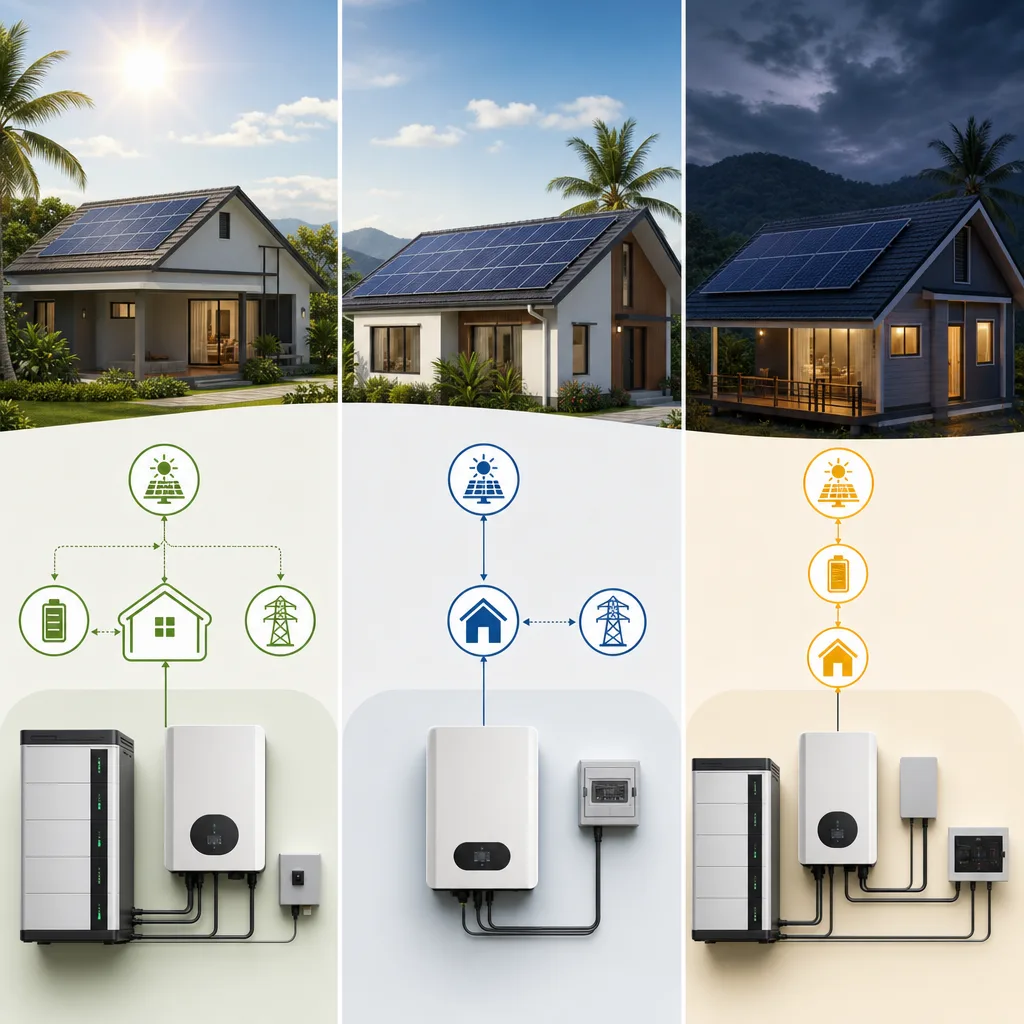
There are three system types in the Philippine market, and the right one depends almost entirely on how often your power goes out.
Quick answer
There are three system types in the Philippine market, and the right one depends almost entirely on how often your power goes out.
- On-grid (grid-tied) — panels and an inverter, no battery. Cheapest per kilowatt, fastest payback, eligible for net metering. It shuts down during a brownout. Roughly ₱33,500–₱38,000 per kW installed.
- Hybrid — panels, a hybrid inverter and a battery, still grid-connected. Keeps selected loads running during outages, stores surplus instead of exporting it cheaply. Roughly ₱43,000–₱68,000 per kW all-in, median around ₱48,800/kW.
- Off-grid — panels, a large battery bank, usually a generator, no utility connection. Only correct where the grid is absent, unreliable, or prohibitively expensive to connect. Highest cost per kilowatt and not eligible for net metering.
The short version: on-grid if your Meralco supply is stable and you want the fastest return. Hybrid if brownouts are frequent, if you work from home, or if most of your consumption happens after dark. Off-grid only if you genuinely have no practical grid connection.
The one thing most buyers don't know: a standard grid-tied system stops producing the moment the grid fails. Anti-islanding protection requires it, so utility crews aren't electrocuted by power flowing into lines they believe are dead. Without a battery, your panels sit idle in full sunlight during a brownout.
Comparison at a glance
| On-grid | Hybrid | Off-grid | |
|---|---|---|---|
| Battery | No | Yes | Yes, large bank |
| Grid connection | Yes | Yes | No |
| Works during brownout | ❌ No | ✅ Yes, selected loads | ✅ Yes |
| Net metering eligible | ✅ Yes | ✅ Yes | ❌ No |
| Installed cost per kW | ₱33,500–₱38,000 | ₱43,000–₱68,000 | Highest |
| Typical 5 kW installed | ₱250,000–₱365,000 | ₱420,000–₱700,000 | Varies widely |
| Payback | Fastest (4–7 years) | Longer | Not the point |
| Best for | Stable supply, daytime load | Frequent outages, night load | Islands, remote sites |
Cost ranges from installer quotes collected in the Philippine market, Q2 2026. Metro Manila installations run roughly 10–15% higher than other regions due to labour costs.
Image alt text suggestion: "Comparison diagram of on-grid, hybrid and off-grid solar system configurations for Philippine homes, showing battery and grid connections."
What is an on-grid solar system?
An on-grid or grid-tied system is panels plus an inverter, with no battery.
Solar powers your household loads during daylight. Surplus energy exports to your distribution utility for bill credits under net metering. The grid covers you at night and during cloudy spells.
It is the workhorse of Philippine residential solar because it is the cheapest per kilowatt and pays back fastest. Based on 23 installer quotes shared in the r/SolarPH community in May 2026, on-grid systems ran ₱33,500–₱38,000 per kW. A 5 kW system typically lands between ₱250,000 and ₱365,000 fully installed.
Its one significant limitation is the brownout behaviour. When grid power fails, the inverter disconnects and the system stops producing. This surprises nearly every first-time buyer.
Who on-grid suits
- Households in areas with reliable supply
- Consumption concentrated in daylight hours — work-from-home during the day, daytime aircon, pool pumps
- Buyers optimising purely for payback period
- Anyone who wants to start smaller and expand later
What is a hybrid solar system?
A hybrid system combines panels, a hybrid inverter and battery storage while remaining connected to the grid.
It can power loads directly from solar, store the surplus, draw from the grid when needed, and keep selected circuits running during an outage. It sits between grid-tied and fully off-grid.
Hybrid all-in pricing — panels, inverter, battery and installation — ran ₱43,000–₱68,000 per kW for mainstream setups in mid-2026, with a median around ₱48,800/kW across the sample. A 5 kW hybrid system typically costs ₱420,000–₱700,000 installed, depending heavily on battery capacity.
Why hybrid makes more financial sense in the Philippines than people assume
Most buyers evaluate a battery purely as backup insurance. In the Philippines there is a second, larger argument that rarely gets made.
Net metering does not credit you at the retail rate. Exported energy is credited at the blended generation rate. As of July 2026, a Meralco customer paid ₱14.8261/kWh to import but was credited roughly ₱9.25/kWh to export.
That is a gap of about ₱5.58 on every exported kilowatt-hour. Energy you consume yourself is worth roughly 60% more than the same energy sent to the grid.
A battery converts low-value exported energy into high-value self-consumed energy. If your household runs aircon after dark — which describes most Filipino homes — an on-grid-only system sells cheap at noon and buys back expensive at 8pm, every day, for twenty-five years.
Who hybrid suits
- Areas with frequent brownouts
- Home offices, clinics, small businesses where downtime costs money
- Households whose consumption is concentrated in the evening
- Anyone with medical equipment or refrigerated stock
What is an off-grid solar system?
An off-grid system has no utility connection at all. Panels, a substantial battery bank, and usually a backup generator for extended cloudy periods.
It is the right answer for islands, remote farms, and sites where the grid genuinely does not reach or where connection costs are prohibitive.
It is the wrong answer almost everywhere else. Off-grid systems must be sized for worst-case conditions rather than average conditions, which means significantly more panels and far more battery capacity than a hybrid system serving the same household. You are also ineligible for net metering, since there is no grid to export to.
Even on islands, a hybrid configuration paired with the local electric cooperative often costs several hundred thousand pesos less than full off-grid while delivering comparable reliability.
Who off-grid suits
- Genuinely unserved locations
- Sites where a grid connection would cost more than the battery bank
- Operations requiring complete independence from utility supply
How to actually decide
Work through these in order.
1. Count your brownouts
This is the primary variable, not budget.
If your area loses power two or more times a week, hybrid is worth the premium on convenience alone. If outages are rare, on-grid delivers a materially faster payback.
Worth noting that grid reliability deteriorated in 2026. In May, the National Grid Corporation of the Philippines placed the Luzon grid on red alert for three consecutive days. On 13 May, Meralco implemented rotating interruptions affecting roughly 1.9 million customers across Bulacan, Cavite, Laguna, Metro Manila, Quezon and Rizal. Peak demand records fell twice that year — 14,016 MW on 24 April and 14,268 MW on 12 May — while 16 plants sat on forced outage and another 14 ran derated.
2. Work out when you actually use electricity
Pull twelve months of bills. If your consumption is concentrated between 6am and 6pm, on-grid captures most of the value. If it is concentrated after dark, you are exporting at ₱9.25 and rebuying at ₱14.83, and a battery closes that gap.
3. Size against your contracted capacity, not your ambition
Under ERC rules, installed capacity cannot exceed your contracted demand or the capacity of your service entrance. Oversizing beyond your actual consumption also wastes capital — a 10 kW system on a household with a ₱3,000 monthly bill will never pay back sensibly.
4. If you choose on-grid, insist on a hybrid-ready inverter
This is the most consequential decision in the entire process and it costs relatively little at the point of purchase.
You can add batteries to an on-grid system later only if the inverter was hybrid-ready from the start. If it wasn't, you will be replacing the inverter — an avoidable four-to-six-figure mistake. A hybrid-ready unit with smart monitoring typically adds ₱10,000–₱15,000 up front.
Ask the question in writing before you sign.
5. Match the brand tier to the job
Mid-tier inverter brands including Deye, Solis and Sungrow deliver equivalent residential performance at a fraction of premium ecosystem pricing. One documented comparison had a full Huawei SUN2000 and LUNA2000 ecosystem quoted at ₱1.3 million for a household with a ₱16,000–₱18,000 monthly Meralco bill — roughly two to three times the cost of an equivalent Deye or Solis configuration.
Premium ecosystems are defensible for commercial installations or buyers prioritising warranty depth and monitoring. For residential buyers optimising payback, they are usually not.
6. Understand that bigger is cheaper per kilowatt
Economies of scale are steep. In one documented case with the same installer and same equipment tier, a 3.48 kW system cost ₱79,000/kW while an 18.3 kW system cost ₱47,700/kW — a difference of 40%.
If you are on the fence between two sizes and you have the consumption to justify the larger one, the larger one is usually better value per peso.
What to ask before you sign
- Is this inverter hybrid-ready, and will you confirm that in writing?
- Is the inverter on my distribution utility's approved list for net metering?
- Which specific circuits stay live during a brownout, and for how long?
- Is the net metering application included, and who files it?
- Are LGU building and electrical permits included in the quoted price?
- What is the mounting system's wind rating?
- Who honours the panel and inverter warranties locally?
Related reading: Why your net metering credit is only ₱9.25 when you pay ₱14.83 · Your solar panels won't work during a brownout — here's why
Frequently asked questions
Anong mas maganda, hybrid o on-grid?
Depende sa dalas ng brownout sa inyo. If your area loses power two or more times a week, hybrid is worth the extra cost. If your supply is stable and most of your consumption is during the day, on-grid gives a faster payback — usually 4–7 years versus longer for hybrid. Kung hindi ka sigurado, at minimum get a hybrid-ready inverter so you can add batteries later without replacing it.
Will my solar panels work during a brownout?
Not with a standard on-grid system. Grid-tied inverters include anti-islanding protection that shuts the system down when grid power is lost, so power isn't fed into lines utility crews believe are dead. Only hybrid and off-grid systems with battery storage keep running during an outage.
How much does a hybrid solar system cost in the Philippines?
Hybrid all-in pricing ran ₱43,000–₱68,000 per kW for mainstream setups in 2026, with a median around ₱48,800/kW. A 5 kW hybrid system typically costs ₱420,000–₱700,000 installed depending on battery capacity, inverter brand and roof complexity. Metro Manila runs roughly 10–15% higher than other regions.
Can I add a battery to my on-grid system later?
Only if your inverter is hybrid-ready. If it is a standard grid-tie inverter, adding storage means replacing the inverter entirely. Confirm hybrid-readiness in writing before purchase — the upgrade typically costs only ₱10,000–₱15,000 at the point of installation.
Is off-grid solar eligible for net metering in the Philippines?
No. Net metering under RA 9513 and ERC Resolution No. 09-2013 requires a connection to a distribution utility's grid, since the mechanism credits energy exported to that utility. Off-grid systems have no grid connection and therefore no export.
Why is my net metering credit lower than what I pay Meralco?
Because exported energy is credited at the blended generation rate rather than the full retail tariff. In July 2026 a Meralco customer paid ₱14.8261/kWh to import while being credited roughly ₱9.25/kWh to export. This is why self-consumption — and therefore storage — is worth more than exporting in the Philippine market.
Prices reflect installer quotes and published package pricing collected across the Philippine market in Q2 2026 and vary by region, roof complexity and equipment tier. Rates verified against Meralco's July 2026 tariff announcement. This article is general information — get at least three itemised quotes before deciding.
Related Articles
Buyer Guides
Solar for OFW Families: How to Buy a System You Can't Stand Next To
August 20, 2026
Buyer Guides
What If Your Solar Installer Goes Out of Business? A Philippine Owner's Guide (2026)
August 15, 2026
Buyer Guides
Solar Panel Brands in the Philippines: What's Actually Available (2026)
August 14, 2026