Buyer Guides
Solar Panel Brands in the Philippines: What's Actually Available (2026)
August 14, 2026 · SolarSwitch · 14 min read
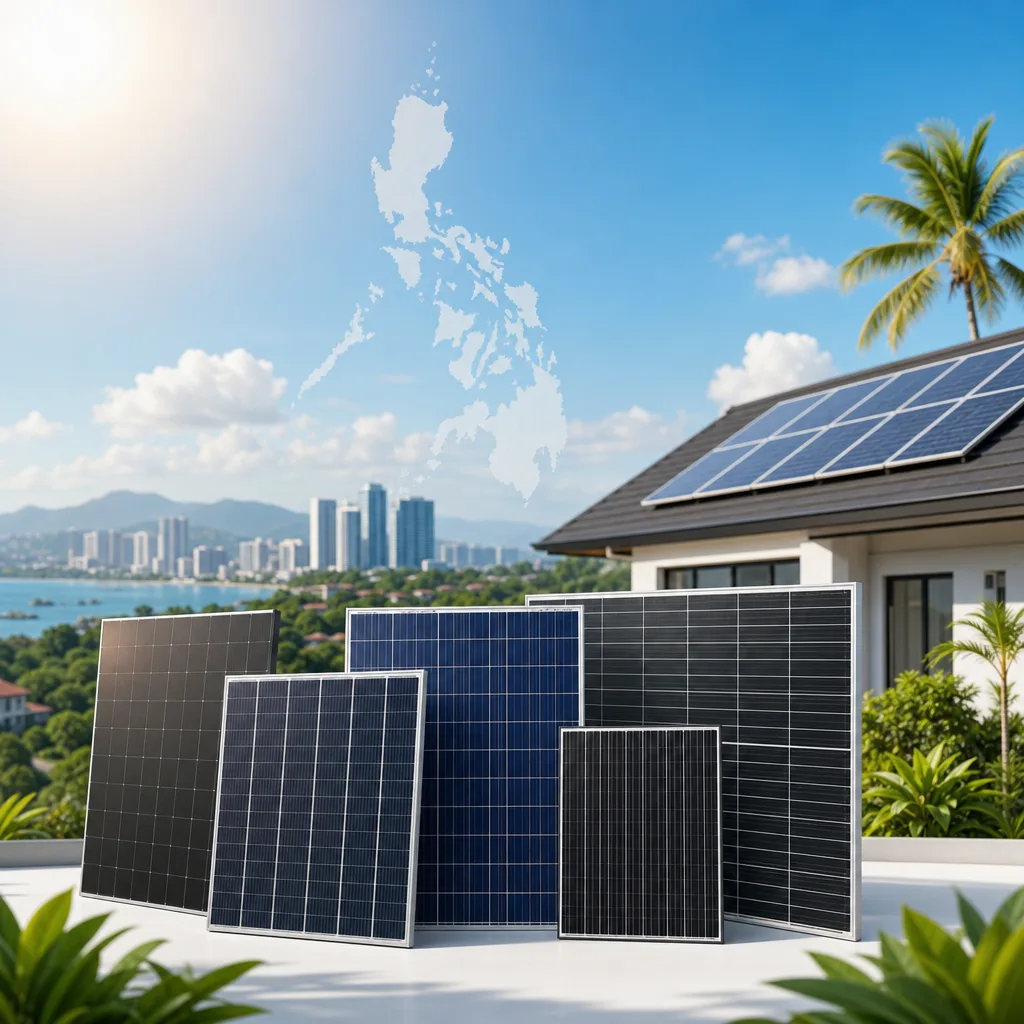
Most brand guides are written by installers ranking the panels they happen to stock. This one explains what Tier 1 actually means, which specifications matter in Philippine conditions, and how to verify that the panel on your roof is the one on your quote.
Quick Answer
Brand matters less than almost every guide claims. Any panel from a major manufacturer will generate power reliably for decades. The variable that actually determines whether your 25-year warranty is worth anything is who honours it locally — the distributor and installer standing behind it, not the logo on the frame.
"Tier 1" is a bankability rating, not a quality rating. BloombergNEF's tier list measures whether banks have financed projects using a manufacturer's panels. It says nothing directly about performance, efficiency, or defect rates. Installers cite it as a quality badge because it sounds like one.
You have two different warranties, and they're often conflated. The product warranty covers manufacturing defects and typically runs 10–12 years. The performance warranty guarantees output and typically runs 25–30 years. A quote advertising "25-year warranty" is usually referring to the second one.
In Philippine conditions, temperature coefficient matters more than headline efficiency. Panels are rated at 25°C. Your roof in Manila in April is far hotter than that. A panel that loses less output per degree will outperform a nominally more efficient one that doesn't. The most useful thing you can do costs nothing: get the full model number in writing, look up the manufacturer's datasheet yourself, and confirm the specifications match your quote.
A disclosure before we start
SolarSwitch is a solar installer. We sell and install solar systems in the Philippines, and we stock particular brands. That gives us an obvious commercial interest in what you conclude from this page.
So we're not going to rank brands, and we're not going to tell you which one is "best." Every guide that does is written by someone with the same conflict we have — usually an installer whose top pick happens to be what's in their warehouse. Where we list brands below, they're in alphabetical order, and we've tried to describe them accurately rather than favourably.
What we will do is explain the things that actually separate one panel from another, so you can evaluate any quote — including ours — on the merits.
What "Tier 1" actually means
This is the most misused term in solar sales, and understanding it changes how you read every quote you receive.
BloombergNEF's Tier 1 list is a measure of bankability. A manufacturer earns a place by having supplied own-brand panels to a certain number of utility-scale projects that were financed on a non-recourse basis by commercial banks within the past two years.
Read that again: it measures whether banks lent money against projects using those panels. BNEF states plainly that the list is not intended as a recommendation of quality, and that buyers should conduct their own technical due diligence.
So what does it actually tell you?
What Tier 1 does mean:
- The manufacturer is large, financially substantial, and has survived commercial scrutiny
- They are likely to still exist in ten years — which matters enormously for a warranty claim
- Their panels have been deployed at scale, so field performance data exists
What Tier 1 does not mean:
- That the panels are more efficient
- That they have lower defect rates
- That any specific production batch is good
- That the warranty will be honoured where you live
That last point is the one that costs Filipino buyers money. A Tier 1 badge on a panel whose local distributor has no service presence in the Philippines is a warranty you cannot practically claim against.
Use Tier 1 as a floor, not a ranking. It's a reasonable filter for "will this company exist in 2046." It is not the answer to "which panel should I buy."
The two warranties, and why the difference matters
Nearly every quote you'll receive advertises a "25-year warranty." Almost none explain that this refers to two separate documents with very different terms.
| Product warranty | Performance warranty | |
|---|---|---|
| What it covers | Manufacturing defects — delamination, cell cracking, junction box failure, frame corrosion | Guaranteed power output over time |
| Typical term | 10–12 years (some premium lines 15–25) | 25–30 years |
| What triggers a claim | Something is physically wrong with the panel | Output falls below the guaranteed curve |
| How hard to claim | Moderate — the defect is usually visible | Difficult — requires measured proof of underperformance |
The product warranty is the one that will actually matter to you. Physical failures — a failed junction box, water ingress, delamination in a humid coastal environment — happen in the first decade far more often than gradual underperformance does.
So when comparing quotes, ask specifically: how long is the product warranty? Two panels both advertising "25 years" may have 10-year and 15-year product warranties respectively. That's a real difference and it's rarely volunteered.
Questions worth asking about any warranty
- Who administers the claim — the manufacturer, a regional office, the Philippine distributor, or your installer?
- Does the warranty cover labour? Many cover the replacement panel but not the cost of removing the failed one and installing the new one. On a roof, that labour is not trivial.
- Is there a Philippine service presence, or does a claim mean corresponding with an overseas office?
- What happens if your installer goes out of business? Workmanship warranties die with the installer. Manufacturer warranties don't — but you lose the person who would have handled the claim for you.
- What voids it? Improper installation is the most common exclusion, which is another reason installer quality and panel quality are not separable questions.
What actually matters in Philippine conditions
Global panel reviews optimise for conditions that aren't ours. Here's what to weigh in a hot, humid, salty, typhoon-exposed archipelago.
Temperature coefficient — the specification to check first
Solar panels are rated at a cell temperature of 25°C. A rooftop panel in Metro Manila in April routinely operates at 55–65°C. Every degree above 25°C costs you output.
The temperature coefficient of Pmax tells you how much. It's expressed as a percentage per degree Celsius, and it's always negative — typically between −0.26%/°C and −0.40%/°C depending on cell technology.
The difference compounds daily. A panel at −0.29%/°C operating at 60°C loses about 10.2% of rated output. One at −0.38%/°C loses about 13.3%. That gap is roughly 3% of your system's production, every hot afternoon, for twenty-five years.
In practice this means N-type TOPCon and similar modern cell architectures usually outperform older PERC panels in Philippine heat, even when their headline efficiency figures look similar. Ask for the temperature coefficient explicitly — it's on every legitimate datasheet.
Salt mist corrosion resistance — for coastal sites
If you're within a few kilometres of the coast, which describes an enormous share of Philippine homes and businesses, ask whether the panel carries IEC 61701 salt mist corrosion certification.
Salt air attacks frames, mounting hardware, and junction box seals. This is a real failure mode locally, and it's one where mounting hardware matters as much as the panel — anodised aluminium and stainless fasteners rather than the cheapest available.
Wind load rating — for typhoon exposure
Panels carry a mechanical load rating, typically expressed in pascals for front (snow/wind) and rear (uplift) loading. In the Philippines, uplift is the failure mode that matters, and it's usually the mounting system and roof attachment that fails before the panel does.
Ask for the panel's rated load, then ask separately how the mounting system is engineered for your roof and your area's design wind speed. A well-rated panel on an under-specified rail system is not a typhoon-resistant installation.
Humidity, PID, and damp heat
Potential Induced Degradation is accelerated by heat and humidity — a Philippine specialty. Look for panels tested to IEC 61215 and IEC 61730, and ask whether the manufacturer publishes PID-resistance data. Double-glass modules are inherently more resistant to moisture ingress than backsheet designs, which is a genuine advantage in coastal and high-humidity locations, at the cost of additional weight.
Degradation rate
Most modern panels degrade around 0.4% per year, with better lines under 0.3%. Over 25 years the difference between 0.25%/year and 0.5%/year is roughly 6% of cumulative production — meaningful, but smaller than most marketing implies, and smaller than the temperature-coefficient effect.
The brands you'll commonly see quoted in the Philippines
Listed alphabetically, not ranked. These are the manufacturers that appear most often on Philippine quotes and have established distribution here.
- Canadian Solar — Headquartered in Canada with manufacturing largely in Asia. Long-established and widely financed. Somewhat less common in Philippine residential quotes than the highest-volume brands, though well represented commercially.
- JA Solar — Large Chinese manufacturer, consistently on Tier 1 lists, widely available through Philippine distributors.
- Jinko Solar — Among the highest-volume manufacturers globally and one of the most frequently stocked brands in the Philippines. Its N-type TOPCon lines are common on both residential and commercial quotes.
- LONGi — Major monocrystalline manufacturer, very widely distributed locally, competing directly with Jinko on most residential quotes.
- Risen Energy — Established manufacturer with a smaller but real Philippine presence.
- Trina Solar — Manufacturing since the late 1990s. Its large-format modules are common on commercial and industrial roofs where maximising watts per square metre matters.
Other brands appear locally too, including regional manufacturers and house brands from larger installers. Their presence on a quote isn't automatically a problem — but the questions in the verification section below become more important, not less.
If you get three quotes in the Philippines today, at least two will likely feature panels from this list. That's not because they're the only good options; it's because they're what distributors stock, which is itself a meaningful advantage for warranty service.
How to verify what you're actually being sold
This is the section to act on. All of it is free and takes about fifteen minutes.
Step 1 — Get the full model number in writing
Not "Jinko 550W." The complete model designation, as it appears on the datasheet — series name, wattage, and variant code. If a quote won't specify this, that is itself the answer.
Step 2 — Look up the datasheet yourself
Every legitimate manufacturer publishes datasheets on their own website. Find the model number and check that the rated power, efficiency, temperature coefficient, and warranty terms match what you were quoted. Discrepancies are worth asking about directly.
Step 3 — Confirm the certifications
Look for IEC 61215 (design qualification) and IEC 61730 (safety), plus IEC 61701 if you're coastal. These should appear on the datasheet.
Step 4 — Ask who the Philippine distributor is
Then ask what happens if you need to claim in year eight. A specific answer — a named distributor with an office you could visit — is a good sign. A vague one is not.
Step 5 — Ask for the product warranty term specifically
Separately from the performance warranty. Get both in writing.
Step 6 — Check the panel that arrives matches the quote
On delivery day, check the labels on the actual modules against your contract. Substitution after signing does happen, and it is far easier to raise before installation than after.
Red flags
Things that should make you slow down:
- "German technology" or "American quality" on a cheap panel. Almost all mainstream panels are manufactured in Asia, including the ones from Western-headquartered brands. Marketing that leans on a country of origin rather than a datasheet is usually obscuring something.
- A quote that won't specify the model number. There's no legitimate reason for this.
- "25-year warranty" with no distinction between product and performance. Ask which is which; the answer tells you how carefully the quote was prepared.
- A brand with no searchable datasheet. If you cannot find the specifications on the manufacturer's own website, you cannot verify anything you've been told.
- Pricing far below every other quote. Panels are a commodity with fairly transparent global pricing. A dramatic discount usually means a different grade of panel, a different mounting system, or work that isn't in the scope.
- Grade B or "OEM" panels presented as equivalent. These exist and are sometimes sold legitimately at a discount, but they should be disclosed, not discovered.
Where brand fits in the overall decision
Honestly? Below several other things.
If we ranked what determines whether your solar system performs well over twenty-five years, panel brand would come somewhere after:
- Whether the system was sized correctly for your actual consumption pattern — the single biggest determinant of financial return
- Installation quality — mounting, waterproofing, cable management, earthing, and protection
- Inverter selection and sizing — the component most likely to need replacement within the system's life
- Who will service it in year eight — and whether they'll still be trading
- Panel brand and specification
That ordering isn't an argument for ignoring the panel. It's an argument for not letting brand comparison consume the attention that should go to sizing and installer selection. Two installers quoting identical Jinko panels can deliver systems with materially different lifetime output.
Ask any installer — including us — for the full specification, the product warranty term, and the name of the Philippine distributor. Those three answers tell you more about a quote than the logo on the panel does.
Frequently asked questions
What is the best solar panel brand in the Philippines?
There isn't a single answer, and any guide that gives one is usually recommending what its author sells. Panels from major manufacturers with established Philippine distribution — Canadian Solar, JA Solar, Jinko, LONGi, Risen, and Trina among them — all generate power reliably. The variable that matters more is who honours the warranty locally and how well the system is installed.
Does Tier 1 mean a solar panel is high quality?
No. BloombergNEF's Tier 1 list measures bankability — whether commercial banks have provided non-recourse financing to utility-scale projects using a manufacturer's own-brand panels. BNEF states it is not a quality ranking. It is a useful indicator that a manufacturer is financially substantial and likely to exist long enough to honour a warranty, but it says nothing directly about efficiency or defect rates.
Are Chinese solar panels good for the Philippines?
Most panels installed worldwide are manufactured in China, including those sold under Western-headquartered brands. The major Chinese manufacturers supply utility-scale projects globally and are represented on Tier 1 bankability lists. The relevant question is not country of origin but whether the specific model has appropriate certifications, a suitable temperature coefficient, and a distributor who will service a warranty claim in the Philippines.
What is a good temperature coefficient for solar panels in the Philippines?
Lower magnitude is better. Modern panels typically range from about −0.26%/°C to −0.40%/°C. Because rooftop cell temperatures in the Philippines routinely reach 55–65°C, well above the 25°C rating condition, a panel at −0.29%/°C will produce noticeably more on a hot afternoon than one at −0.38%/°C, even at similar rated efficiency.
How long is a solar panel warranty in the Philippines?
There are two. The product warranty, covering manufacturing defects, typically runs 10 to 12 years, with some premium lines offering longer. The performance warranty, guaranteeing output over time, typically runs 25 to 30 years. Quotes advertising "25-year warranty" are usually referring to the performance warranty, so ask for the product warranty term separately.
What certifications should solar panels have for Philippine conditions?
IEC 61215 for design qualification and IEC 61730 for safety are the baseline. For coastal installations, IEC 61701 salt mist corrosion resistance is worth requiring. Mechanical load ratings matter for typhoon exposure, though the mounting system and roof attachment are usually the limiting factor rather than the panel itself.
How do I check the panels I was quoted are what gets installed?
Get the complete model number in writing before signing, look up the manufacturer's datasheet independently and confirm the specifications match, then check the labels on the actual modules against your contract on delivery day. Raising a discrepancy before installation is far simpler than afterwards.
Sources
- BloombergNEF — Tier 1 module maker list methodology and stated limitations
- IEC standards 61215, 61730, and 61701 — design qualification, safety, and salt mist corrosion testing
- Manufacturer published datasheets for modules distributed in the Philippines
- SolarSwitch installation and procurement practice
Related Articles

Buyer Guides
Solar for OFW Families: How to Buy a System You Can't Stand Next To
August 20, 2026
Buyer Guides
What If Your Solar Installer Goes Out of Business? A Philippine Owner's Guide (2026)
August 15, 2026
Buyer Guides
Solar Red Flags in the Philippines: 11 Warning Signs Before You Sign (2026)
August 12, 2026