
Buyer Guides
What If Your Solar Installer Goes Out of Business? A Philippine Owner's Guide (2026)
August 15, 2026 · SolarSwitch · 12 min read
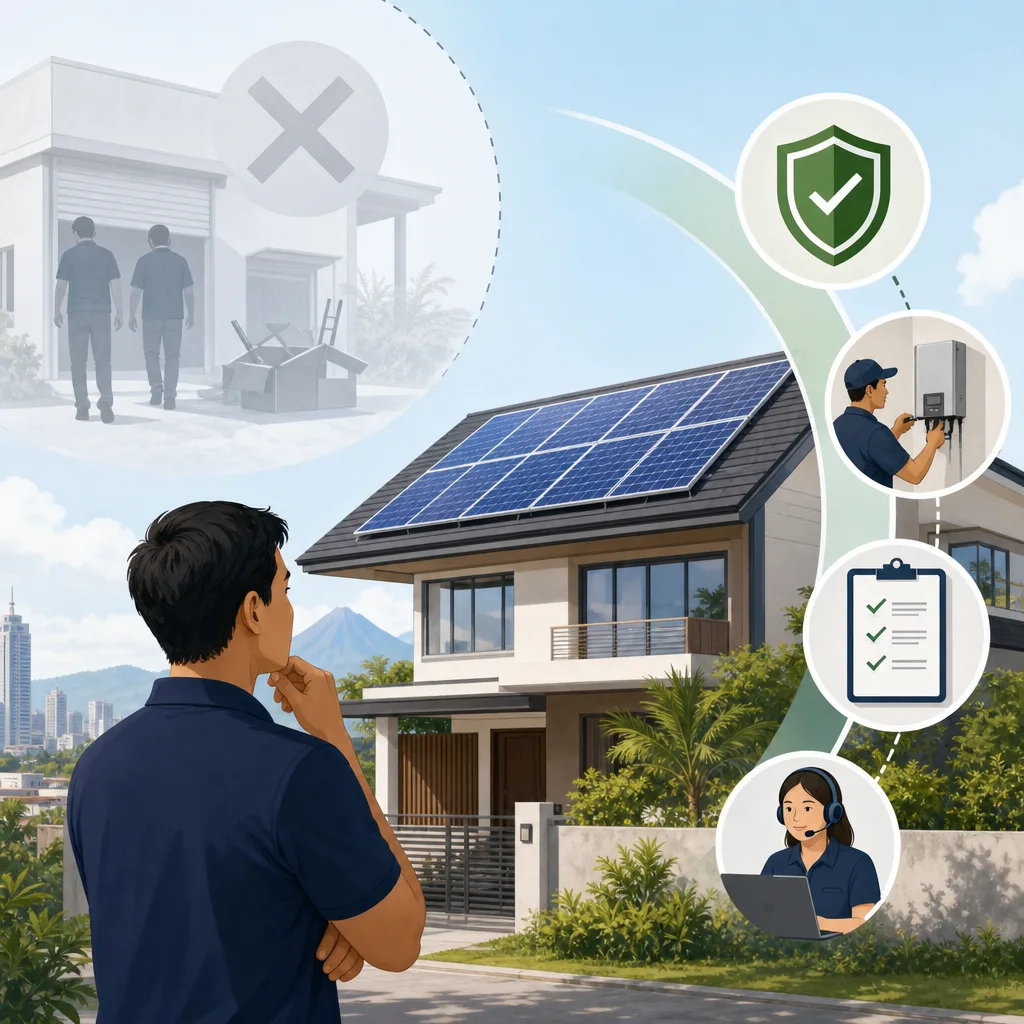
If your installer stops answering the phone, your system does not stop working and your manufacturer warranties do not disappear. Here's exactly what survives, what doesn't, and the steps to take in the first week — written for the Philippines, not America.
Quick Answer
Your system does not stop working. Panels keep producing as long as the sun is up. A company closing has no effect on the hardware on your roof. Your manufacturer warranties survive. Panel, inverter and battery warranties are issued by the manufacturers, not your installer, and they remain valid. Most manufacturers allow warranty work to be carried out by any qualified third-party contractor. Your net metering arrangement survives too. That agreement is between you and your distribution utility. Your installer filed the paperwork; they were never a party to it. What you actually lose is the workmanship warranty and your service contact. Workmanship cover is the installer's own promise and it dies with the company. The practical gap — nobody to call — is the real problem, and it is solvable. The single most valuable thing you can hold is documentation. Equipment serial numbers, warranty certificates, the Certificate of Compliance, as-built drawings, and monitoring credentials in your own name. With those, a new contractor can pick up your system in an afternoon. Without them, everything is harder.
First, the reassurance
If you have just discovered your installer's number is disconnected, take a breath. The situation is annoying and it will cost you some time. It is not a catastrophe, and your investment is not lost.
The equipment on your roof is inert, durable and independent. It does not phone home to your installer. It does not require a subscription. Panels have no moving parts and routinely run for decades. The system will keep offsetting your Meralco bill tomorrow morning exactly as it did last week.
What has changed is that you no longer have a relationship with anyone who knows your system. That is a service problem, and service problems have solutions.
What survives, and what doesn't
| Survives the closure? | Notes | |
|---|---|---|
| The physical system | ✅ Yes | Panels, inverter, mounting, wiring — unaffected |
| Panel product warranty | ✅ Yes | Issued by the manufacturer, typically 10–12 years |
| Panel performance warranty | ✅ Yes | Issued by the manufacturer, typically 25–30 years |
| Inverter warranty | ✅ Yes | Issued by the manufacturer |
| Battery warranty | ✅ Yes | Issued by the manufacturer |
| Net metering agreement | ✅ Yes | Between you and your distribution utility |
| Your export credits | ✅ Yes | Continue accruing on your bill as normal |
| The Certificate of Compliance | ✅ Yes | Already issued; the engineer signed it, not the company |
| Workmanship warranty | ❌ No | The installer's own promise, and it dies with them |
| Free service calls and support | ❌ No | You will now pay a third party for this |
| Monitoring access | ⚠️ Depends | See below — this catches most people out |
The pattern is straightforward once you see it: anything a third party promised you survives; anything the installer promised you doesn't.
What to do in the first week
Step 1 — Gather every document you have
Do this before you call anyone. Thirty minutes here makes every later step faster and cheaper.
Find:
- The installation contract or quotation, including the equipment list
- Any warranty certificates for panels, inverter, and battery
- Equipment serial numbers — panel and inverter, ideally photographed
- The Certificate of Compliance signed by the PRC-licensed engineer
- The electrical permit and Certificate of Final Electrical Inspection from your LGU
- Your net metering approval and executed agreement with the DU
- As-built drawings or the single-line diagram
- Monitoring platform login details
- Proof of payment
If you are missing serial numbers, they are physically printed on the equipment. Panel labels are on the back of each module, which usually means a roof visit, but the inverter serial number is normally visible on the unit itself and is the more important one — inverters fail far more often than panels.
Step 2 — Check whether the system is actually working
Before assuming a problem, verify there is one.
Look at your inverter's status indicator. A steady green light generally means normal operation; red or flashing amber indicates a fault, and the pattern usually maps to a code in the manual. Then compare your recent Meralco bills — if consumption has jumped without a change in your habits, the system may be underperforming.
Many people discover their installer has closed while investigating something that turns out to be unrelated — a tripped breaker, a communications dropout after changing internet providers, or a dirty array at the end of the dry season.
Step 3 — Reclaim your monitoring access
This is the step most owners don't anticipate.
It is very common for installers to register the monitoring platform under their own account, with the homeowner either given no credentials or given a sub-account that depends on the installer's parent account. When the company folds, that access can go dark.
The fix is to claim system ownership directly with the equipment manufacturer. Major inverter manufacturers operate monitoring platforms with a defined ownership transfer process — you will typically need the inverter serial number, proof of purchase, and the site address. A new service contractor can also do this on your behalf, and they will need the same information.
If your installer is still trading and you are reading this as a precaution, do this today: confirm your monitoring account is registered to your email address, not your installer's. It takes five minutes and it removes the problem entirely.
Step 4 — Engage a new contractor for service
Any qualified solar contractor can service your system. You are not restricted to the original installer, and manufacturers generally permit warranty work by third-party contractors — many operate authorised service partner networks specifically for this.
When choosing one, apply the same tests you would to a new installation. Ask for their PCAB licence, the PRC registration of the engineer who signs their work, and references. Our guide on solar red flags in the Philippines covers the full checklist.
Ask specifically whether they will:
- Perform a full system inspection and report on what they find
- Take over monitoring and set up performance alerts
- Handle manufacturer warranty claims on your behalf
- Provide an ongoing maintenance arrangement
Expect to pay for an initial assessment. That is reasonable — they are inheriting someone else's work and need to understand it before they can stand behind anything.
Step 5 — Check whether anyone acquired the business
Sometimes a closing company's assets and customer contracts are bought by another firm, which may assume some service obligations. It is worth a search and a few calls before assuming nothing survived. This is not common, but it costs nothing to check.
Your net metering is safe — here's why that matters
Worth stating plainly, because it worries people unnecessarily.
Your net metering arrangement is an agreement between you and your distribution utility. Your installer prepared and filed the application, and may have coordinated the approval, but they were never a party to the resulting agreement. Meralco does not care whether your installer still exists.
Your bi-directional meter keeps measuring. Your export credits keep appearing. Nothing needs re-applying.
The one caveat: if you later modify the system — add panels, change the inverter, add a battery — that may require notifying the DU and possibly a fresh application. At that point you will need a contractor who can handle the paperwork, which is another reason to establish a relationship with one before you need it.
If money is owed or work was left unfinished
The above assumes a completed system. If your installer took payment and disappeared mid-project, or left work incomplete, that is a different and harder problem.
Realistic options in the Philippines:
Document everything immediately. Contract, receipts, bank transfers, messages, photographs of the site as it stands, and the equipment actually delivered versus what was quoted. Whatever route you take, the case rests entirely on documentation, and memories fade faster than you expect.
File with the DTI Consumer Protection Group for consumer disputes over goods and services.
Approach the DOE's Renewable Energy Management Bureau where the matter falls within its remit.
File with the PRC if the issue involves the work or certification of a licensed engineer.
Consider court action for financial claims. Be realistic: this route is slow, and the cost may exceed the recovery for a residential-scale claim. Get advice before committing.
Engage a new contractor to complete the work. Often the fastest path to a functioning system, even though it feels unjust. A partially installed system generating nothing is costing you money every month.
One community-reported case on r/SolarPH involved a homeowner losing an estimated ₱280,000 after a contractor folded roughly six months into the project. That is the scenario worth designing against — and it is exactly why payment structure matters so much when you sign.
How to make this a non-event before it happens
If you are reading this while choosing an installer rather than recovering from one, this is the useful section.
1. Hold back a retention payment. A schedule of roughly 30–50% on signing, 40–50% at substantial completion, and 10–20% retained until your net metering approval comes through keeps the installer engaged through the step most likely to be abandoned. It also means you are never fully paid up on incomplete work.
2. Demand a proper handover package. Serial numbers, warranty certificates, as-built drawings, the CoC, the CFEI, and the net metering approval, in writing, at completion. This single document set is the difference between a routine transition and a difficult one. An installer who won't commit to providing it is telling you something.
3. Register monitoring in your own name. Your email, your account, at commissioning. Not the installer's.
4. Choose equipment with a service path. This is the underrated one. A panel from a major manufacturer has published datasheets, a warranty process, and a regional service presence. An unbranded panel has none of that — so if your installer disappears, so does any realistic prospect of a claim. Our guide to solar panel brands in the Philippines explains why manufacturer longevity matters more than the specifications people usually compare.
5. Ask who will service the system in year eight. Then judge the answer. A company with a defined maintenance offering and staff to deliver it is structurally more likely to still be trading than one that treats installation as a one-off sale.
6. Keep your own copies. Scan the handover package and store it somewhere you will still be able to find it in a decade. Not only in an email thread.
The honest framing
Solar is a twenty-five year asset installed by companies that do not all last twenty-five years. That mismatch is structural, and it exists in every solar market in the world — the last few years have seen sizeable installers fail in the United States and elsewhere, leaving what the industry calls "orphaned systems."
The Philippine market is young and growing fast, which means some of the companies operating today will not be operating in ten years. That is not cynicism, it is arithmetic.
The correct response isn't to avoid solar or to assume the worst of installers. It is to buy in a way that leaves you fine either way: documented, with monitoring in your name, with mainstream equipment, and without having paid in full before the job was done. Do that and an installer closing becomes an inconvenience rather than a loss.
If your installer has closed and you need someone to look at your system, SolarSwitch can assess it, take over monitoring, and tell you honestly what condition it's in — including if the answer is that it's fine and you don't need us.
Frequently asked questions
Does my solar system stop working if the installer goes out of business?
No. The panels, inverter and wiring are unaffected by the company's status and will keep generating exactly as before. What you lose is the service relationship, not the system.
Are my solar panel warranties still valid if the installer closed?
Yes. Panel, inverter and battery warranties are issued by the equipment manufacturers, not the installer, and they survive the installer's closure. You will need serial numbers and proof of purchase to make a claim, either directly or through a new contractor. The exception is the workmanship warranty, which is the installer's own promise and is effectively void once they cease trading.
What happens to my net metering if my solar company disappears?
Nothing. The net metering agreement is between you and your distribution utility. Your installer filed the application but was never a party to the agreement, so your bi-directional meter and export credits continue unaffected.
How do I get my monitoring app working again?
Claim system ownership directly with the inverter manufacturer, which normally requires the inverter serial number, proof of purchase, and the site address. Many installers register monitoring under their own account rather than the homeowner's, so this step is often necessary. A new service contractor can also complete the transfer on your behalf.
Can another company service solar panels they didn't install?
Yes. Any qualified contractor can service your system, and manufacturers generally permit warranty work by third parties, with many operating authorised service partner networks. Expect to pay for an initial assessment, since the new contractor is inheriting an unfamiliar installation.
What should I do if my solar installer took my money and disappeared?
Document everything immediately — contract, receipts, transfers, messages and photographs. Then consider the DTI Consumer Protection Group for consumer disputes, the DOE's Renewable Energy Management Bureau where applicable, the PRC if a licensed engineer's work is involved, and court action for financial claims, though that route is slow. Engaging a new contractor to complete the work is often the fastest path to a functioning system.
How can I protect myself before choosing an installer?
Retain 10 to 20 percent of the price until net metering approval is received, require a complete handover package including serial numbers and warranty certificates, register the monitoring account under your own email at commissioning, and choose equipment from manufacturers with an established service presence. Together these make an installer's closure an inconvenience rather than a loss.
Sources
- Manufacturer warranty documentation and monitoring platform ownership transfer procedures
- Department of Trade and Industry — Consumer Protection Group
- Department of Energy — Renewable Energy Management Bureau
- Professional Regulation Commission
- Community reports from Philippine solar consumer forums
- SolarSwitch service practice
Related Articles

Buyer Guides
Solar for OFW Families: How to Buy a System You Can't Stand Next To
August 20, 2026

Buyer Guides
Solar Panel Brands in the Philippines: What's Actually Available (2026)
August 14, 2026
Buyer Guides
Solar Red Flags in the Philippines: 11 Warning Signs Before You Sign (2026)
August 12, 2026