Buyer Guides
Solar for OFW Families: How to Buy a System You Can't Stand Next To
August 20, 2026 · SolarSwitch · 12 min read
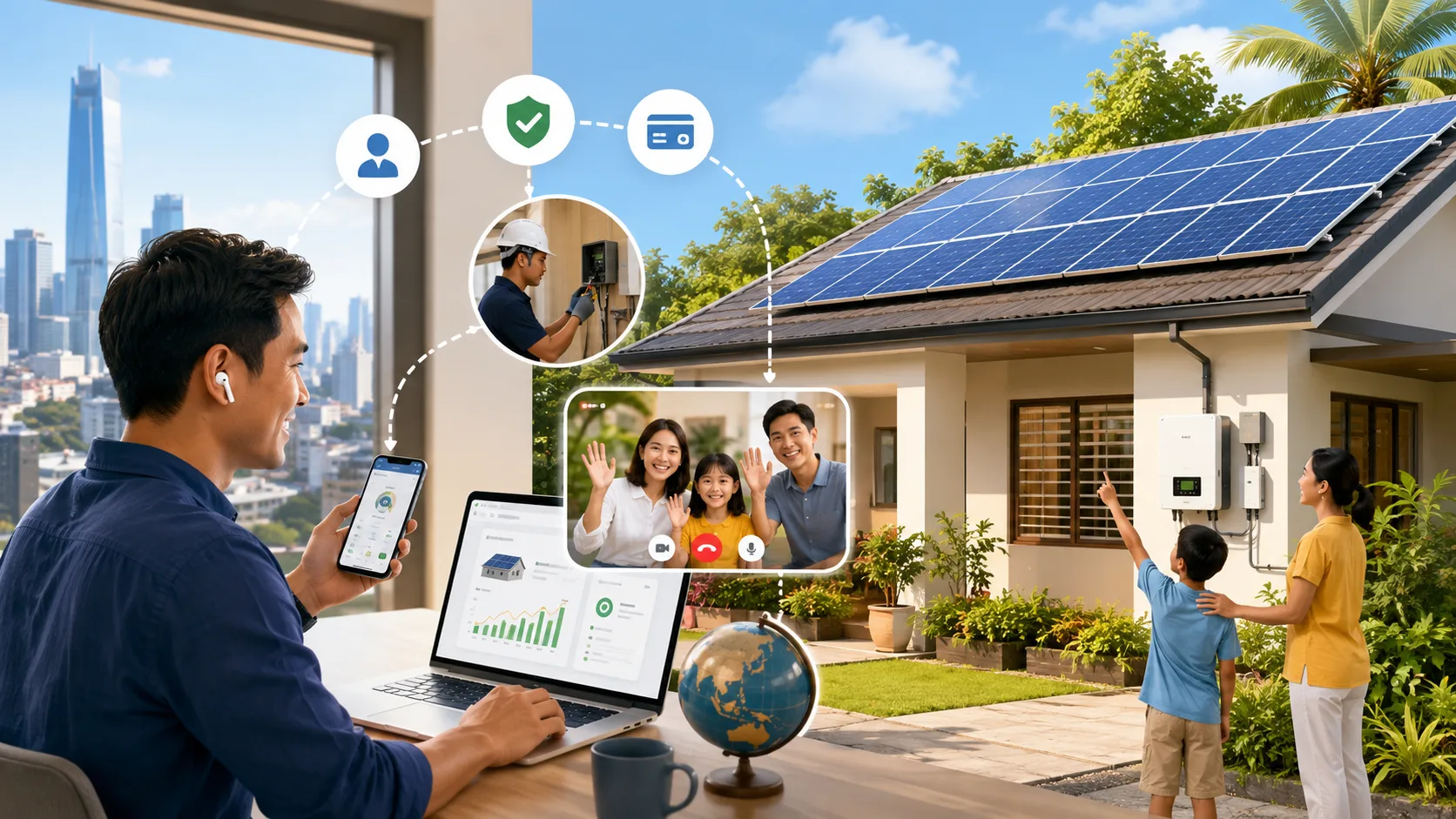
An OFW funding solar is paying for work they cannot walk out and inspect. But there's one thing that makes solar easier to verify from 6,000 km away than almost any other purchase — and most buyers don't set it up correctly.
Quick Answer
You are paying for work you cannot inspect. That is the whole problem, and no amount of reassurance solves it. What solves it is structure — payment milestones, documentation, and verification your family can carry out without technical knowledge. But solar is unusually verifiable from abroad. Register the monitoring platform to your email address, not your family's and not the installer's, and you can check production from anywhere in the world, every day, for the life of the system. Almost nothing else you fund back home gives you that. Your household is probably a better solar candidate than most. Homes with someone present during the day self-consume around 90% of generation, against roughly 55% for a house that sits empty on weekdays. That is worth about 15.8% more return per kilowatt-hour. A ₱4,000 monthly electricity bill is ₱1.2 million over 25 years at today's rate — and closer to ₱2.29 million if rates rise 5% a year. Meralco's rate has already risen 14.1% in eight months this year. Never release full payment before commissioning. Retention is the only leverage you have from another country.
Why this purchase is different
Most of what a remittance funds is consumption — tuition, groceries, medicine, a bill. It leaves nothing behind.
Solar is one of the few things that converts a recurring remittance into a one-time one. The electricity you fund every month for twenty-five years becomes a system you fund once.
Here is the scale of what that recurring cost actually is:
| Monthly bill | Per year | Over 10 years | Over 25 years | Over 25 years at 5%/yr escalation |
|---|---|---|---|---|
| ₱3,000 | ₱36,000 | ₱360,000 | ₱900,000 | ₱1,718,176 |
| ₱4,000 | ₱48,000 | ₱480,000 | ₱1,200,000 | ₱2,290,901 |
| ₱5,000 | ₱60,000 | ₱600,000 | ₱1,500,000 | ₱2,863,626 |
| ₱6,000 | ₱72,000 | ₱720,000 | ₱1,800,000 | ₱3,436,351 |
| ₱8,000 | ₱96,000 | ₱960,000 | ₱2,400,000 | ₱4,581,801 |
| ₱10,000 | ₱120,000 | ₱1,200,000 | ₱3,000,000 | ₱5,727,252 |
Escalation is not a hypothetical. Meralco's typical household rate went from ₱12.9508 per kWh in January 2026 to ₱14.7833 in August — up 14.1% in eight months. A projection that holds the rate flat for twenty-five years is the optimistic case, not the cautious one.
Your household has a real advantage
This is worth knowing before anyone quotes you, because it changes the return and most installers will not mention it.
Solar economics turn on self-consumption — how much of the generation is used on site rather than exported. Energy used at home displaces the full retail rate. Energy exported earns only the generation component, which is considerably less.
| Household pattern | Self-consumption | Blended value per kWh |
|---|---|---|
| Empty on weekdays (both working, no one home) | 55% | ₱12.29 |
| Mixed | 70% | ₱13.12 |
| Someone home during the day | 90% | ₱14.23 |
A typical OFW household — parents, a spouse, children, or relatives at home during daylight hours — sits at the top of that table. The refrigerator, fans, laundry, cooking, water pump and daytime aircon all run while the sun is up.
On a 6 kWp system generating about 7,884 kWh a year, that difference is worth roughly ₱15,267 more per year than the same system on an empty house.
The house you are funding is, in solar terms, better than the one your officemate in Manila is thinking about.
The honest problem: you cannot inspect the work
Everything above assumes the system is properly installed. That is the part distance makes hard.
Be clear about what you are exposed to:
Corner-cutting on things you'll never see. Cable sizing, earthing, protection devices, weatherproofing under a mounting foot. None of it is visible in a photo, and none of it fails immediately.
Equipment substitution. Panels or an inverter different from what you paid for. Discovered years later, if ever.
Payment released against progress that hasn't happened. A family member under pressure to release funds, with no way to judge whether the stage was actually reached.
A system that works but has no paperwork. No Certificate of Compliance, no permit, no net metering approval. It generates, but it is unregistered, uninsurable and cannot export.
Family who cannot assess technical quality. Not a criticism — nobody's mother should have to evaluate DC string terminations. It just means verification has to be designed around what they can check.
The thing that changes everything: the monitoring account
Here is the part most buyers get wrong, and it matters more to you than to anyone else.
Every modern solar system includes a monitoring platform — a phone app showing production in real time, day by day, string by string. It works from anywhere in the world.
Register it to your email address. Not your family's. Not the installer's.
Do that, and from Dubai, Riyadh, Hong Kong or a ship in the Pacific, you can open an app and see exactly what your system produced today, yesterday, and every day since commissioning. You will know within twenty-four hours if something has failed. You will know if output drops in a way that doesn't match the season.
This is why solar is more verifiable from abroad than almost anything else a remittance buys. You cannot check from Dubai whether the tuition was paid or the roof repair was done properly. You can check your solar production before breakfast.
Two conditions. It must be registered to you at commissioning — retrofitting ownership later is possible but tedious. And it must be a genuine manufacturer platform, not a spreadsheet the installer emails you.
Some installers register monitoring under their own account and give the customer nothing. If that company stops trading, access can go dark entirely. Our guide on what happens if your installer goes out of business covers why this matters.
How to buy from abroad, step by step
1 · Have the site survey done properly, and be on the call
Ask the installer to video-call you from the roof. You should see: the roof condition, orientation, any shading, the distribution board, and where the inverter will go. If an installer will quote without a site visit, that alone is disqualifying.
2 · Get the complete equipment list in writing before you pay anything
Full model numbers — panels, inverter, mounting, battery if included. Not "Jinko 550W" but the complete designation. Look up the datasheets yourself and confirm they match. This takes fifteen minutes and it is the single most useful thing you can do from abroad.
3 · Structure payment against milestones
A reasonable schedule:
| Stage | Share |
|---|---|
| On signing | 30–50% |
| Equipment delivered to site | 10–20% |
| Substantial completion and commissioning | 30–40% |
| After net metering approval | 10–20% retained |
That final retention is your only real leverage. Net metering approval is the step most likely to be abandoned after payment, and holding funds against it is what keeps the installer engaged. Anyone requiring full payment upfront has removed your ability to do anything if things go wrong.
4 · Brief your family on what to check — and keep it non-technical
Give them a short list of things anyone can verify:
- Photograph the labels on the actual panels and the inverter on delivery day, before installation. Send them to you. Compare against the contract.
- Count the panels. Confirm the number matches what was quoted.
- Photograph the roof before installation, during mounting, and after completion.
- Note who is on site and roughly how long they worked.
- Do not sign anything or release payment without speaking to you first.
None of that requires technical knowledge, and together it closes most of the substitution risk.
5 · Insist on the handover package
At completion, you should receive, in digital form you can access from abroad:
- As-built drawings and the single-line diagram
- Certificate of Compliance signed by a PRC-licensed professional
- LGU electrical permit and Certificate of Final Electrical Inspection
- Net metering approval and executed agreement with the distribution utility
- Complete equipment serial number schedule
- Manufacturer warranty certificates and datasheets
- Monitoring credentials in your name
- Commissioning test results
Store your own copies somewhere you'll still find them in a decade — not only in a chat thread.
6 · Watch the first month closely
Compare actual production against the expected monthly figures in your proposal. If your installer did not provide a monthly production profile, that is worth knowing about them. Seasonal variation is normal — August produces roughly 64% of April — but a system materially below its own model on clear days is not seasonal.
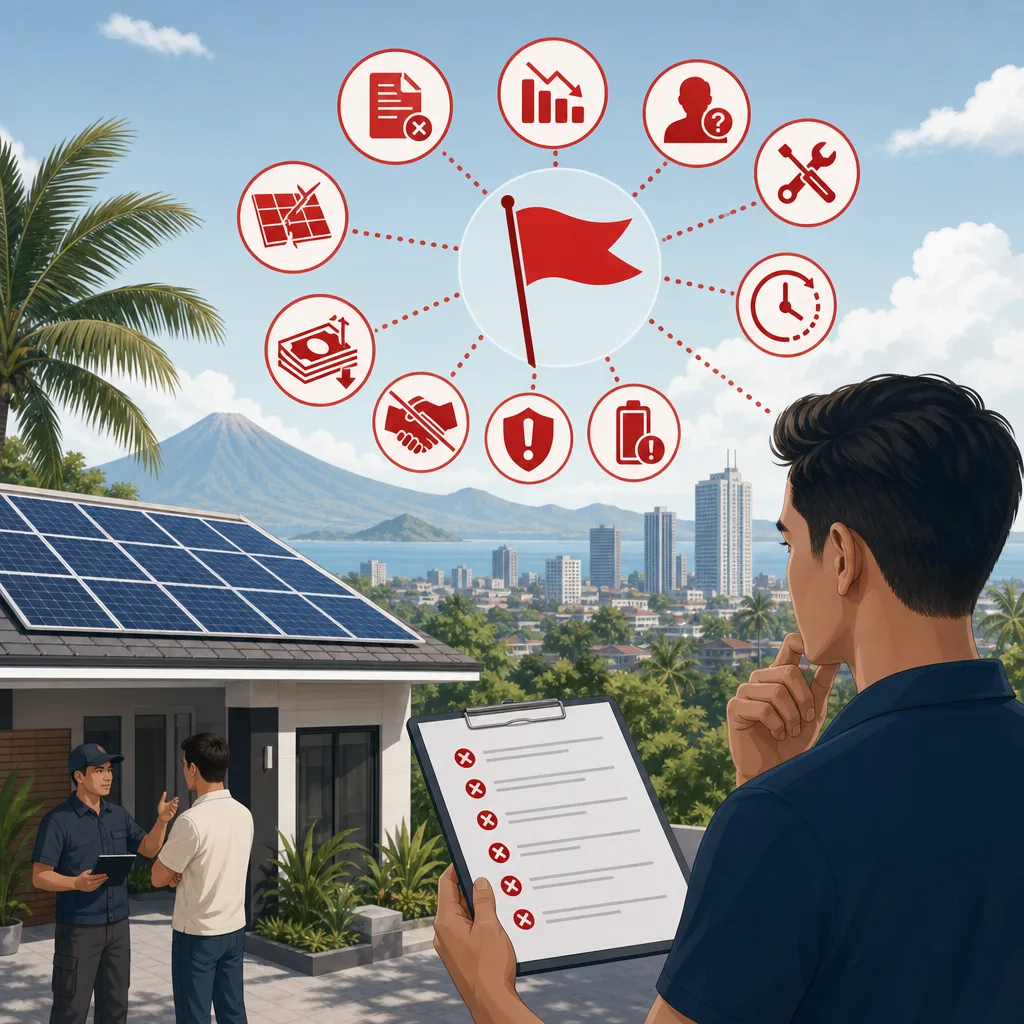
Red flags that matter more at a distance
All of these apply to any buyer. They matter more when you cannot walk over and look.
- Pressure to pay in full before work starts. No legitimate reason exists.
- Refusal to name the PRC-licensed engineer who will sign the electrical plans. Without that signature the permits cannot be filed and net metering will not be approved.
- A quote with no model numbers. You cannot verify what you cannot identify.
- Communicating only through your family, not with you. You are the payer. An installer who avoids the person paying is telling you something.
- "You'll have zero electric bill." You won't. Fixed monthly charges apply regardless, and most homes still import at night.
- No monitoring, or monitoring under the installer's account. For an overseas buyer this removes your only means of ongoing verification.
- A price far below every other quote. Something was removed. Ask what, item by item.
Our full solar red flags guide covers the rest, including what recourse exists if things go wrong.
Are you eligible for the SSS solar loan?
Possibly — worth checking rather than assuming.
SSS is preparing an Energy Sustainability Loan Program, targeting a September 2026 announcement, offering up to ₱400,000 repayable over four to seven years. Land-based OFWs have been mandatory SSS members since 2019.
The catch: eligibility is currently indicated as limited to members holding a Mandatory Provident Fund account, which covers those with a monthly salary credit above ₱20,000. Many OFW members contribute at higher salary credits and may qualify; many will not.
Log into My.SSS and check your MPF status. It takes two minutes and it is checkable today, whereas the loan terms are not yet published. Our full analysis of the programme runs the numbers on whether the payment costs less than the electricity it replaces.
One thing worth thinking about before you buy
Solar is a twenty-five year asset attached to a specific house.
That is fine if the house is where your family will stay. It is worth pausing on if there is any real prospect of selling, of the family relocating, or of a major renovation within a few years.
Systems can be removed and reinstalled, but it is expensive and rarely worth it. Manufacturer warranties transfer with the property; a good contract also makes the workmanship warranty transferable to a buyer.
Ask two questions before committing. Does the roof have at least ten years of life left? And is this house where the family intends to remain? If either answer is uncertain, that is worth resolving first — it is a much cheaper conversation now than later.
Frequently asked questions
Can I buy a solar system in the Philippines while working abroad?
Yes, and it is common. The practical requirements are structuring payment against milestones rather than paying upfront, getting the complete equipment list in writing before you pay, having monitoring registered to your own email address, and insisting on a full documentation handover you can access from overseas.
How can I verify a solar installation from another country?
The monitoring platform is your main tool — registered in your name, it shows daily production from anywhere in the world for the life of the system. Beyond that: have your family photograph equipment labels and serial numbers on delivery, compare them against the contract, and require the full handover package including the Certificate of Compliance and net metering approval.
Is solar a good use of remittance money?
It converts a recurring cost into a one-time one. A ₱4,000 monthly electricity bill is ₱1.2 million over twenty-five years at today's rate, and about ₱2.29 million if rates rise 5% a year. Households with someone present during the day also self-consume around 90% of generation, which delivers a better return than a home that sits empty on weekdays.
How much should I pay upfront for solar in the Philippines?
Roughly 30 to 50% on signing, 10 to 20% on equipment delivery, 30 to 40% at commissioning, and 10 to 20% retained until net metering approval comes through. That final retention is the main protection an overseas buyer has, because utility paperwork is the step most likely to be abandoned after payment.
What should my family check during the installation?
Non-technical things they can genuinely verify: photograph the labels on the actual panels and inverter before installation, count the panels against the quote, photograph the roof before, during and after, and never sign or release payment without speaking to you first.
What if the installer disappears after I've paid?
Manufacturer warranties on panels, inverters and batteries survive, because they are issued by the manufacturers rather than the installer — which is why the serial number schedule and warranty certificates matter. Your net metering agreement is with the distribution utility and also survives. What is lost is the workmanship warranty and your service contact, both of which another qualified contractor can pick up.
The short version
You are funding a purchase you cannot stand next to. That is a real disadvantage, and structure — not trust — is what compensates for it.
Milestone payments with retention. Complete model numbers before you pay. Monitoring in your own name. The full documentation pack. Four things, all achievable from abroad, and together they close most of the gap.
Send us your family's Meralco bills and tell us where you are. We will work on your schedule, video-call you from the roof during the survey, and set the monitoring up in your name from day one — so you can check your system from wherever you are, every day, for the next twenty-five years.
Related Articles
Buyer Guides
What If Your Solar Installer Goes Out of Business? A Philippine Owner's Guide (2026)
August 15, 2026
Buyer Guides
Solar Panel Brands in the Philippines: What's Actually Available (2026)
August 14, 2026
Buyer Guides
Solar Red Flags in the Philippines: 11 Warning Signs Before You Sign (2026)
August 12, 2026