Buyer Guides
Net Metering in the Philippines 2026: The Complete Guide to the New 10-Day Approval Rule
August 5, 2026 · SolarSwitch · 11 min read
Quick answer
Your distribution utility now has 10 working days to approve or reject a complete net metering application. If it fails to act within that window, the application is deemed approved.
This came from Department Circular DC2026-01-00012, issued by the Department of Energy and effective 1 April 2026. It is the most significant procedural change to Philippine rooftop solar since RA 9513 was enacted in 2008.
What changed, in four points:
- 10 working days for the utility. Meralco, VECO, DLPC and every electric cooperative must approve, reject with written reasons, or request specific additional documents within 10 working days of receiving a complete application.
- 3 working days for LGU electrical permits. Local government units must issue electrical permits within three working days.
- Deemed approval on delay. Failure to act within the window means the application is treated as approved.
- The commercial cap was lifted. Reports indicate the non-residential ceiling moved from 100 kW to 1 MW — see the caveat below, because sources conflict on this point.
For context on how big a change this is: before the circular, no mandatory timeline existed. Meralco applications routinely sat for 30–60 days, and smaller provincial cooperatives sometimes took 90 days or more. Customers carried the cost of commissioned systems that could not legally export.
Key facts at a glance
| Item | Detail |
|---|---|
| Governing law | Republic Act 9513 (Renewable Energy Act of 2008) |
| Implementing rules | ERC Resolution No. 09, Series of 2013 |
| New circular | DOE Department Circular DC2026-01-00012 |
| Effective date | 1 April 2026 |
| DU response window | 10 working days |
| LGU electrical permit | 3 working days |
| Consequence of delay | Deemed approval |
| Export credit rate | Blended generation rate (not retail) |
| Meralco export credit | ~₱9.25/kWh (July 2026) |
| Meralco import rate | ₱14.8261/kWh (July 2026) |
| Bidirectional meter cost | Paid by the distribution utility |
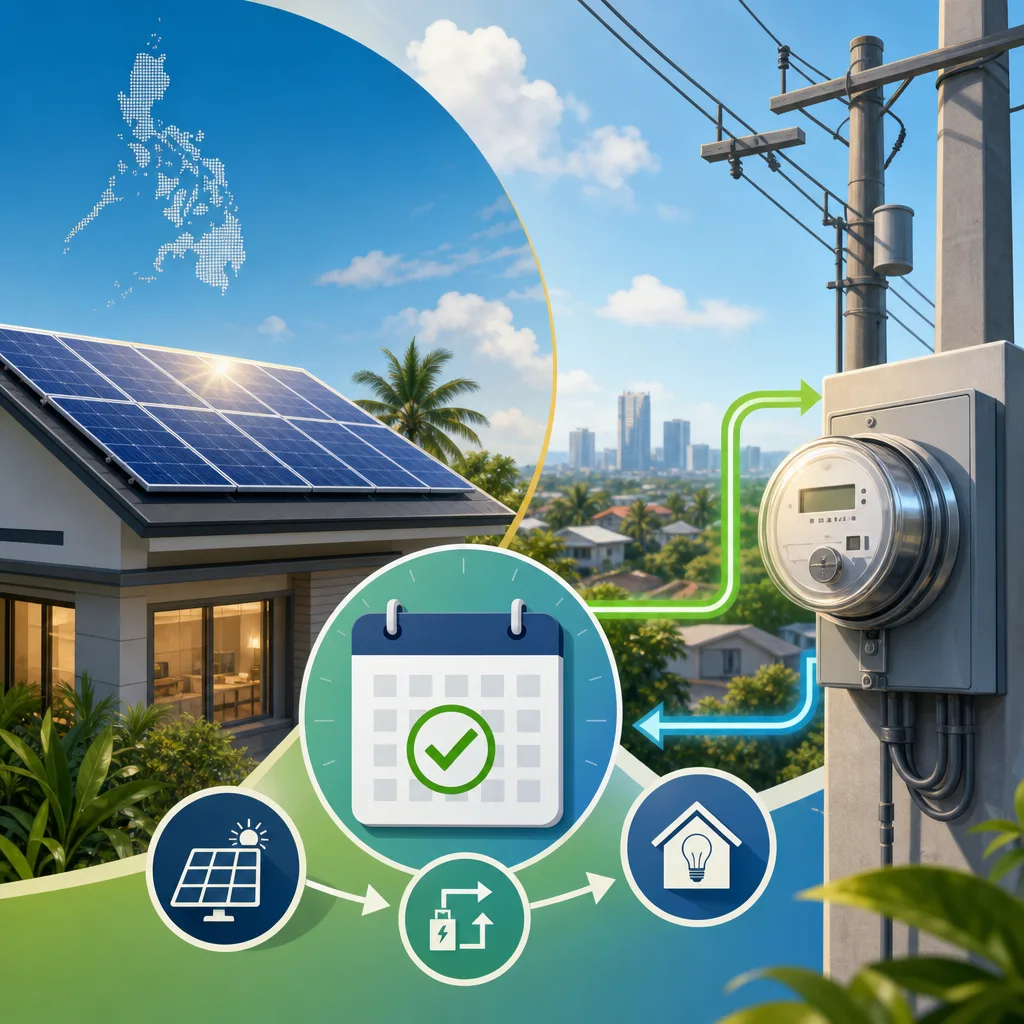
Image alt text suggestion: "Flowchart of the Philippine net metering application process in 2026 showing the 10-working-day utility approval window under DOE Circular DC2026-01-00012."
What is net metering in the Philippines?
Net metering lets a grid-connected renewable energy system export surplus electricity to your distribution utility in exchange for peso credits deducted from your bill.
It was introduced under Republic Act 9513, the Renewable Energy Act of 2008, and implemented through ERC Resolution No. 09, Series of 2013. The scheme launched in 2013.
A bidirectional meter records both the energy you import and the energy you export. At the end of each billing cycle, your exports are valued and credited against what you owe.
Two things distinguish the Philippine scheme from net metering elsewhere, and both matter to your returns:
You are credited at the generation rate, not the retail rate. More on this below — it is the most misunderstood aspect of the programme.
The meter is installed at the utility's expense. Distribution utilities are obliged to install the bidirectional meter themselves. You should not be charged for it.
What exactly did DOE Circular DC2026-01-00012 change?
The 10-working-day approval window
This is the operationally significant change.
Every distribution utility and electric cooperative must now approve, reject with specific written grounds, or request identified missing documents within 10 working days of receiving a complete application.
The word "complete" carries weight. The clock does not start on a partial submission. This is why document preparation matters more than it used to — an incomplete package simply doesn't start the timer.
A utility may reject only on three grounds: the consumer fails eligibility criteria, the application is incomplete, or the proposed system is technically incompatible with the grid. Rejections must be issued in writing with specific reasons stated.
If the utility does not act within 10 working days, the application is deemed approved. That is a legal basis to demand a response that simply did not exist before.
The 3-working-day LGU permit window
Local government units must issue electrical permits within three working days.
One important qualification: the three-day requirement covers processing time after the inspection appointment takes place — not the time it takes to schedule that inspection. In LGUs with heavy workloads, scheduling delays at the booking stage remain entirely possible. Plan around this.
Sources differ on the Certificate of Final Electrical Inspection specifically, with some reporting a three-working-day window from inspection and others a seven-working-day window. Confirm the current standard with your LGU's engineering office.
Deemed approval
Introduced through Joint Memorandum Circular No. 001, s. 2026, issued by the DOE together with the Department of the Interior and Local Government and the Department of Public Works and Highways. The same circular streamlined the approval process and eliminated additional permit requirements that had accumulated at local level — including, in many jurisdictions, the barangay permit.
The measures were issued under the country's declared energy emergency and remain in force for its duration.
The capacity cap — read this carefully
This is the one point where you should verify before relying on it.
Multiple compliance sources report that the April 2026 circular lifted the non-residential net metering cap from 100 kW to 1 MW, with the effective ceiling becoming the consumer's contracted capacity or 1 MW, whichever is lower. If accurate, this is enormous for commercial and industrial rooftops — a 500 kW factory array previously had no straightforward net metering pathway for anything above the first 100 kW.
However, other industry sources published after the circular still describe the cap as 100 kW. The reporting is genuinely inconsistent.
If you are planning a commercial project that depends on this, confirm directly with your distribution utility in writing before committing capital. Do not size a project on the basis of a blog post — including this one.
How much is your export actually worth?
This is where most homeowners are surprised, and it deserves a plain answer.
Philippine net metering credits exported energy at the blended generation rate — the generation component of your bill — not the full retail tariff you pay when importing.
For a Meralco customer as of July 2026:
| Rate per kWh | |
|---|---|
| You pay to import | ₱14.8261 |
| You are credited to export | ~₱9.25 |
| Gap | ~₱5.58 |
Every kilowatt-hour you consume yourself is worth roughly 60% more than the same kilowatt-hour exported.
The blended generation rate is recalculated every billing cycle and moves with the utility's generation costs, so this gap widens and narrows over time. But the structural point holds: self-consumption beats export in the Philippines.
Three practical consequences:
- Size your system against your actual daytime consumption rather than maximising export.
- If your household load is concentrated after dark, seriously evaluate a hybrid system with storage.
- Shifting flexible loads into daylight hours — laundry, water heating, pool pumps, EV charging — is free money.
What documents do you need?
Prepare the full package before submitting. An incomplete application does not start the 10-day clock.
- Completed distribution utility net metering application form
- Certificate of Compliance (CoC) signed by a licensed electrical engineer
- Certificate of Final Electrical Inspection (CFEI) from your LGU
- As-built electrical single-line diagram
- Bill of materials
- Anti-islanding certification for the inverter
- Proof of property ownership or lease
- Copy of your latest electricity bill
The CFEI is the single most-searched compliance topic in the Philippine solar market, and the one that most often holds applications up. It is issued by your city or municipal engineering office after the post-installation inspection, and it verifies that what was installed matches the permitted plans and complies with the Philippine Electrical Code.
How to apply: step by step
1. Confirm your equipment is eligible. Your inverter must carry anti-islanding certification and be acceptable to your distribution utility for net metering. Confirm this before purchase, not after.
2. Size the system correctly. Installed capacity cannot exceed your contracted demand or the capacity of your service entrance.
3. Secure LGU permits. Building permit and electrical permit, under the National Building Code. Your installer should handle these as part of the package — confirm they are included in your quoted price.
4. Install and commission. Work must be performed by an appropriately licensed contractor. Larger installations require a Professional Electrical Engineer to sign the plans and a structural engineer to certify roof loading.
5. Obtain the CFEI. Your LGU engineering office conducts the final electrical inspection and issues the certificate.
6. Submit the complete application. For Meralco, this goes through the online customer portal or a business centre.
7. Save your submission receipt. The portal generates a confirmation with a reference number and timestamp. This is your evidence of the submission date and it starts the 10-working-day clock. Email a copy to yourself. If a utility later disputes timing, this is the document that settles it.
8. Utility responds within 10 working days. Approval, written rejection with grounds, or a request for specific missing documents.
9. Bidirectional meter installed at the utility's expense.
What your distribution utility is obliged to do
Worth knowing, because obligations are only useful if you know they exist:
- Accept and process complete applications within 10 working days
- Install a bidirectional net meter at the utility's expense
- Apply the blended generation credit accurately each billing cycle
- Issue annual credit settlements
- Not impose additional technical requirements beyond those in the rules
- Provide written notice of any rejection, stating specific grounds
If a utility imposes requirements not found in ERC Resolution No. 09-2013 or delays beyond the mandated window without formal written notice citing specific regulatory grounds, you have a basis to escalate.
Why this matters: the Philippine rooftop market is barely tapped
The scale of the opportunity here is genuinely striking.
As of March 2026, the Philippines had 3,765 MW of grid-connected solar. Of that, 99% is ground-mounted and only 1% — 52 MW — sits behind the meter. Cumulative net metering capacity was last publicly reported at 157 MW as of May 2025, and one industry estimate puts installed distributed capacity at roughly 200 MW across more than 15,000 systems as of early 2026. The figures vary because there is no comprehensive official tracking of Philippine rooftop solar.
Against that, a Pulse Asia survey found 93% of Filipinos see a need for affordable rooftop solar.
Industry projections following the circular suggest the accelerated process could add 500 to 1,000 MW of distributed solar capacity by 2027.
The demand exists. The regulatory friction that suppressed it has just been substantially reduced.
Related reading: Hybrid vs on-grid vs off-grid solar for Philippine homes · Why your net metering credit is only ₱9.25 when you pay ₱14.83 · The 100 kW cap and commercial rooftop solar
Frequently asked questions
How long does net metering approval take in the Philippines in 2026?
Distribution utilities must approve or reject a complete application within 10 working days under DOE Department Circular DC2026-01-00012, effective 1 April 2026. Failure to act within that window means the application is deemed approved. Before the circular, no mandatory timeline existed and applications commonly took 30–90 days.
Paano mag-apply ng net metering sa Meralco?
Ihanda muna ang complete documents: application form, Certificate of Compliance mula sa licensed electrical engineer, CFEI mula sa LGU, as-built single-line diagram, bill of materials, proof of ownership, at latest bill. Isumite ito sa Meralco online portal o sa business center. I-save ang reference number at timestamp — ito ang simula ng 10-working-day clock. Kailangang sumagot ang Meralco sa loob ng 10 working days.
What is the net metering export rate in the Philippines?
Exported energy is credited at the blended generation rate — the generation component of your bill — rather than the full retail tariff. For a Meralco customer in July 2026 this was approximately ₱9.25/kWh, against a retail rate of ₱14.8261/kWh. The rate is recalculated each billing cycle.
What happens if my utility doesn't respond in 10 days?
The application is deemed approved. Keep your submission confirmation with its reference number and timestamp, as this establishes the date the clock started.
Do I still need a barangay permit for solar?
Joint Memorandum Circular No. 001, s. 2026 eliminated additional permit requirements that had accumulated at local level, including barangay permits in many jurisdictions. You still require a building permit and an electrical permit from your LGU. Confirm current requirements with your specific LGU.
What is the maximum system size for net metering?
Residential systems are limited by your contracted demand and service entrance capacity rather than a hard cap. For non-residential consumers, multiple sources report the April 2026 circular lifted the ceiling from 100 kW to 1 MW, though reporting on this point is inconsistent — verify with your distribution utility in writing before planning a commercial project around it.
Who pays for the bidirectional meter?
The distribution utility. Installing the net meter at its own expense is one of the DU's obligations under the rules. You should not be charged for it.
Can I get net metering with an off-grid system?
No. Net metering requires a connection to a distribution utility's grid, because the mechanism credits energy exported to that utility. Off-grid systems have no grid connection and therefore no export.
This guide reflects DOE Department Circular DC2026-01-00012 and Joint Memorandum Circular No. 001, s. 2026, as reported through August 2026, alongside RA 9513 and ERC Resolution No. 09, Series of 2013. Rates verified against Meralco's July 2026 tariff announcement. Industry reporting on the non-residential capacity cap is inconsistent — confirm current requirements with your distribution utility before making commercial commitments. This is general information, not legal or engineering advice.
Related Articles

Buyer Guides
Solar for OFW Families: How to Buy a System You Can't Stand Next To
August 20, 2026
Buyer Guides
What If Your Solar Installer Goes Out of Business? A Philippine Owner's Guide (2026)
August 15, 2026
Buyer Guides
Solar Panel Brands in the Philippines: What's Actually Available (2026)
August 14, 2026