
Buyer Guides
How Off-Grid Solar Systems Work in the Philippines
August 7, 2026 · SolarSwitch · 11 min read
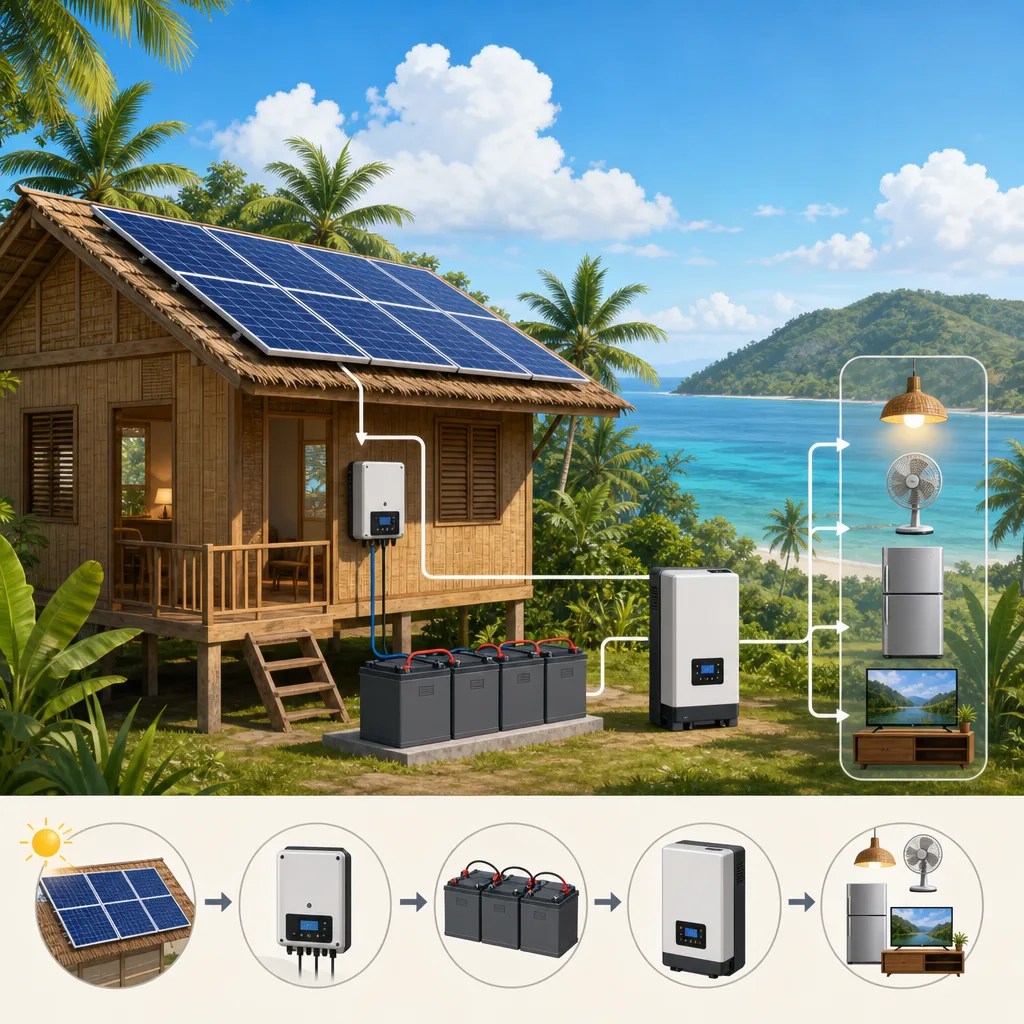
An off-grid solar system generates, stores and delivers all your electricity without any connection to a distribution utility. There is no Meralco, no electric cooperative, no net metering, and no backup when your battery runs empty.
Quick answer
An off-grid solar system generates, stores and delivers all your electricity without any connection to a distribution utility. There is no Meralco, no electric cooperative, no net metering, and no backup when your battery runs empty.
The energy path is simple:
- Solar panels generate DC electricity from sunlight.
- A charge controller regulates that power into the battery bank.
- The battery bank stores it — this is the heart of the system, not an accessory.
- An off-grid inverter converts DC to 230V AC for your appliances.
- A backup generator covers extended cloudy stretches.
The defining difference from grid-tied solar: an off-grid system must be sized for your worst week, not your average week. There is no utility to fall back on. That single constraint is why off-grid costs substantially more per kilowatt than a hybrid system serving the same house.
A 5 kW off-grid system in the Philippines runs roughly ₱320,000–₱450,000, with the battery bank representing the largest single line item.
Who genuinely needs it: island and remote-area properties where no grid connection exists, or where the cost of extending distribution lines exceeds the cost of the battery bank. For nearly everyone else with a working connection — even an unreliable one — a hybrid system delivers comparable resilience for meaningfully less money.
System at a glance
| Component | Function | Notes for Philippine conditions |
|---|---|---|
| Solar array | Generates DC power | Size for worst-month sun hours, not annual average |
| Charge controller (MPPT) | Regulates charging | MPPT recovers more energy than PWM in variable cloud |
| Battery bank | Stores all your energy | LiFePO4 standard in 2026; largest cost item |
| Off-grid inverter | DC to 230V AC | Surge rating must exceed motor startup loads |
| Backup generator | Covers extended overcast | Target 1–3 hours runtime per week, not zero |
| Mounting | Structural | Wind rating is critical — typhoon corridor |
Image alt text suggestion: "Diagram of an off-grid solar system in the Philippines showing solar array, MPPT charge controller, LiFePO4 battery bank, off-grid inverter and backup generator with no grid connection."
How does an off-grid solar system actually work?
Generation
Panels convert sunlight into DC electricity. In an off-grid system, the array is deliberately oversized relative to daily consumption — because you must fully recharge the battery bank and run the house on the same day, during the least sunny month of the year.
Philippine sizing has a specific complication: the southwest monsoon. During habagat season, roughly June through October, extended overcast periods are normal rather than exceptional. An array sized on annual-average sun hours will leave you short exactly when you need it most.
Regulation
An MPPT charge controller sits between the array and the batteries, managing charging voltage and current to protect battery life. MPPT controllers extract meaningfully more energy than older PWM types under variable cloud conditions, which describes most Philippine afternoons.
Storage
This is where off-grid systems differ most from anything grid-connected. The battery bank is not a backup accessory — it is the entire supply between sunset and sunrise, and through every overcast day.
Lithium iron phosphate (LiFePO4) has become the standard chemistry in 2026, offering roughly 4,000 to 10,000 cycles and a 10–15 year service life. Total cost of ownership typically runs 64–75% below lead-acid despite the higher purchase price, because lead-acid banks in tropical heat often need replacing within three years.
Conversion
An off-grid inverter converts stored DC into 230V AC. One specification deserves attention that marketing materials routinely omit: surge rating. Motors and compressors — water pumps, refrigerators, aircon — draw several times their running current at startup. If your inverter's peak rating doesn't exceed those startup currents, the appliance simply won't start, regardless of how much energy sits in your battery.
Backup generation
Almost every well-designed off-grid system includes a generator. This is not a design failure. Sizing a battery bank to cover every conceivable cloudy stretch is enormously expensive; a generator covering the last few percent of edge cases is far cheaper than the batteries it replaces.
The engineering goal is to minimise generator runtime to roughly 1–3 hours per week under worst-case conditions, not to eliminate it.
How do you size an off-grid system?
Sizing off-grid is unforgiving. There is no utility to cover a shortfall, so the calculation has to be done properly.
The battery formula
Battery capacity (Wh) = Daily energy use (Wh) × Days of autonomy ÷ Depth of discharge
Worked example. A household using 4 kWh per day, wanting 2 days of autonomy, on lithium batteries with 90% usable depth of discharge:
4,000 Wh × 2 ÷ 0.9 = 8,889 Wh ≈ 9 kWh of battery capacity
That is a modest household. Scale it up and the numbers move quickly — a home consuming 15 kWh daily with 3 days of autonomy needs 50 kWh of storage.
How many days of autonomy?
This is the judgement call that determines your budget, and Philippine practice varies:
- 1.5–3 days — the range used by several Philippine off-grid specialists, on the reasoning that a well-sized array plus generator backup makes larger banks poor value.
- 2 days — commonly cited as the minimum for lithium systems.
- 3–5 days — general off-grid guidance, often translating to 20–60 kWh banks.
- 3–4 days — typical for lead-acid, which cannot be discharged as deeply.
For Philippine conditions, the practical answer depends on habagat exposure and how tolerable generator runtime is at your site. A property where diesel must arrive by pump boat justifies a larger bank than one with road access.
Array sizing
The array must cover daily consumption plus recharge the battery bank plus a weather margin, calculated against worst-month rather than average sun hours. A useful sanity check: an off-grid battery bank is typically 2–5× larger than a grid-tied system serving the same daily load.
What does off-grid solar cost in the Philippines?
A 5 kW off-grid system generally lands in the ₱320,000–₱450,000 range, with the battery bank the dominant cost.
Some context on how that compares:
| System type | Typical 5 kW installed |
|---|---|
| On-grid (no battery) | ₱250,000–₱375,000 |
| Hybrid (grid + battery) | ₱350,000–₱700,000 |
| Off-grid (no grid) | ₱320,000–₱450,000+ |
A caution on all published Philippine pricing: the ranges quoted across the market vary enormously — anywhere from ₱37 to ₱75 per watt installed depending on the source. Off-grid pricing is even more variable because logistics dominate. Delivery by barge or pump boat to an island site, and mobilising an installation crew there, can add materially to a quote that looks comparable to a mainland job on paper.
Budget separately for:
- Backup generator and fuel storage
- Critical loads panel if isolating essential circuits — roughly ₱50,000–₱110,000
- Logistics for remote sites
- Remote monitoring, which is close to essential when a site visit means a boat trip
Why off-grid is usually the wrong answer — and when it isn't
Off-grid gets romanticised. The honest engineering position is that it is the correct solution for a narrow set of circumstances and an expensive mistake outside them.
The case against, if you have a grid connection
You forfeit net metering entirely. Net metering under RA 9513 requires a connection to a distribution utility, because the mechanism credits energy exported to that utility. No connection means no export and no credits.
You pay for worst-case sizing. Off-grid must survive your worst week unassisted. A hybrid system can lean on the grid during that week, so it needs far less battery for comparable comfort.
An unreliable grid is still worth something. Even in areas with frequent brownouts, a hybrid system paired with the local electric cooperative typically costs several hundred thousand pesos less than full off-grid while delivering similar day-to-day resilience.
The case for
- No grid connection exists, and extending distribution lines would cost more than the battery bank
- Island or remote sites where connection is not realistically on offer
- Operations requiring genuine independence from utility supply
- Sites already paying diesel-level costs — where the comparison isn't against a ₱14.83/kWh grid tariff but against running a generator
That last category is larger in the Philippines than most people assume, and it is worth understanding why.
The national picture: why off-grid matters here more than most countries
The Philippines is an archipelago, and a substantial share of it has never been reachable by the main grids.
The National Power Corporation's Small Power Utilities Group operates 281 power plants across 125 islands and isolated communities, serving over 1.2 million off-grid households under the Missionary Electrification Mandate. Reported plant counts vary across sources depending on how facilities are categorised, but the scale is not in dispute.
Almost all of it runs on diesel. SPUG plants burn roughly one million litres of diesel per day. The true cost of generation on small islands runs ₱20 to ₱30 per kWh once fuel transport is accounted for — against a Meralco residential rate of ₱14.83/kWh.
Consumers in those areas don't pay the full true cost, because grid-connected customers subsidise them through the Universal Charge for Missionary Electrification. The ERC authorised roughly ₱30.773 billion for the 2026 programme, and NPC has petitioned to raise annual collections to ₱44.2 billion, equivalent to ₱0.4405 per kWh — a 65.5% increase on the current ₱0.2662 rate. Mindoro and Palawan together account for roughly 60% of the subsidy.
Service remains unreliable regardless. Residents of SPUG areas report daily outages of one to two hours in the dry season and interruptions running from eight to 72 hours during calamities.
The economics have flipped. The DOE's own assessment is that transitioning to solar-plus-battery costs less than the average ₱18/kWh true cost of diesel generation. The Maharlika Investment Fund has a pilot project in Mindoro on exactly this premise, and a recent DOE-supported grid upgrade in Oriental Mindoro enabled full dispatch of a 16 MW wind facility.
The government has set a 100% electrification target by 2028. Roughly 2.8 million Filipinos in off-grid islands still depend on diesel, paying tariffs in the ₱16–₱25/kWh range.
For a property in one of these areas, off-grid solar is not an ideological choice. It is competing against ₱20–₱30/kWh diesel, and it wins.
Building off-grid in a typhoon corridor
Two considerations that matter more here than almost anywhere else.
Mounting and wind rating. Off-grid sites are frequently coastal and exposed. Ask your installer for the specific wind rating of the mounting system and how it is anchored to the structure. This is the most common point of failure in Philippine installations, and it is not where to economise.
Serviceability. A fault on a remote island is a logistics problem, not just a technical one. Remote monitoring lets an installer diagnose and often resolve issues without a site visit. Specify it, and confirm who provides ongoing support, how quickly, and what happens if the installer ceases trading.
Related reading: Hybrid vs on-grid vs off-grid solar for Philippine homes · Net metering Philippines 2026: the 10-day approval rule
Frequently asked questions
Paano gumagana ang off-grid solar system?
Ang solar panels ay gumagawa ng DC electricity mula sa araw. Dumadaan ito sa charge controller papunta sa battery bank, kung saan naka-imbak ang enerhiya. Kapag gagamitin, kinokonvert ng off-grid inverter ang DC papuntang 230V AC para sa mga appliances. Walang koneksyon sa Meralco o electric cooperative — kaya kailangang sapat ang laki ng battery para sa gabi at sa mga maulap na araw. Karaniwang may backup generator para sa matagal na tag-ulan.
How much does an off-grid solar system cost in the Philippines?
A 5 kW off-grid system typically runs ₱320,000–₱450,000, with the battery bank the largest cost component. Remote and island sites cost more due to transport and crew mobilisation. Published pricing across the Philippine market varies widely, so obtain at least three itemised quotes.
How many batteries do I need for off-grid solar?
Use: battery capacity (Wh) = daily energy use (Wh) × days of autonomy ÷ depth of discharge. A household using 4 kWh daily with 2 days of autonomy on lithium (90% DoD) needs roughly 9 kWh of storage. Philippine installers commonly design for 1.5–3 days of autonomy, while general off-grid guidance suggests 3–5 days.
Can I get net metering with an off-grid system?
No. Net metering under RA 9513 and ERC Resolution No. 09-2013 requires a connection to a distribution utility's grid, since the mechanism credits energy exported to that utility. Off-grid systems have no connection and therefore no export.
Do I need a generator with off-grid solar?
Almost always, and this is good design rather than a compromise. Sizing batteries to cover every possible overcast stretch is far more expensive than a generator covering the final few percent of cases. Well-designed systems target 1–3 hours of generator runtime per week under worst-case conditions.
Is off-grid better than hybrid in the Philippines?
Only where no practical grid connection exists. If you have a connection — even an unreliable one — a hybrid system typically costs less, preserves net metering eligibility, and delivers similar resilience, because it can lean on the grid during extended bad weather instead of carrying that entire load in batteries.
How long do off-grid solar batteries last?
LiFePO4 batteries, the 2026 standard, deliver roughly 4,000–10,000 cycles and a 10–15 year service life. Lead-acid banks are cheaper up front but frequently need replacement within about three years in tropical heat, making total cost of ownership considerably higher.
Figures drawn from NPC, the Energy Regulatory Commission, the Department of Energy and Philippine installer pricing surveys, current as of August 2026. Philippine solar pricing varies substantially by source, region and logistics — treat all ranges as indicative and obtain itemised quotes. This is general information, not an engineering specification.
Related Articles
Buyer Guides
Solar for OFW Families: How to Buy a System You Can't Stand Next To
August 20, 2026
Buyer Guides
What If Your Solar Installer Goes Out of Business? A Philippine Owner's Guide (2026)
August 15, 2026
Buyer Guides
Solar Panel Brands in the Philippines: What's Actually Available (2026)
August 14, 2026